

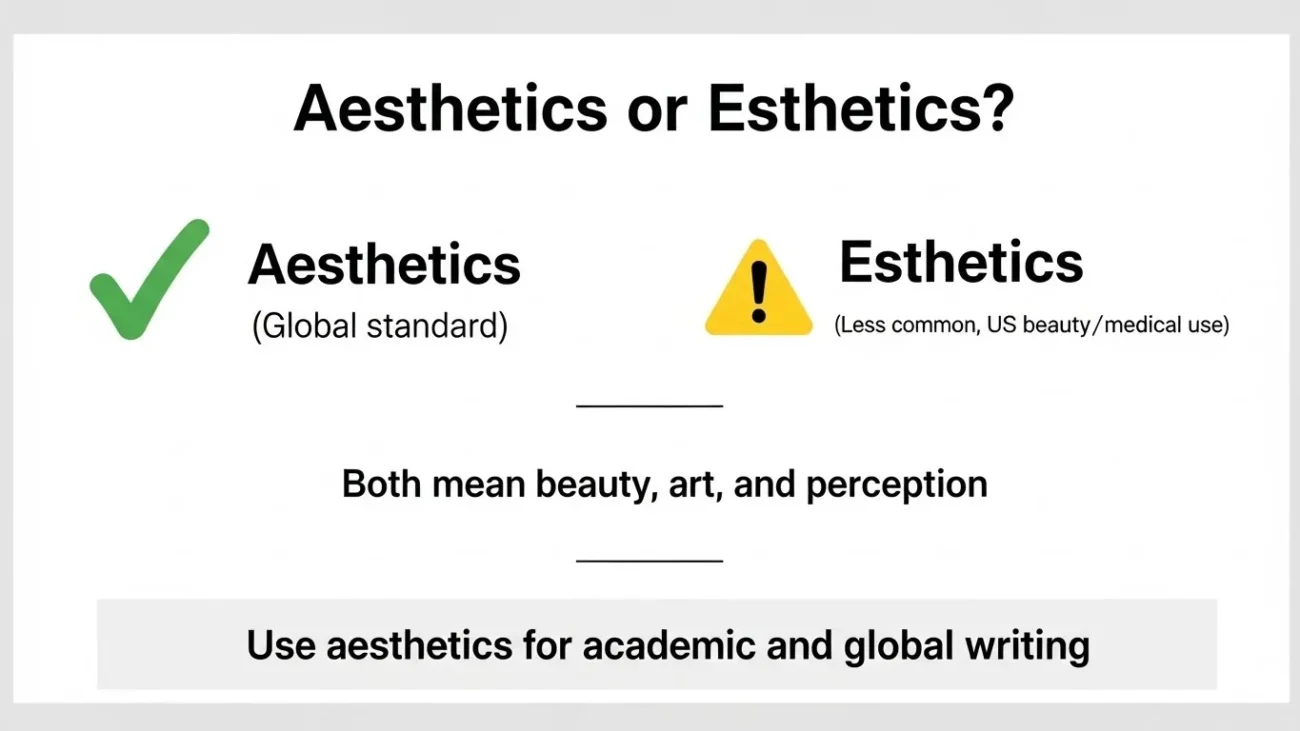
The correct spelling is usually aesthetics; esthetics is an accepted but less common American variant, mainly used in beauty and medical contexts.
Many people search for “ esthetics or aesthetics” because both spellings appear in books, academic papers, beauty clinics, philosophy texts, and online articles.
You might see aesthetics in British writing and esthetics in some American publications, which naturally causes confusion.
This article clears up the confusion in a simple way. You’ll get a quick answer, learn the origin of the word, understand British vs American usage, see real life examples, and get clear advice on which spelling you should use.
By the end, you’ll know exactly when aesthetics vs esthetics is the better choice.
Aesthetics or Esthetics : Quick Answer
Both spellings are correct, but usage differs in popularity.
- Aesthetics → Standard and widely preferred (UK + most US usage)
- Esthetics → Accepted American variant but less common
Both words refer to:
- The study of beauty and art
- Principles of good taste
- Beauty and cosmetic treatments
Examples:
- ✅ She studies aesthetics in philosophy.
- ✅ The clinic offers medical esthetics. (US, specialized use)
The Origin of Aesthetics or Esthetics
The word comes from the Greek aisthētikos, meaning relating to perception or sensation. It entered English in the 18th century through German and French philosophy, where the spelling aesthetic was used.
Later, American English simplified some words by removing the silent a, leading to esthetic and esthetics. However, this simplified form never fully replaced the original spelling.
As a result:
- Aesthetics remained dominant worldwide
- Esthetics survived as a secondary American variant
British English vs American English Spelling
This difference is mainly about preference, not correctness.
Comparison Table
| English Variety | Common Spelling | Notes |
| British English | Aesthetics | Standard |
| American English | Aesthetics | Most common |
| American English (specialized) | Esthetics | Used in beauty/medical fields |
| Canadian English | Aesthetics | Standard |
| Australian English | Aesthetics | Standard |
Which Spelling Should You Use?
Use aesthetics if:
- You are writing academically or formally
- Your audience is global
- You want the most widely accepted spelling
Use esthetics if:
- You are writing for a US based beauty or medical audience
- The term appears in official program names or certifications
For general writing, aesthetics is the safest and most professional choice.
Common Mistakes with Aesthetics or Esthetics
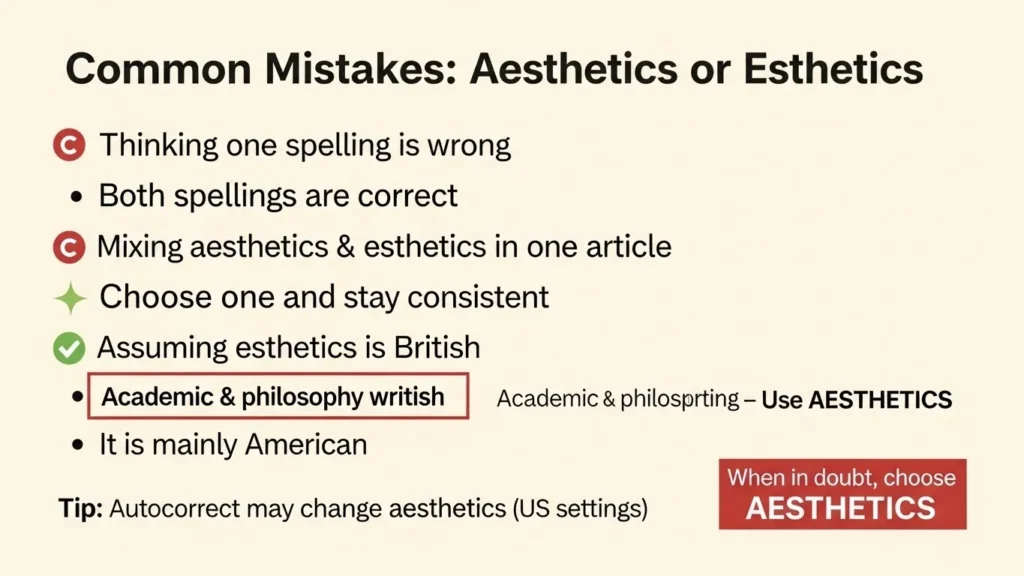
- ❌ Thinking one spelling is wrong
✅ Both are correct - ❌ Mixing both spellings in one article
✅ Choose one and stay consistent - ❌ Assuming esthetics is British
✅ It is mainly American
Tip:
When in doubt, choose aesthetics.
Another frequent mistake is using esthetics in academic or philosophical writing, where it looks informal or incorrect.
❌ “The paper discusses esthetics in Kant’s theory.”
✅ “The paper discusses aesthetics in Kant’s theory.”
Writers also confuse the field with the profession.
❌ “She has a degree in esthetics.” (when meaning philosophy)
✅ “She has a degree in aesthetics.
Auto correct can also silently replace aesthetics with esthetics, especially in US settings.
Finally, some people assume esthetics is modern and aesthetics is outdated this is false. Aesthetics remains the dominant and preferred form worldwide.
Aesthetics or Esthetics in Everyday Examples
Emails
- “We focus on design and aesthetics.”
News
- “Modern architecture values clean aesthetics.”
Social Media
- “Love the minimalist aesthetics ✨”
Formal Writing
- “The course explores philosophical aesthetics.”
Beauty & Medical
- “She is licensed in advanced esthetics.” (US)
Aesthetics or Esthetics : Google Trends & Usage Data
Search trends show that:
- Aesthetics dominates worldwide searches
- Esthetics appears mainly in US beauty related searches
The term is commonly searched in:
- Philosophy and art
- Architecture and design
- Skincare and cosmetic treatments
Overall, aesthetics has significantly higher global usage.
Comparison Table: Aesthetics vs Esthetics
| Word | Usage | Meaning |
| Aesthetics | Global standard | Beauty, art, perception |
| Esthetics | US variant (limited) | Same meaning |
FAQs: Aesthetics or Esthetics
1. Are aesthetics and esthetics the same?
Yes. They have the same meaning.
2. Is esthetics American English?
Yes, but it is less common.
3. Is aesthetics British English only?
No. It is used worldwide.
4. Which spelling should I use in exams?
Use aesthetics.
5. Is esthetics used in the beauty industry?
Yes, especially in the US.
6. Can I mix both spellings?
No. Consistency is important.
7. Which spelling is safer for global writing?
Aesthetics.
Conclusion
The difference between aesthetics or esthetics is not about meaning but about preference and tradition. Aesthetics is the original spelling and remains the global standard in academic, professional, and everyday writing. Esthetics is an accepted American variant, mainly used in specific beauty and medical contexts.
If you want clarity, professionalism, and global acceptance, aesthetics is the best choice. Understanding this distinction helps you write with confidence and avoid unnecessary confusion.
Choosing the wrong spelling can subtly weaken credibility, especially in formal or academic writing. To avoid confusion and maintain clarity, default to aesthetics unless a specific industry or official program requires esthetics. This small choice makes your writing clearer, more polished, and globally appropriate.

I am Mark Twain, a writer who loved the English language for its humor, irony, and everyday comparisons. I used simple words to show deep differences between truth and lies, wisdom and foolishness. My writing proves that clear English is always more powerful than complicated English.