

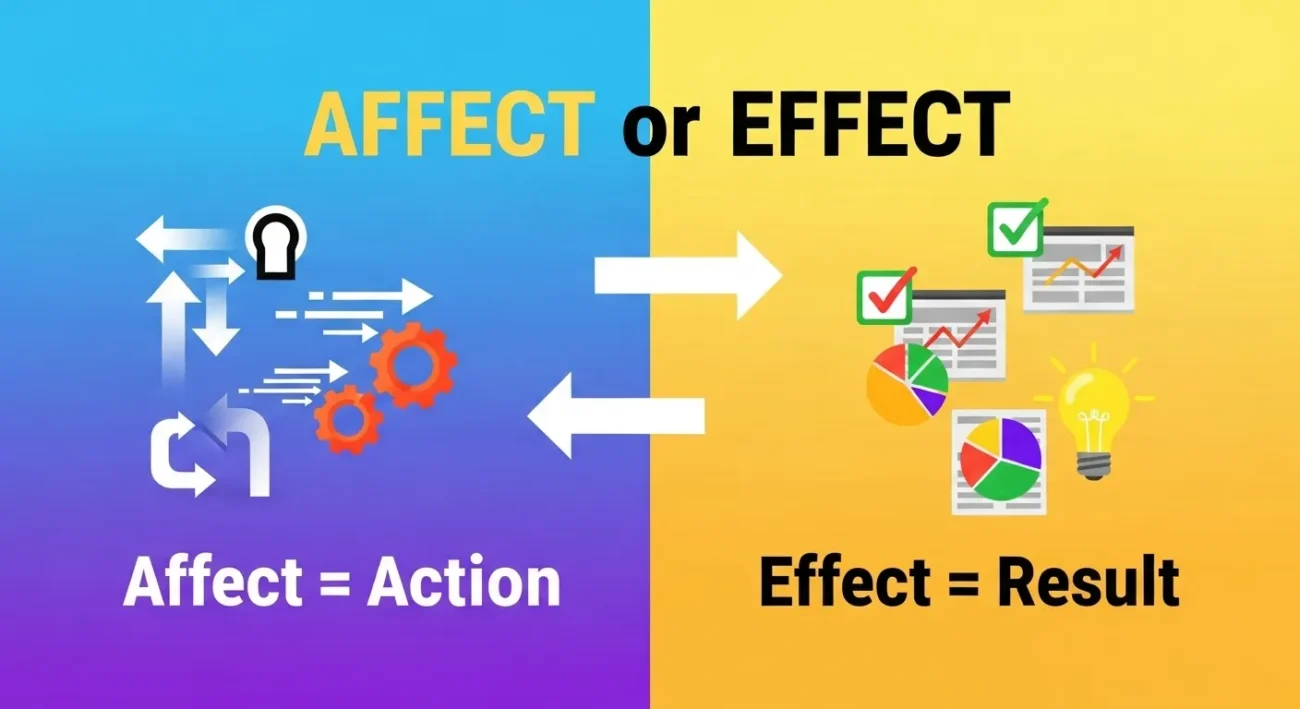
Affect is used for an action, while effect is used for the result of that action.
I remember Googling affect or effect years ago because I kept freezing mid-sentence, unsure which word to use. If you’ve ever paused while writing an email, article, exam answer, or social post wondering “Is this affect or effect?”, you’re not alone.
Millions of people search this exact keyword because both words look similar, sound related, and often appear in the same situations. The confusion can make confident writers doubt themselves.
In this article, I’ll break it down in plain, simple language. I’ll explain meanings, origins, common mistakes, real-life examples, and practical advice so you never hesitate again.
Affect or Effect : Quick Answer
I always remember it like this:
- Affect → usually a verb (an action)
- Effect → usually a noun (a result)
Examples:
- Lack of sleep affects your health.
- Lack of sleep has a bad effect on your health.
Easy trick I use:
Affect = Action
Effect = End result
The Origin of Affect or Effect
When I learned the history, the confusion finally made sense.
- Affect comes from the Latin word afficere, meaning to influence or act upon.
- Effect comes from effectus, meaning result or outcome.
Over time, English kept both words but assigned them different roles. That’s why spelling differences exist and why they feel connected. They are related but not interchangeable.
British English vs American English Spelling
Here’s something important I’ve noticed: there is NO spelling difference between British and American English for affect or effect.
The confusion isn’t regional it’s grammatical.
Comparison Table
| Word | British English | American English | Meaning |
| Affect | Affect | Affect | To influence (verb) |
| Effect | Effect | Effect | Result or outcome (noun) |
Both versions of English follow the same rules.
Which Spelling Should You Use?
I decide based on function, not audience.
- US audience → Same rule applies
- UK/Commonwealth audience → Same rule applies
- Global audience → Same rule applies
If you’re describing an action, use affect.
If you’re describing a result, use effect.
This works everywhere blogs, academic writing, business emails, and exams.
Common Mistakes with Affect or Effect
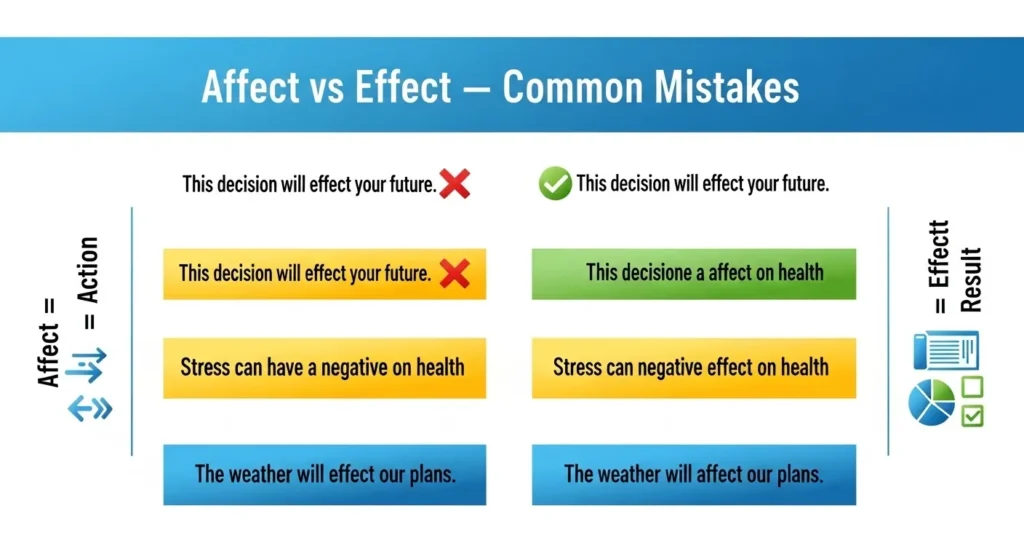
I’ve made these mistakes myself, so here’s what to avoid:
❌ Wrong:
- This decision will effect your future.
✅ Correct:
- This decision will affect your future.
❌ Wrong:
- Stress can have a negative affect on health.
✅ Correct:
- Stress can have a negative effect on health.
Rare but important exceptions:
- Effect (verb) → to bring about
- The new law will effect change.
- Affect (noun) → emotional expression (psychology term)
These are uncommon. I recommend ignoring them until you’re fully comfortable.
Affect or Effect in Everyday Examples
Here’s how I see these words used daily:
Emails
- “This delay may affect our timeline.”
- “The delay had a serious effect on delivery.”
News
- “Rising prices affect middle-class families.”
- “The policy’s effect was immediate.”
Social Media
- “Does caffeine affect sleep?”
- “That movie had a deep effect on me.”
Formal Writing
- “Climate change affects global food security.”
- “The long-term effects are still unknown.”
Effect or Affect : Google Trends & Usage Data
From what I’ve seen in trend data and search behavior:
- “Affect vs effect” is searched globally, especially in:
- United States
- United Kingdom
- India
- Pakistan
- Australia
People usually search this:
- Before exams
- While writing emails
- During content creation
- When proofreading professional documents
The keyword spikes during school terms and content publishing seasons, proving it’s a practical, real-life confusion.
Affect vs Effect : Side by Side Comparison
| Feature | Affect | Effect |
| Part of speech | Verb (mostly) | Noun (mostly) |
| Meaning | To influence | Result or outcome |
| Example | Noise affects focus | Noise has an effect |
| Common mistake | Used as noun | Used as verb |
| Memory trick | Action | End result |
FAQs About Affect or Effect
1. Is affect always a verb?
Almost always, yes. Only rare psychology cases use it as a noun.
2. Is effect always a noun?
Usually yes, except when it means to bring about change.
3. Which one should I use in exams?
Use affect for actions and effect for results. Teachers expect this rule.
4. Do British and American English treat them differently?
No. Both follow the same grammar rules.
5. Can I remember a simple trick?
Yes. Affect = Action. Effect = End result.
6. Which is more common in daily writing?
Both are common, but effect appears more as a noun in reports and articles.
7. Can Grammarly catch mistakes?
Often yes, but understanding the rule is better than relying on tools.
Conclusion
I’ve learned that once you truly understand affect or effect, the fear disappears. The confusion exists because both words are related in meaning and history, but their roles are different. Affect is about influence and action, while effect is about results and outcomes. Remembering this simple distinction saves time, boosts confidence, and improves writing instantly.
If you’re a student, professional, blogger, or casual writer, mastering this pair makes your language clearer and more credible. I no longer pause mid-sentence when writing emails or articles and you won’t either. With practice, this rule becomes automatic, and “affect or effect” turns from a problem into a strength.

I am Michael Swan, an English grammarian known for explaining confusing grammar and word comparisons in a clear way. I focused on real usage, not just rules, helping learners understand why English works the way it does. My work simplifies complex language problems for everyday users.