

The Short Answer is :Afternoon is the time after 12 PM until late day, and evening is the later part of the day before night.
I remember once sending a message at 5:30 PM and writing “Good afternoon.” The reply came: “It’s evening now!” That small moment made me realize many people feel confused about afternoon or evening. When exactly does afternoon end? When does evening begin? Does it change by country?
In this complete guide, I will clearly explain the meaning, time difference, origin, usage rules, examples, common mistakes, and practical advice so you never feel unsure again.
Afternoon or Evening: Quick Answer
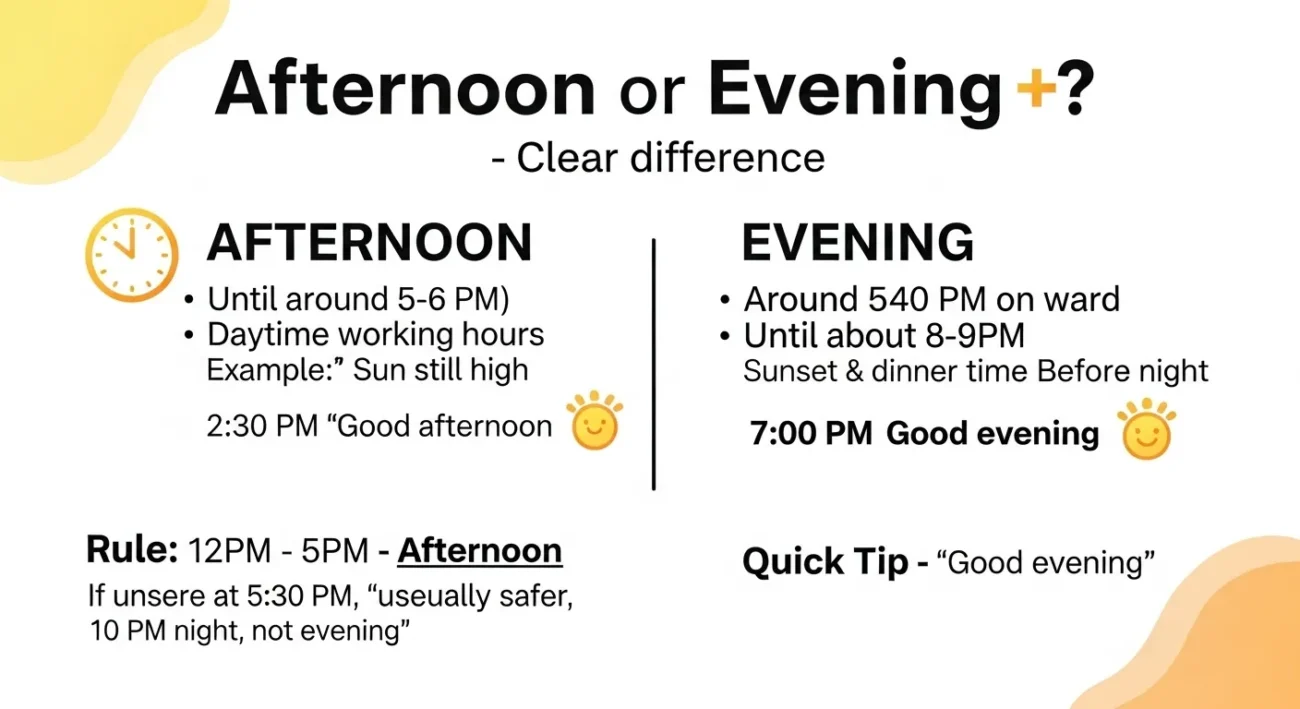
👉 Afternoon = From 12:00 PM (noon) until around 5:00–6:00 PM.
👉 Evening = From around 5:00–6:00 PM until night (around 8:00–9:00 PM).
Simple Examples:
- 2:00 PM → Afternoon
- 4:30 PM → Afternoon
- 6:30 PM → Evening
- 8:00 PM → Evening
The exact time can vary slightly by culture and season.
The Origin of Afternoon and Evening
The word afternoon comes from Middle English. It simply means “after noon.” Noon is 12 PM, so afternoon naturally follows.
The word evening comes from an old English word meaning “the close of the day.” It refers to the time when the day begins to end and darkness approaches.
In early times, people did not use exact clocks like today. They divided the day by sunlight. That is why these time periods are flexible even now.
British English vs American English Usage
There is no spelling difference between British and American English.
| Word | United States | United Kingdom | Australia | Canada |
|---|---|---|---|---|
| Afternoon | Same | Same | Same | Same |
| Evening | Same | Same | Same | Same |
However, cultural timing may slightly vary.
For example:
- In some countries, 5 PM is still considered afternoon.
- In others, 5 PM feels like evening.
Which Word Should You Use?
Use afternoon when:
- It is clearly between 12 PM and 5 PM.
- The sun is still high.
- Work hours are active.
Use evening when:
- It is around or after 6 PM.
- The sun begins to set.
- Dinner time starts.
Greeting Rule:
- 12 PM – 5 PM → Good afternoon
- After 5 or 6 PM → Good evening
If unsure around 5 PM, “Good evening” is usually safer.
Common Mistakes with Afternoon or Evening
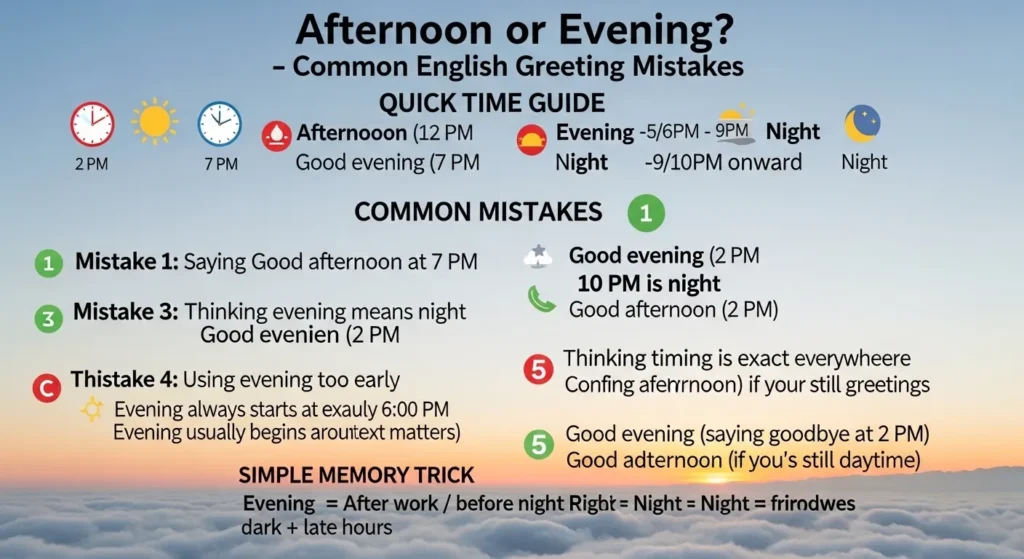
Mistake 1: Saying Good afternoon at 7 PM
❌ Good afternoon (at 7 PM).
✅ Good evening (at 7 PM).
Mistake 2: Thinking evening means night
❌ 10 PM is evening.
✅ 10 PM is night.
3 ) Mistake: Using evening too early
❌ Good evening (at 2 PM).
✅ Good afternoon (at 2 PM).
Mistake 4: Thinking the timing is exact everywhere
❌ Evening always starts at exactly 6:00 PM.
✅ Evening usually starts around 5–6 PM depending on context.
Mistake 5: Confusing formal greetings
❌ Good evening (used when saying goodbye at 2 PM).
✅ Good afternoon (if it is still daytime).
Evening or Afternoon in Everyday Examples
In Emails:
- Good afternoon, I hope you are well.
- Good evening, thank you for your reply.
Office Settings:
- The meeting is scheduled for the afternoon.
- We will host a dinner event in the evening.
In Schools:
- Afternoon classes start at 1 PM.
- Evening classes start at 6 PM.
On Social Media:
- Beautiful afternoon vibes!
- Relaxing evening with family.
Afternoon vs Evening: Time Comparison Table
| Time | Correct Word |
|---|---|
| 12:00 PM | Afternoon |
| 1:00 PM | Afternoon |
| 3:00 PM | Afternoon |
| 5:00 PM | Afternoon (sometimes evening) |
| 6:00 PM | Evening |
| 7:30 PM | Evening |
| 9:00 PM | Night |
This table helps remove confusion.
Cultural Differences
In some countries:
- In the UK, evening often begins around 6 PM.
- In the US, many people consider 5 PM as early evening.
- In warmer countries, evening may feel later due to sunset time.
Season also matters:
- In summer, sunset is late, so evening may feel later.
- In winter, sunset is early, so evening feels earlier.
Similar Time Words Compared
| Word | Meaning |
|---|---|
| Morning | Sunrise to 12 PM |
| Afternoon | 12 PM to 5–6 PM |
| Evening | 5–6 PM to 8–9 PM |
| Night | After 8–9 PM |
This simple breakdown makes time periods easy to understand.
FAQs
1. Is 5 PM afternoon or evening?
Usually afternoon, but some people consider it early evening.
2. Is 6 PM evening?
Yes, 6 PM is generally evening.
3. When does afternoon end?
Around 5 or 6 PM.
4. Is 8 PM evening or night?
It depends on context, but often still evening.
5. Is spelling different in British English?
No, spelling is the same everywhere.
6. Can I say good afternoon at 12 PM?
Yes. After 12 PM is afternoon.
7. Is 4:59 PM afternoon?
Yes, it is still afternoon.
8. Why is there confusion?
Because sunset times and cultural habits differ.
Conclusion
Afternoon and evening seem simple, but small timing differences create confusion. I remember feeling unsure at 5:30 PM before sending a greeting. That moment made me learn the real difference.
Afternoon begins after 12 PM and usually lasts until 5 or 6 PM. Evening starts around 5 or 6 PM and continues until night. There is no spelling difference between countries. The only variation is cultural timing.
If you are unsure near 6 PM, choosing “Good evening” is often safe. Understanding these time periods helps you sound polite and confident in daily communication.
Now you can clearly decide whether it is afternoon or evening without hesitation.
Discover More Articles:

I am Mark Twain, a writer who loved the English language for its humor, irony, and everyday comparisons. I used simple words to show deep differences between truth and lies, wisdom and foolishness. My writing proves that clear English is always more powerful than complicated English.