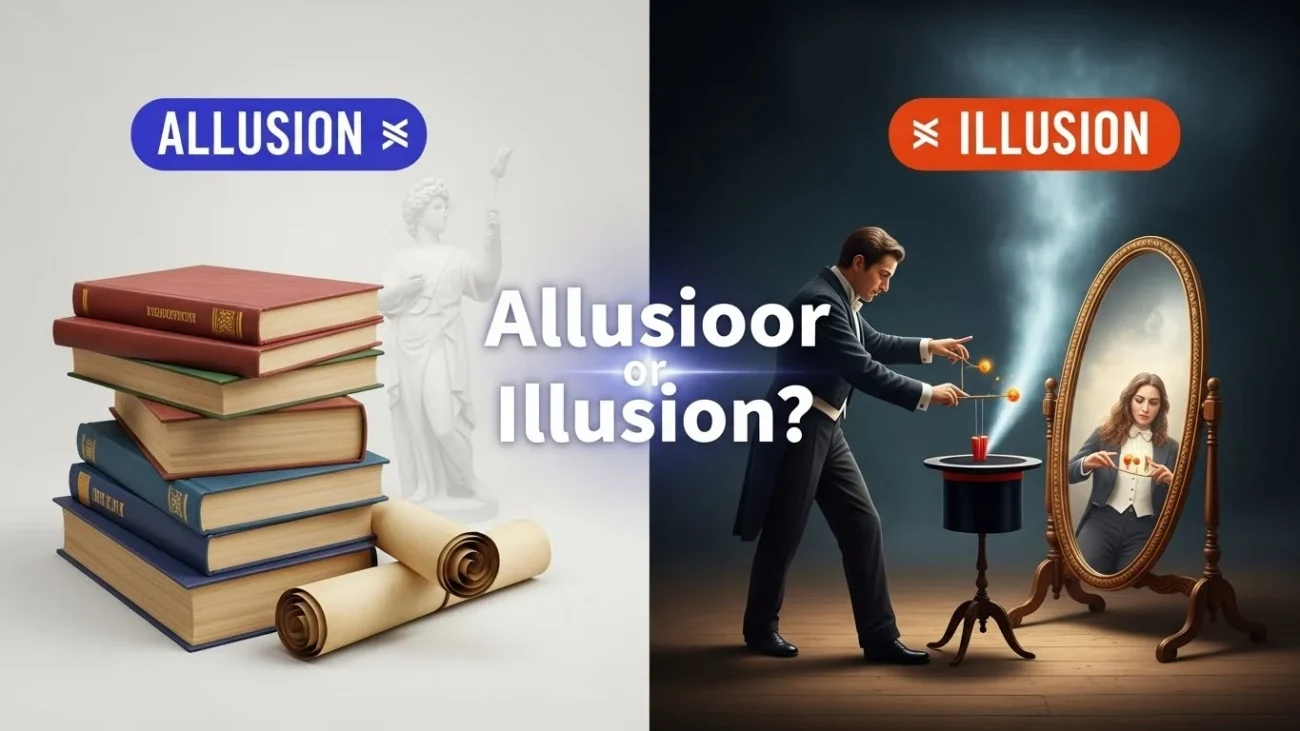
Many people search for allusion or illusion because these two words look and sound similar, yet they have very different meanings.
You may see a line in a book that makes an allusion to history, or hear someone say something was just an illusion. Because both words relate to ideas and perception, they are easy to confuse in writing and exams.
This confusion often leads to mistakes in essays, professional emails, and creative writing. A single wrong word can change the meaning of a sentence or make it sound incorrect. That’s why learners and writers frequently look up this pair.
This article clears the confusion in a simple way. You’ll get a quick answer, then learn the origin of each word, common mistakes, everyday examples, and expert advice.
By the end, you’ll confidently know when to use allusion and when illusion is the right choice.
Allusion or Illusion : Quick Answer
- 📚 Allusion → an indirect reference
- 🎭 Illusion → a false idea or trick of the senses
Examples:
- The novel makes an allusion to Greek myths.
- The magic trick was an illusion.
👉 Reference = allusion
👉 False appearance = illusion
Read MOre: Flu vs Flue: Which One Is Correct and When to Use It
The Origin of Allusion or Illusion
- Allusion comes from Latin alludere, meaning to refer to or hint at.
- Illusion comes from Latin illusio, meaning mockery or deception.
Different roots explain why their meanings are unrelated, despite similar spelling.
British English vs American English Spelling
There is no spelling difference between British and American English.
| Word | British English | American English |
| Allusion | Same | Same |
| Illusion | Same | Same |
👉 Only meaning matters, not region.
Which Spelling Should You Use?
Use allusion when:
- Referring indirectly to something
- Writing literature, speeches, or analysis
Use illusion when:
- Talking about something unreal
- Describing tricks, dreams, or false beliefs
Memory tip:
- Allusion → alludes to
- Illusion → is not real
Common Mistakes with Allusion or Illusion
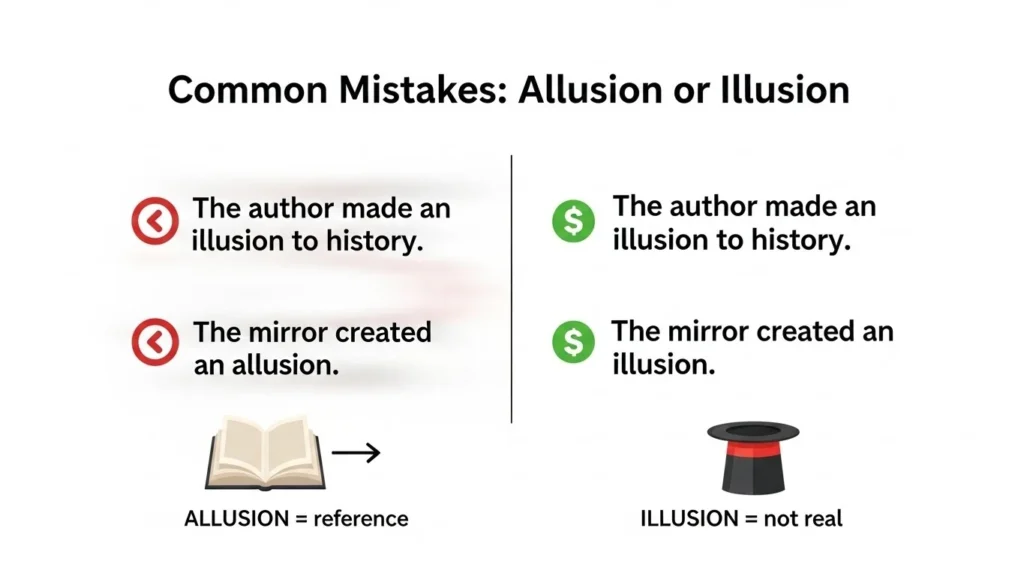
❌ The author made an illusion to history.
✅ The author made an allusion to history.
❌ The mirror created an allusion.
✅ The mirror created an illusion.
❌ Using them interchangeably
✅ Match the word to meaning
Usage Tips, Context Clarity, and Writing Advice for Allusion vs Illusion
Understanding the difference between allusion and illusion becomes much easier when you focus on the writer’s intention.
Ask yourself whether the sentence is pointing to something else or describing something unreal. If the purpose is to hint at another text, event, person, or idea without naming it directly, allusion is the correct choice.
This is extremely common in literature, poetry, political speeches, and academic analysis, where writers expect readers to recognize subtle references.
On the other hand, illusion is about perception rather than reference. It describes something that appears real but is not. Illusions can be visual, emotional, or psychological.
Magic tricks, dreams, false hopes, and misleading advertisements all rely on illusions. In these cases, there is no reference involved only deception or misunderstanding.
Allusion or Illusion in Everyday Examples
Literature
- The poem contains an allusion to war.
Entertainment
- Stage magic depends on illusions.
Media
- The ad creates the illusion of luxury.
Education
- Teachers explain literary allusions.
Allusion or Illusion : Google Trends & Usage Data
- Illusion is more commonly searched
- Allusion appears often in academic contexts
- Confusion is high due to similar spelling
👉 User intent depends on writing context.
Comparison Table: Allusion vs Illusion
| Feature | Allusion | Illusion |
| Meaning | Indirect reference | False appearance |
| Verb form | Allude | Illude (rare) |
| Common field | Literature | Psychology, magic |
| Pronunciation | Similar | Similar |
| Interchangeable | ❌ No | ❌ No |
FAQs: Allusion or Illusion
1. Are allusion and illusion homophones?
Almost, but not exactly.
2. Which word is used in literature?
Allusion.
3. Which word means something unreal?
Illusion.
4. Can illusion be intentional?
Yes, like in magic tricks.
5. Is allusion always indirect?
Yes, it is never a direct mention.
6. Do British and American English differ here?
No.
Conclusion
The difference between allusion or illusion is about meaning, not spelling or region. Allusion refers to an indirect reference, often used in literature, speeches, or analysis. Illusion refers to something false or deceptive, such as a trick, dream, or mistaken belief.
A simple rule helps: if you mean “reference,” choose allusion; if you mean “something unreal,” choose illusion. Once you remember this, you’ll avoid a very common English mistake and write with more confidence and clarity.

I am Sidney Greenbaum, a linguist who studied how English is actually used, not just how it is taught. I analyzed sentence structure and word differences to make English clearer and more practical. My research helped learners understand real-world English comparisons.