

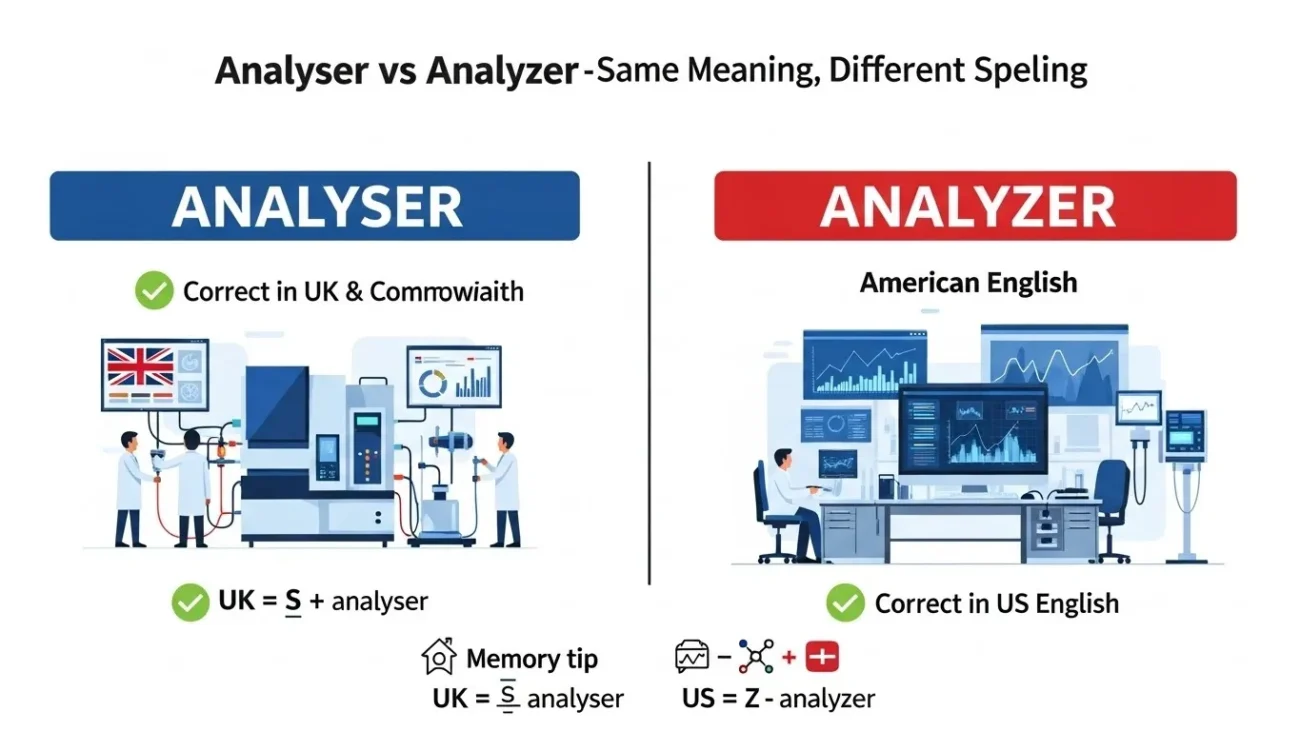
Many people search for analyser or analyzer because the two spellings look very similar, but only one is correct depending on the region.
Using the wrong spelling can make writing look inconsistent, especially in scientific, technical, or professional contexts.
The confusion comes from differences between British and American English spelling conventions. This article clears the confusion simply and clearly.
You’ll get a quick answer, learn the origin, see common mistakes, everyday examples, and expert advice. By the end, you’ll confidently know when to use analyser or analyzer.
Analyser or Analyzer : Quick Answer
- ✅ Analyser → British English spelling
- ✅ Analyzer → American English spelling
Meaning: A device, tool, or person that examines or studies something carefully.
Examples:
- The laboratory used a gas analyser to measure oxygen levels. (UK)
- The lab bought a new gas analyzer for testing. (US)
👉 Same meaning; spelling depends on region.
Read More: Creak or Creek : Which One Is Correct in Your Sentence?
The Origin of Analyser/Analyzer
- Both words come from the verb analyze (American) / analyse (British), from Greek analusis, meaning to break down.
- The suffix -er is added to indicate a tool or person that performs the action.
- British English uses -se + -er, while American English converts -se to -ze + -er.
British English vs American English Spelling
| Word | British English | American English |
| Analyser | ✅ Preferred | ❌ Rare / unusual |
| Analyzer | ❌ Rare | ✅ Preferred |
Tip: Check your audience British readers expect analyser, American readers expect analyzer.
Which Spelling Should You Use?
- Use analyser for UK, Commonwealth countries, or British publications.
- Use analyzer for US audiences, American publications, or scientific papers written in American English.
Memory tip:
- UK = s → analyser
- US = z → analyzer
Common Mistakes with Analyser or Analyzer
❌ US company bought an analyser.
✅ The US company bought an analyzer.
❌ The British labs use analyzer.
✅ British labs use analyser.
❌ Mixing British and American spelling in one document
✅ Stick to one convention per document
One of the most frequent mistakes with analyser and analyzer is assuming that one spelling is always wrong. In reality, both spellings are correct, but only within their respective regional standards.
Writers often mix the two spellings in the same document, especially when copying content from international sources.
For example, using analyser in one paragraph and analyzer in another makes the writing look careless and inconsistent.
Another common error occurs in technical and scientific writing.
Many people believe that American English spelling is “more correct” for scientific terms, so they use analyzer even when writing for British journals or UK-based audiences.
This can reduce credibility, particularly in academic or professional contexts where consistency matters.
Autocorrect and spellcheck tools also contribute to the confusion. If your device is set to US English, it will automatically flag analyser as incorrect, even though it is perfectly correct in British English.
The opposite happens when UK English settings replace analyzer.
Some writers mistakenly think analyser refers only to machines and analyzer to people, which is incorrect. Both words can refer to tools, software, or people, depending on context.
The key to avoiding mistakes is simple: choose one English variant based on your audience and use it consistently throughout the document.
Analyser or Analyzer in Everyday Examples
Science/Technology
- The blood analyser detected unusual levels of glucose. (UK)
- The new spectrometer analyzer is highly accurate. (US)
Education
- Students used a text analyser to study grammar patterns. (UK)
- Teachers use a reading analyzer to track comprehension. (US)
Business
- Market analyzers help companies predict trends. (US)
- Analysts in the UK prefer analysers for software tools.
Comparison Table: Analyser vs Analyzer
| Feature | Analyser | Analyzer |
| Region | British English | American English |
| Meaning | Device or person that analyzes | Device or person that analyzes |
| Common error | Using US spelling in UK text | Using UK spelling in US text |
| Usage | Scientific, technical, educational | Scientific, technical, educational |
FAQs: Analyser or Analyzer
1. Are analyser and analyzer the same?
Yes, both refer to a tool or person that analyzes, but spelling differs by region.
2. Which is correct in American English?
Analyzer is correct in American English.
3. Which is correct in British English?
Analyser is correct in British English.
4. Can you use either spelling interchangeably?
Only if your audience is global, but consistency is important.
5. Do dictionaries recognize both?
Yes, most dictionaries note analyser (UK) and analyzer (US).
6. Is pronunciation different?
No, both are pronounced the same: /ˈænəlaɪzər/.
Conclusion
The difference between analyser or analyzer is regional. Analyser is used in British English, while analyzer is used in American English. Both have the same meaning and refer to someone or something that examines carefully.
A simple tip: UK readers = analyser; US readers = analyzer. Stick to one version in any document to maintain consistency and professionalism.
The difference between analyser or analyzer is not about meaning, usage, or pronunciation it is purely regional. Analyser is the correct spelling in British English and is widely used in the UK and other Commonwealth countries.
Analyzer is the standard spelling in American English and is preferred in the United States. Both words refer to a person, device, or tool that examines or studies something carefully, especially in scientific, technical, or analytical fields.
Because modern writing often reaches a global audience, confusion between these spellings is very common.
If mixing British and American spellings in the same piece of writing can make your work appear unpolished or unprofessional. That is why consistency is just as important as correctness.
A simple rule can help you remember: UK spelling uses “s” (analyser), US spelling uses “z” (analyzer). Before you start writing, decide which audience you are targeting and stick to that spelling throughout your content.
By understanding this regional difference and applying it correctly, you ensure your writing looks clear, credible, and professional.
You are writing a research paper, technical documentation, or business content, choosing the right spelling will strengthen the quality and reliability of your work.

I am Sidney Greenbaum, a linguist who studied how English is actually used, not just how it is taught. I analyzed sentence structure and word differences to make English clearer and more practical. My research helped learners understand real-world English comparisons.