

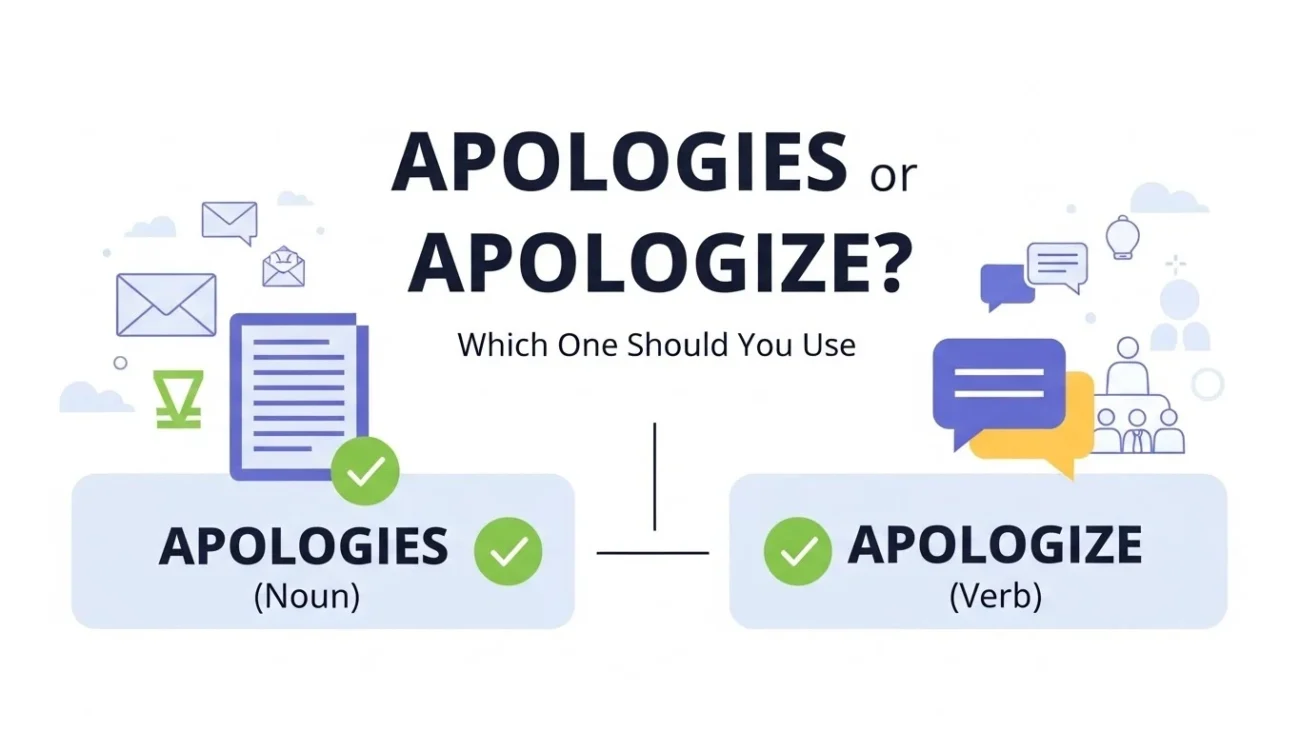
Many people search for apologies or apologize because both words are used when saying sorry, yet they are not interchangeable.
I often see sentences like “I apologies for the delay” or “Please apologize my mistake”. The intention is polite, but the grammar is wrong.
The confusion happens because apologies and apologize come from the same root word, apology, but they play different roles in a sentence.
One is a noun, and the other is a verb. English learners, professionals, and even native speakers mix them upespecially in emails and formal writing.
This article clears that confusion completely. You’ll get a quick answer first, followed by a clear explanation, common mistakes, real-life examples, and professional advice.
By the end, you’ll know exactly when to use apologies and when apologize is the correct choice.
Apologies or Apologize : Quick Answer
- Apologies → noun (means “expressions of regret”)
- Apologize → verb (means “to say sorry”)
Examples:
- Please accept my apologies.
- I apologize for the inconvenience.
👉 Thing (noun) → apologies
👉 Action (verb) → apologize
The Origin of Apologies or Apologize
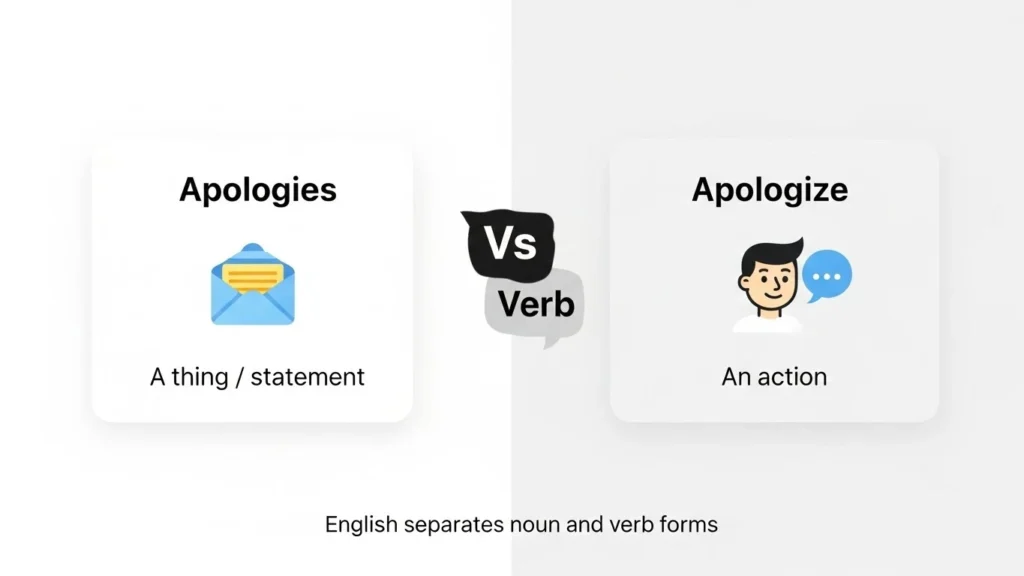
Both words come from the Greek word apologia, meaning a speech in defense. Over time, English shaped different forms:
- Apology / Apologies → noun
- Apologize → verb
The confusion exists because many languages use one form for both noun and verb, but English separates them clearly.
British English vs American English Spelling
Here’s an important difference.
| Aspect | British English | American English |
| Verb form | Apologise | Apologize |
| Noun form | Apologies | Apologies |
| Spelling rule | -ise | -ize |
👉 Apologies is the same everywhere.
👉 Apologize is American spelling (British: apologise).
Which Spelling Should You Use?
Choose based on function and audience:
- Writing to a US audience → apologize
- Writing to a UK/Commonwealth audience → apologise
- Referring to the noun → apologies (everywhere)
Professional tip:
Never use apologies as a verb.
Common Mistakes with Apologies or Apologize
❌ I apologies for being late.
✅ I apologize for being late.
❌ Please apologize my delay.
✅ Please accept my apologies for the delay.
❌ He gave an apologize.
✅ He gave an apology.
One of the most common mistakes with apologies and apologize is using apologies as a verb, such as writing “I apologies for the delay,” which is grammatically incorrect.
Another frequent error is forgetting that apologize must be followed by “for”, not a direct object.
For example, “Please apologize my mistake” is wrong; it should be “Please apologize for my mistake
. Writers also confuse singular and plural forms by saying “He gave an apologize” instead of “He gave an apology.
Regional spelling causes additional mistakes, especially when writers mix apologize (American English) with apologise (British English) in the same document.
In professional emails, people sometimes use both apologies and apologize together unnecessarily, making sentences awkward. To avoid these errors, remember one rule: apologies is a noun, apologize is a verb.
Choosing the correct form instantly improves clarity, professionalism, and grammatical accuracy.
Apologies or Apologize in Everyday Examples
Emails
- Please accept my apologies for the delay.
- I apologize for the late response.
Workplace
- The company issued apologies.
- The manager apologized publicly.
Social Media
- I apologize if this offended anyone.
- Sincere apologies to all followers.
Formal Writing
- An official apology was released.
Apologies or Apologize : Google Trends & Usage Data
Search trends show:
- High confusion in professional emails
- Apologies searched as a noun
- Apologize searched for verb confirmation
Top regions:
- United States
- United Kingdom
- India
- Pakistan
👉 Most users want help with grammar role, not meaning.
Comparison Table: Apologies vs Apologize
| Feature | Apologies | Apologize |
| Part of speech | Noun | Verb |
| Meaning | Expressions of regret | To say sorry |
| Used as action | ❌ No | ✅ Yes |
| Used in sentences | Accept my apologies | I apologize |
| Regional spelling | Same everywhere | US spelling |
FAQs: Apologies or Apologize
1. Is “I apologies” correct?
No. It should be I apologize.
2. Can apologies be singular?
Yes: apology.
3. Is apologize American English?
Yes. British English uses apologise.
4. Can I say “my apologies”?
Yes, it’s polite and correct.
5. Which is more formal?
“My apologies” sounds more formal.
6. Is “apologies for the inconvenience” correct?
Yes, very common in emails.
7. Can apologies be used as a verb?
No, never.
Conclusion
The difference between apologies or apologize is simple once you focus on grammar role. Apologies is a nounit refers to the expression itself. Apologize is a verbit shows the action of saying sorry.
There is also a regional spelling difference for the verb: apologize (American English) and apologise (British English).
Choosing the correct form will instantly make your emails, messages, and professional writing sound accurate and polite.

I am Sidney Greenbaum, a linguist who studied how English is actually used, not just how it is taught. I analyzed sentence structure and word differences to make English clearer and more practical. My research helped learners understand real-world English comparisons.