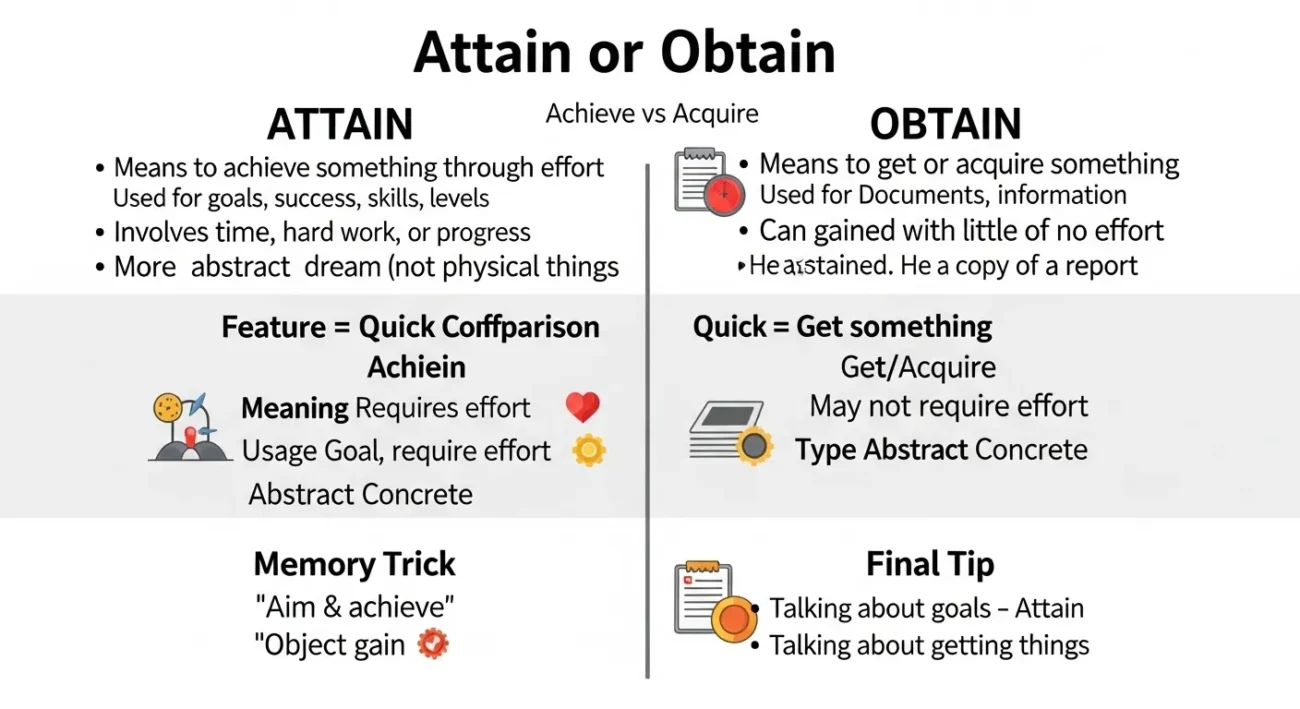
If you are confused between “attain or obtain,” the key difference is that attain means to achieve something through effort, while obtain means to get something through a process or action.
I remember when I first started writing formal English, I used these two words interchangeably because both seemed to mean “get.”
If over time, I realized that their usage depends on the situation and the type of result. Many people search “attain or obtain” because both words are common in academic, professional, and formal writing.
In this guide, I will explain their meanings, usage, examples, differences, and mistakes in a simple way so you can use attain or obtain confidently.
Attain or Obtain : Quick Answer
Understanding attain or obtain becomes easy when you look at their basic meaning.
- Attain: to achieve something with effort or hard work ✅
- Obtain: to get or acquire something through a process ✅
Examples
- She attained success after years of struggle
- He obtained a driving license
Simple idea
- Attain = achieve (effort involved) 🎯
- Obtain = get (process involved) 📄
The Meaning of Attain or Obtain
Attain in Attain or Obtain
Attain means to reach a goal or achieve something important. It usually involves time, dedication, and continuous effort. You cannot “attain” something instantly; it requires work and persistence.
Attain is commonly used for:
- Success
- Goals
- Dreams
- Positions
- Standards
👉 Examples:
- She attained a high level of success
- He attained his career goals
- They attained excellence in performance
Obtain in Attain or Obtain
Obtain means to get, receive, or acquire something, usually through a process, request, or effort that is not necessarily emotional or long term.
Commonly used for for Obtain :
- Documents
- Permission
- Information
- Objects
👉 Examples:
- He obtained a visa
- She obtained permission from the manager
- They obtained important data
Key Differences Between Attain or Obtain
1. Effort vs Process in Attain or Obtain
The biggest difference between attain or obtain is how something is achieved.
- Attain requires effort, time, and dedication
- Obtain requires a process or action
👉 Example:
- She attained success (long effort)
- He obtained a certificate (simple process)
2. Nature of Result in Attain or Obtain
Another important difference is the type of result.
- Attain is used for abstract results (goals, success)
- Obtain is used for physical or formal things
👉 Example:
- Attain happiness
- Obtain a document
3. Emotional Value in Attain or Obtain
- Attain often has emotional or motivational value
- Obtain is more practical and neutral
👉 Example:
- Attain your dreams (emotional)
- Obtain approval (practical)
4. Time Factor in Attain or Obtain
- Attain usually takes long time
- Obtain can be quick or immediate
👉 Example:
- Attain mastery (takes years)
- Obtain a receipt (instant)
Comparison Table for Attain vs Obtain
| Feature | Attain | Obtain |
| Meaning | Achieve | Get |
| Effort | High | Low/Process |
| Type | Abstract | Practical |
| Time | Long term | Short term |
| Example | Attain success | Obtain permission |
Which One Should You Use for Attain or Obtain?
Use Attain in Attain or Obtain if:
- You are talking about goals or achievements
- It involves hard work and effort
- The result is important or meaningful
👉 Examples:
- Attain success
- Attain a goal
- Attain excellence
Use Obtain in Attain or Obtain if:
- You are talking about getting something
- It involves a process or request
- The result is a thing, document, or permission
👉 Examples:
- Obtain a passport
- Obtain information
- Obtain approval
Common Mistakes with Attain or Obtain
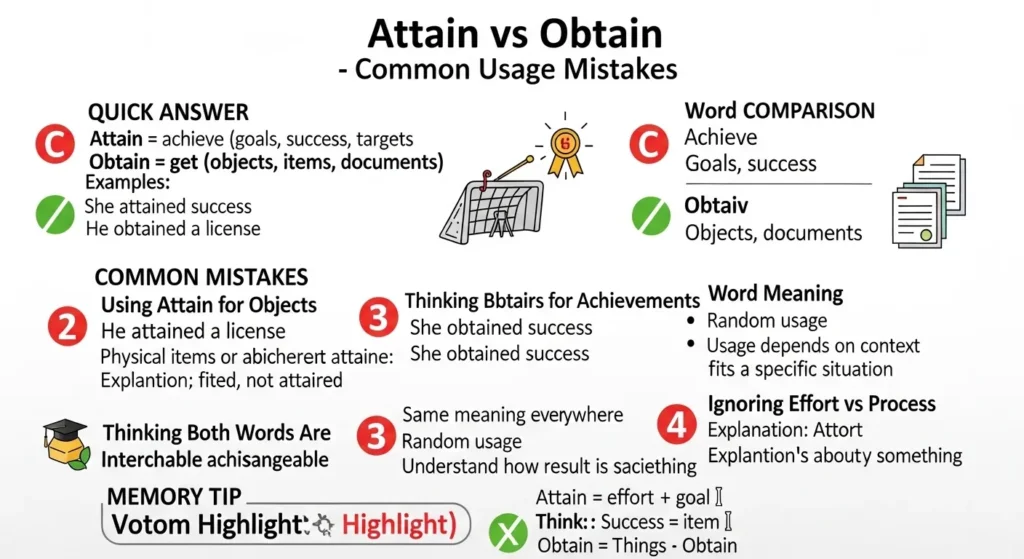
Mistake 1: Using attain for objects
❌ He attained a license
✅ He obtained a license
Mistake 2: Using obtain for achievements
❌ She obtained success
✅ She attained success
3) Mistake: Thinking both words are interchangeable
❌ Same meaning everywhere
✅ Usage depends on context
Mistake 4: Ignoring effort vs process
❌ Random usage
✅ Understand how result is achieved
Attain and Obtain in Everyday Use
Daily Conversation
- She attained her dream job after years of effort
- He obtained a new ID card
Academic Writing
- The study attained significant results
- The researcher obtained data from surveys
Professional Use
- The company attained high growth
- The team obtained client approval
Formal Use
- They attained international recognition
- She obtained legal permission
Attain or Obtain : Memory Trick
🧠 Attain → Aim + Gain (goal achieved) 🎯
🧠 Obtain → Object Gain (something received) 📦
This simple trick helps you remember the difference easily.
Obtain or Attain : Real Life Understanding
In real life, the difference becomes very clear when you think about effort.
If something requires hard work, patience, and time, you should use “attain.” For example, you attain success, skills, or goals.
If something requires a process, request, or simple action, you should use “obtain.” For example, you obtain a document, permission, or information.
Once I understood this idea, I stopped making mistakes between attain or obtain.
Attain or Obtain : Final Insight
The confusion between attain or obtain happens because both words relate to getting something. However, the key difference lies in the journey.
- Attain focuses on achievement through effort
- Obtain focuses on acquiring through action
This is the main concept you need to remember.
Conclusion
When I compare attain or obtain, I clearly see that both words have different roles in English. Attain is used when you achieve something meaningful through hard work, such as success, goals, or excellence. It reflects effort, dedication, and time.
On the other hand, obtain is used when you get something through a process, such as documents, permission, or information. It is more practical and does not always involve emotional value or long effort.
The confusion usually comes from the fact that both words mean “to get,” but they are used in different contexts. If you focus on how something is achieved, you can easily choose the correct word.
In simple words, use attain for achievements and obtain for things. Once you understand this difference, you will use both words correctly without any confusion.

I am Mark Twain, a writer who loved the English language for its humor, irony, and everyday comparisons. I used simple words to show deep differences between truth and lies, wisdom and foolishness. My writing proves that clear English is always more powerful than complicated English.