


Many people search for balanced or unbalanced because these words describe opposite states. However, writers often confuse them in fitness advice, education, psychology, and even daily conversations.
For example, sentences like “He eats a balanced junk diet” or “The report is unbalanced but fair” sound logical at first, yet the word choice is incorrect.
This confusion exists because both words come from the same root balance and people hesitate when deciding whether something feels stable or unstable.
As a result, choosing the wrong word can completely change a sentence’s meaning.
To solve this problem, this article explains the difference clearly and simply.
First, you’ll get a quick answer. Then, you’ll explore word origins, usage rules, common mistakes, real-life examples, trends, and expert tips.
By the end, you’ll confidently know when to use balanced and when unbalanced fits better.
You’ll get a quick answer first, then learn word origins, usage rules, common mistakes, real-life examples, trends, and expert advice.
By the end, you’ll confidently know when to use balanced and when unbalanced is the correct choice.
Balanced or Unbalanced : Quick Answer
Balanced → stable, fair, equal, or healthy
Unbalanced → unstable, unfair, unequal, or unhealthy
Examples:
- She eats a balanced diet.
- The argument sounded unbalanced.
- He shows a balanced personality.
- The table looks unbalanced.
👉 Stable or fair → balanced
👉 Unstable or unequal → unbalanced
Learn More: Wearing or Waring
The Origin of Balanced or Unbalanced
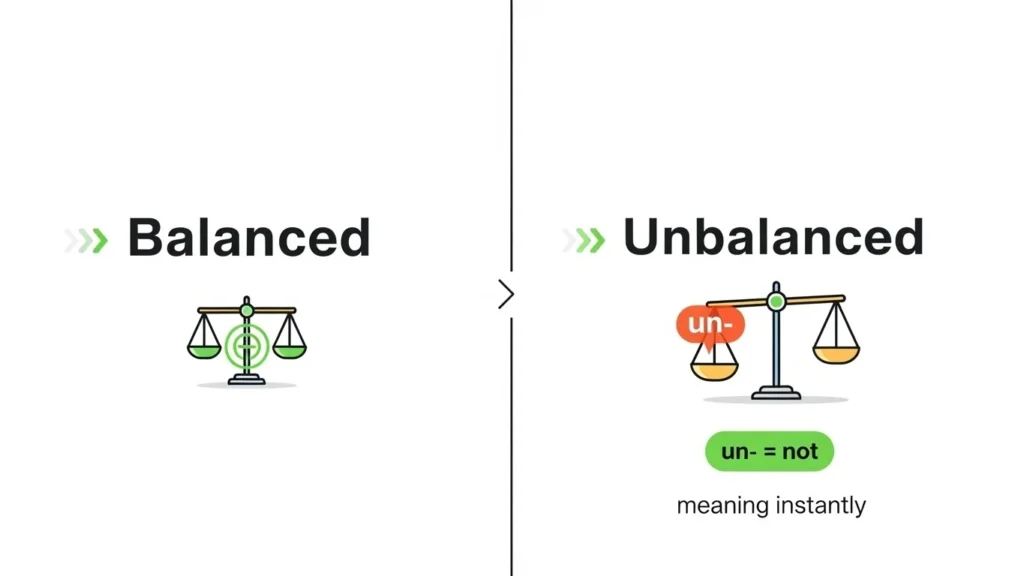
The word balance comes from Latin bilanx, meaning two scales. It originally referred to weighing equally. Over time:
- Balanced described equality and stability
- Unbalanced described inequality or instability
The prefix un- simply means not, making unbalanced the opposite of balanced.
Learn More : Oggle vs Ogle: Which One Is Correct and When to Use It
British English vs American English Spelling
There is no spelling difference between British and American English.
| Aspect | British English | American English |
| Balanced | Balanced | Balanced |
| Unbalanced | Unbalanced | Unbalanced |
| Meaning | Same | Same |
👉 Usage rules are identical worldwide.
Which Spelling Should You Use?
Choose based on meaning, not region.
Use balanced when describing:
- Diets
- Opinions
- Personalities
- Systems
- Designs
Use unbalanced when describing:
- Emotions
- Arguments
- Structures
- Diets lacking nutrients
Professional tip:
If the situation lacks fairness or stability, unbalanced is usually correct.
Common Mistakes with Balanced or Unbalanced
❌ He eats a balanced junk diet.
✅ An unbalanced diet is what he eats.
❌ The report is balanced and biased.
✅ In this case, the report appears unbalanced and biased.
❌ She has an unbalanced lifestyle and good health.
✅ A balanced lifestyle, however, supports her good health.
One common mistake with balanced and unbalanced is using both words together in a way that cancels the meaning, such as “a balanced but biased report.” If something is biased, it is automatically unbalanced.
Another frequent error appears in health writing, where people say “a balanced junk diet,” which is incorrect because junk food lacks nutritional balance.
Writers also misuse unbalanced when they only mean “different” or “varied,” even though unbalanced implies instability or lack of fairness.
In psychology-related content, unbalanced is sometimes used casually, which can unintentionally suggest emotional or mental instability.
Another mistake is ignoring context and assuming balanced is always positive; for example, a “balanced argument” must show fairness, not just equal length.
To avoid these errors, check the meaning carefully: balanced means stable, fair, or healthy, while unbalanced means unequal, unstable, or unhealthy. Correct usage improves clarity and prevents misleading interpretations.
Balanced or Unbalanced in Everyday Examples
Health
- A balanced diet improves energy.
- An unbalanced diet causes weakness.
Work
- The article presents a balanced view.
- The presentation felt unbalanced.
Mental Health
- He has a balanced mindset.
- The character is emotionally unbalanced.
Social Media
- Keep life balanced ⚖️
Balanced or Unbalanced : Google Trends & Usage Data
Search trends show:
- High usage in health and education topics
- Balanced searched more positively
- Unbalanced often searched with mental health and diet
Top regions:
- United States
- United Kingdom
- India
- Pakistan
👉 Users mostly want context-based clarity.
Comparison Table: Balanced vs Unbalanced
| Feature | Balanced | Unbalanced |
| Meaning | Stable, fair | Unstable, unequal |
| Emotional use | Calm | Disturbed |
| Health use | Healthy | Unhealthy |
| Bias level | Fair | Biased |
| Prefix used | None | un- |
FAQs: Balanced or Unbalanced
1. Can a diet be balanced?
Yes, a healthy diet is balanced.
2. Is unbalanced always negative?
Usually yes, but context matters.
3. Can a person be unbalanced?
Yes, emotionally or mentally.
4. Is there a spelling difference by region?
No, same spelling everywhere.
5. Which word is more formal?
Both are equally formal.
6. Can opinions be balanced?
Yes, balanced opinions are fair.
7. Is unbalanced the opposite of balanced?
Yes, exactly.
Conclusion
The difference between balanced or unbalanced is all about stability and fairness. Balanced describes something equal, healthy, or steady. Unbalanced describes something unequal, unstable, or unhealthy. There is no British or American spelling difference only meaning matters.
Choosing the right word depends on context. In general, if something works well and feels fair, you should use balanced. On the other hand, if it lacks harmony or stability, then unbalanced is the more appropriate choice.Mastering this pair will make your writing clearer and more accurate.

I am Michael Swan, an English grammarian known for explaining confusing grammar and word comparisons in a clear way. I focused on real usage, not just rules, helping learners understand why English works the way it does. My work simplifies complex language problems for everyday users.