

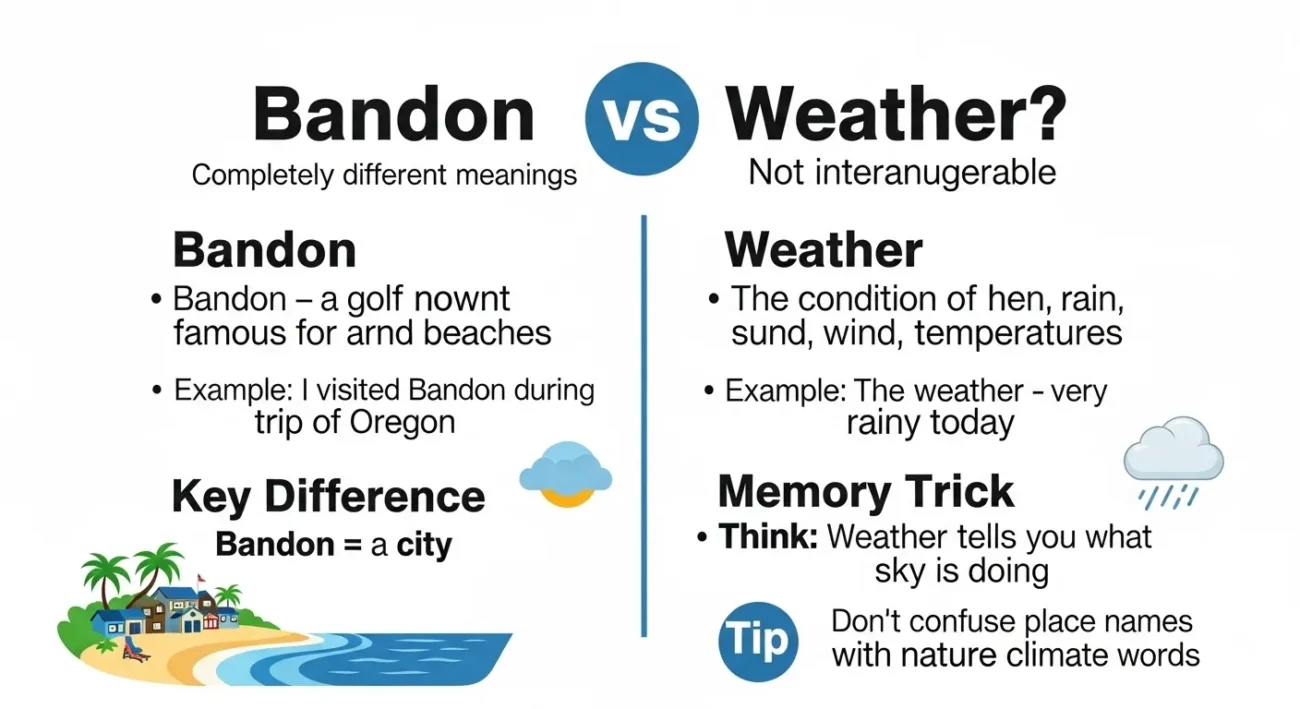
If you are wondering about “bandon or weather,” the correct word is usually abandon, while weather has a completely different meaning.
I often see people get confused when writing these words because they sound simple but are used in very different situations.
When I searched this topic myself, I noticed that many writers accidentally type “bandon” instead of “abandon,” or they are unsure whether a sentence should use abandon or weather. This confusion appears in emails, essays, and even professional writing.
In this guide, I will explain the correct meaning, spelling, and usage of these words so you can avoid common mistakes and write with confidence.
Bandon or Weather : Quick Answer
The correct comparison is usually abandon vs weather, not bandon vs weather.
- Abandon means to leave something behind or give it up completely.
- Weather means to survive or endure a difficult situation.
Examples
Abandon
- They decided to abandon the old building.
- The captain had to abandon the sinking ship.
Weather
- The town managed to weather the storm.
- She weathered many challenges in her career.
Important note:
Bandon by itself is not a standard English verb. It is usually a typing mistake for abandon.
The Origin of Bandon and Weather
Understanding the history of words often makes their meanings easier to remember.
Origin of Abandon
The word abandon comes from the Old French phrase “à bandon,” which meant to place something under someone’s control or to surrender it. Over time, the meaning changed slightly to mean giving something up or leaving it behind.
By the 14th century, the word was used widely in English to describe leaving something permanently.
Example:
- Soldiers were forced to abandon the fort.
Origin of Weather
The word weather has a different background. It comes from Old English “weder,” which referred to atmospheric conditions like wind, rain, or storms.
Later, the verb form developed. It began to mean surviving harsh conditions, much like ships surviving storms at sea.
Example:
- The ship managed to weather the rough seas.
So while abandon relates to leaving, weather relates to surviving.
British English vs American English Spelling
Unlike some English words, abandon and weather do not change spelling between British and American English.
However, spelling mistakes like bandon can appear because people accidentally remove the first letter while typing.
| Word | American English | British English | Meaning |
| Abandon | Abandon | Abandon | To leave or give up |
| Weather | Weather | Weather | To endure conditions |
| Bandon | Incorrect | Incorrect | Typing error |
So there is no regional spelling difference for these words.
Which Spelling Should You Use?
The correct word depends on the meaning of your sentence.
Use Abandon when:
- You mean to leave something behind
- You are talking about giving up a plan or place
Examples:
- They abandoned the project.
- The family abandoned the old house.
Use Weather when:
- You mean to survive or endure difficulty
- You are describing lasting through problems
Examples:
- The company weathered the financial crisis.
- She weathered the criticism calmly.
Audience Advice
- US writers: Use abandon and weather as standard spellings.
- UK/Commonwealth writers: The same spellings apply.
- Global audiences: Both words are universally accepted in English.
Simply remember:
Abandon = leave something
Weather = survive something
Common Mistakes with Bandon or Weather
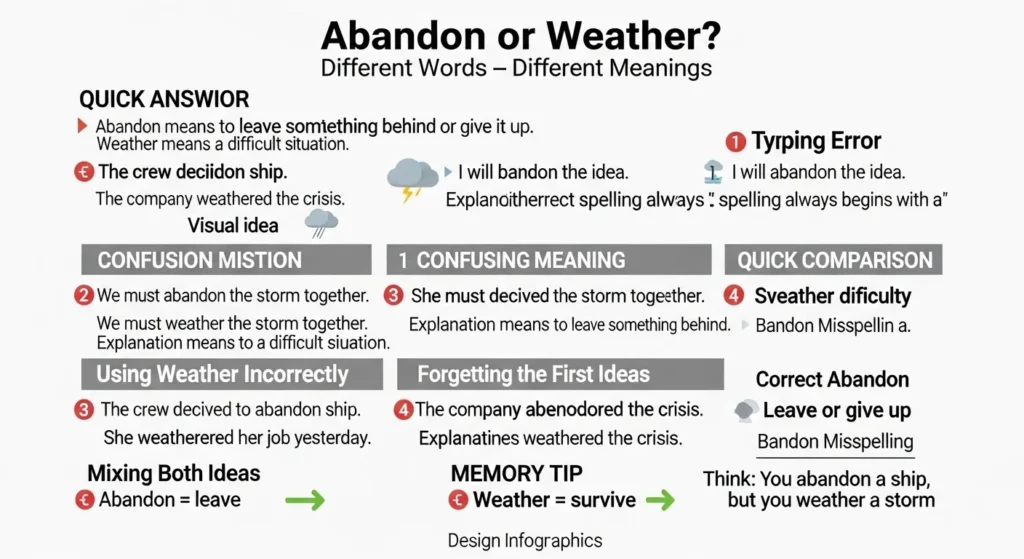
Here are some typical mistakes people make when writing these words.
Mistake 1: Typing error
❌ I will bandon the idea.
✅ I will abandon the idea.
Mistake 2: Confusing meanings
❌ We must abandon the storm together.
✅ We must weather the storm together.
Mistake 3: Using weather incorrectly
❌ She weathered her job yesterday.
✅ She abandoned her job yesterday.
Mistake 4: Forgetting the first letter
❌ The crew decided to bandon ship.
✅ The crew decided to abandon ship.
Mistake 5: Mixing both ideas
❌ The company abandoned the crisis.
✅ The company weathered the crisis.
Learning these small differences can greatly improve writing clarity.
Weather or Bandon in Everyday Examples
These words appear in many everyday situations.
In Emails
- “We may need to abandon the current strategy.”
- “Our team will weather the challenges ahead.”
In News Headlines
- “Residents refuse to abandon their homes.”
- “Local businesses weather economic downturn.”
On Social Media
- “Never abandon your dreams.”
- “We will weather this storm together.”
In Formal Writing
- The researchers abandoned the earlier theory.
- The organization weathered several financial difficulties.
These examples show how each word fits naturally into different types of writing.
Bandon or Weather : Google Trends & Usage Data
Search data shows that many users type “bandon” by mistake when they actually mean “abandon.”
Common search queries include:
- bandon meaning
- bandon vs abandon
- abandon or weather the storm
Usage trends show:
- Abandon is commonly used in legal, business, and everyday writing.
- Weather is frequently used in news, motivational language, and discussions about challenges.
Popular regions searching these terms
- United States
- United Kingdom
- Canada
- India
- Pakistan
Most searches occur when writers want to check spelling or understand the difference between similar words.
Comparison Table
| Word | Part of Speech | Meaning | Example |
| Abandon | Verb | To leave something behind | They abandoned the ship |
| Weather | Verb | To survive difficulty | The town weathered the storm |
| Bandon | — | Incorrect spelling | Typing mistake |
FAQs
1. Is bandon a real word?
No. In most cases, bandon is simply a typing mistake for the word abandon.
2. What does abandon mean?
Abandon means to leave something behind or give it up completely.
Example:
“They abandoned the old plan.”
3. What does weather mean as a verb?
Weather means to survive or endure a difficult situation.
Example:
“She weathered the criticism calmly.”
4. Can weather mean climate?
Yes. Weather can also refer to atmospheric conditions like rain, wind, and temperature.
Example:
“The weather is sunny today.”
5. How can I remember the difference?
A simple trick:
- Abandon → leave
- Weather → survive
6. Is abandon used in both British and American English?
Yes. The spelling abandon is the same in both versions of English.
7. Why do people search “bandon or weather”?
Most people search this phrase because of spelling confusion or typing mistakes, especially when writing quickly.
Conclusion
The confusion between bandon or weather usually comes from a simple spelling mistake. The correct comparison is actually abandon vs weather, and each word has a very different meaning.
Abandon means leaving something behind or giving it up completely. It is often used when someone quits a project, leaves a place, or stops supporting something.
Weather, on the other hand, means surviving difficult conditions. It is commonly used in situations involving challenges, crises, or emotional struggles.
The key takeaway is simple:
If you are talking about quitting or leaving, use abandon.
If you are talking about enduring or surviving, use weather.
Avoid the spelling bandon, as it is usually just a typing error. By remembering this difference, your writing will become clearer, more professional, and easier for readers to understand.
.
Discover More Articles:

I am Michael Swan, an English grammarian known for explaining confusing grammar and word comparisons in a clear way. I focused on real usage, not just rules, helping learners understand why English works the way it does. My work simplifies complex language problems for everyday users.