

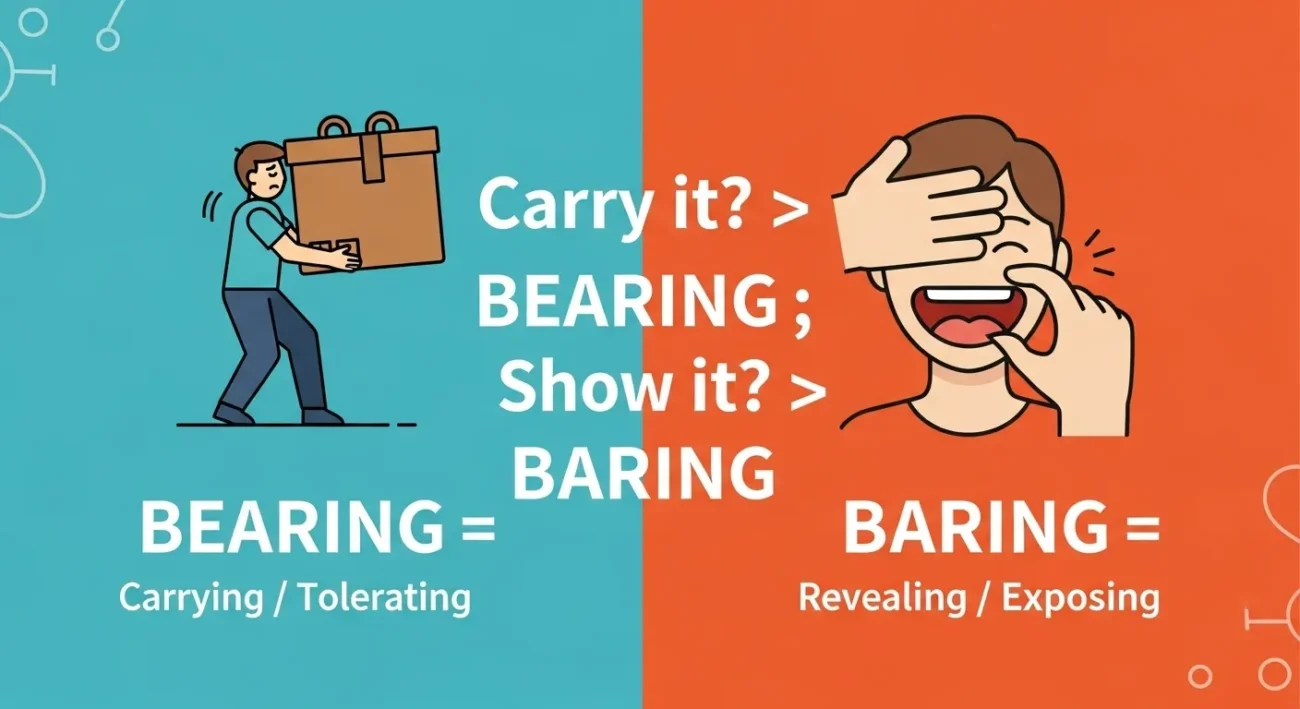
The correct word depends on meaning: bearing means carrying or tolerating, while baring means uncovering or revealing.
I learned this lesson the hard way while writing an email where one small spelling change flipped my meaning completely. Many people search for bearing or baring because these words look similar, sound almost the same, and appear in serious writing news, emails, and even legal texts.
One wrong choice can confuse readers or embarrass the writer. This article clears that confusion once and for all. I’ll explain the difference, show real examples, compare British and American usage, and help you choose the right word every time.
If you want a quick answer, a deep explanation, and professional guidance in one place, you’re in the right spot.
Bearing or Baring: Quick Answer
Bearing means carrying, supporting, or enduring.
Baring means uncovering or exposing something.
Examples:
- She is bearing responsibility for the project.
- He was baring his teeth in anger.
Easy tip I use:
If it involves carrying or tolerating, choose bearing.
If it involves showing or revealing, choose baring.
The Origin of Bearing or Baring
I always find word origins helpful because they explain why confusion exists.
Bearing comes from Old English beran, meaning to carry. Over time, it grew many meanings:
- Carrying weight
- Tolerating pain
- Direction or position
- Giving birth
That’s why bearing feels everywhere it’s doing a lot of work.
Baring comes from Old English bær, meaning naked or uncovered. Its meaning stayed narrow and visual. It almost always refers to exposing something that was hidden.
The spelling difference exists because the meanings grew apart, even though pronunciation stayed close.
British English vs American English Spelling
Here’s something important I learned:
There is NO spelling difference between British and American English for bearing or baring.
Both dialects use the same spellings and meanings.
Comparison Table
| Word | American English | British English | Meaning |
| Bearing | Bearing | Bearing | Carrying, tolerating |
| Baring | Baring | Baring | Revealing, uncovering |
So if someone tells you it’s a US vs UK issue it’s not.
Which Spelling Should You Use?
This is how I decide quickly:
- US audience: Use meaning, not location
- UK/Commonwealth: Same rule applies
- Global or content: Choose based on context only
My personal rule:
I stop and ask myself one question:
👉 Is something being carried or shown?
That one pause saves mistakes.
Common Mistakes with Bearing or Baring
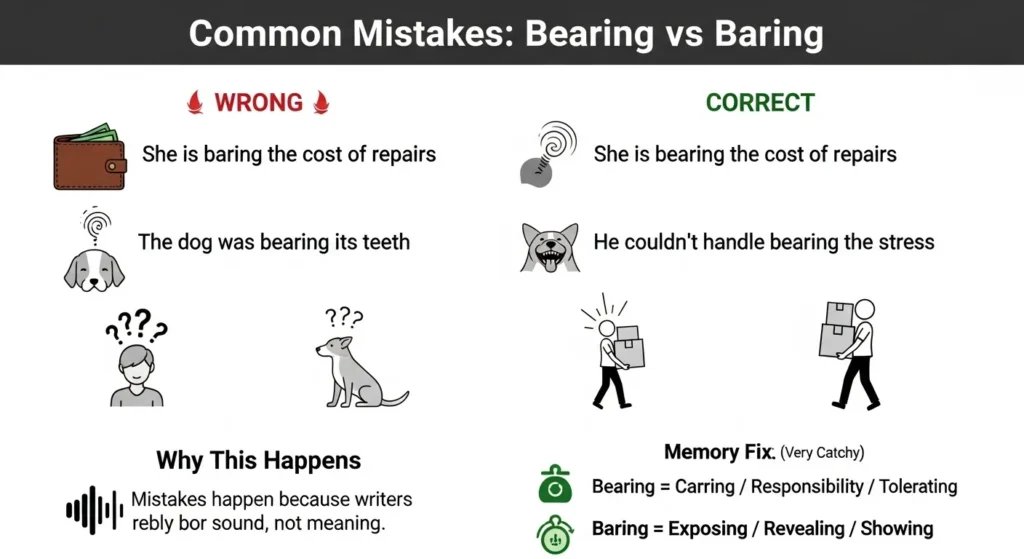
I see these errors all the time, even in professional writing.
❌ Wrong → ✔ Correct
- ❌ She is baring the cost of repairs.
✔ She is bearing the cost of repairs. - ❌ The dog was bearing its teeth.
✔ The dog was baring its teeth. - ❌ He couldn’t handle baring the stress.
✔ He couldn’t handle bearing the stress.
Why mistakes happen:
Because writers rely on sound, not meaning. I used to do the same.
Bearing or Baring in Everyday Examples
Here’s how I see these words used in real life.
Emails
- I appreciate you bearing with me during the delay.
- Please avoid baring confidential information.
News
- The company is bearing heavy losses this quarter.
- The protester stood baring his chest.
Social Media
- Thanks for bearing my long post 😂
- She went viral for baring the truth.
Formal Writing
- The evidence has no bearing on the case.
- The artist focused on baring human emotion.
Bearing or Baring: Google Trends & Usage Data
From what I’ve seen in search data and usage patterns:
- Bearing is searched more often worldwide
- Common searches include:
- bearing with me
- bearing responsibility
- bearing meaning
- bearing with me
- Baring spikes during news, fashion, and social media trends
- baring teeth
- baring skin
- baring emotions
- baring teeth
Country insight:
- US, UK, India, and Pakistan search bearing far more
- Baring is context driven, not region driven
Bearing vs Baring: Side by Side Comparison Table
| Aspect | Bearing | Baring |
| Meaning | Carrying, tolerating | Revealing, uncovering |
| Usage | Emotional, physical, abstract | Visual, physical |
| Common Phrase | Bearing responsibility | Baring teeth |
| Frequency | Very common | Less common |
| Usage | High | Medium |
FAQs About Bearing or Baring
1. Is “bearing with me” correct?
Yes. It means being patient.
2. Can bearing and baring ever be interchangeable?
No. One wrong choice changes meaning completely.
3. Is baring always physical?
Mostly yes, but it can be emotional too, like baring your soul.
4. Does bearing relate to direction?
Yes. In navigation, bearing means direction or angle.
5. Is baring informal?
No. It works in both formal and informal writing.
6. Which word appears more in content?
Bearing, by a large margin.
7. How do I remember the difference fast?
Think: bearing = burden, baring = bare skin.
Conclusion
After writing, editing, and correcting this mistake many times, I’ve learned that bearing or baring confusion is easy to avoid once you understand intent. Bearing is about carrying weight physical, emotional, or abstract. Baring is about revealing something hidden. They sound alike, but they live in different worlds of meaning.
There is no American or British spelling difference, only a meaning difference. When writing emails, articles, or professional documents, choosing the wrong word can weaken clarity and trust. My advice is simple: pause, check the meaning, and move forward with confidence. Mastering small differences like this improves writing instantly and makes your message sharper, clearer, and more professional.

I am Michael Swan, an English grammarian known for explaining confusing grammar and word comparisons in a clear way. I focused on real usage, not just rules, helping learners understand why English works the way it does. My work simplifies complex language problems for everyday users.