

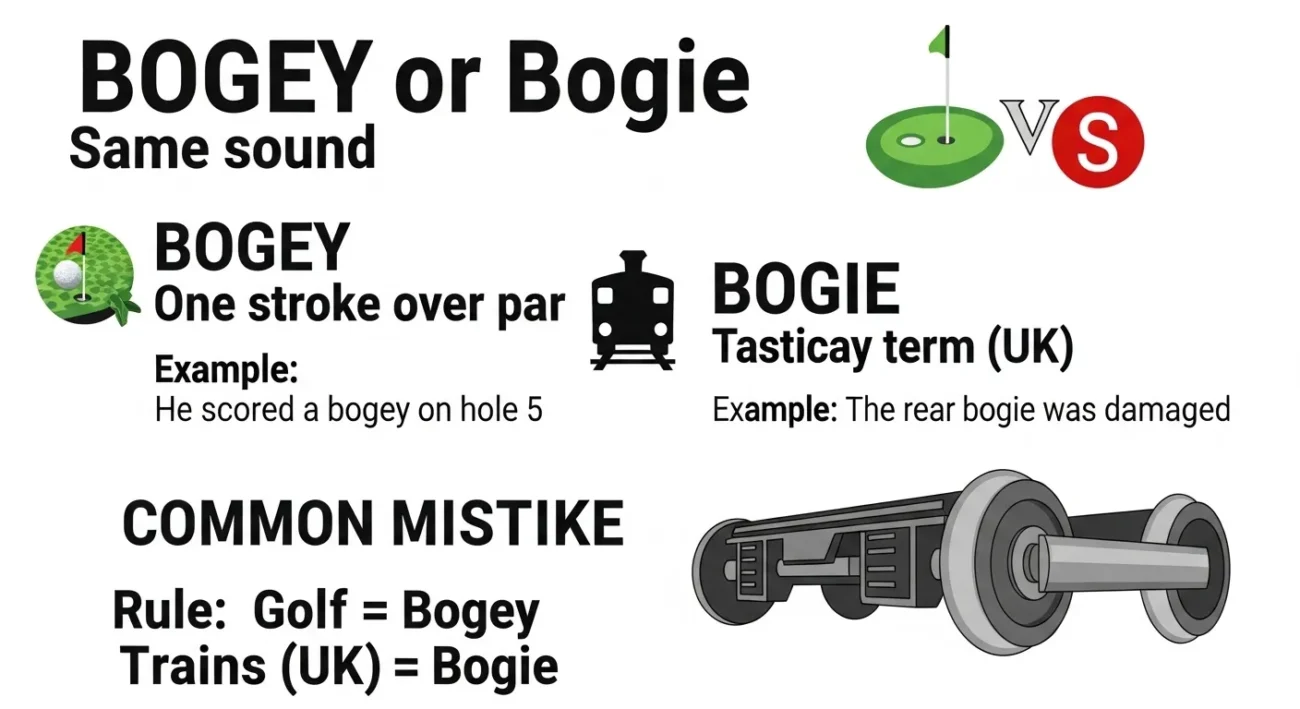
Bogey or bogie? The quick answer: both are correct, but they are used in different contexts.
I once wrote about golf and typed “bogie” by mistake. Later, I learned that “bogey” is the standard golf term in American English. Many people search this question because the words look the same and sound the same. But their meaning can change depending on context.
In this guide, I will explain the difference, origin, spelling rules, common mistakes, real examples, and which word you should use.
Bogey or Bogie: Quick Answer
The meaning depends on context.
- Bogey → Golf term (one stroke over par)
- Bogie → British spelling or railway term
Examples:
- He scored a bogey on the fifth hole.
- The train’s bogie was damaged.
So the spelling changes based on subject and region.
The Origin of Bogey and Bogie
The word “bogey” first appeared in the late 19th century in golf. It meant the target score a player tried to match.
In British English, “bogie” became a spelling variation.
In railway language, “bogie” refers to a wheeled chassis under a train carriage. This usage is common in the UK and other Commonwealth countries.
Golf organizations like PGA Tour use the spelling “bogey” in official scoring.
So history and context both shape the spelling.
British English vs American English Spelling
This difference sometimes relates to region.
| Context | American English | British English |
| Golf | Bogey | Bogey (most common) |
| Railway Term | Rare | Bogie |
| General Variant | Bogey | Bogie |
In golf, both countries mostly use bogey.
In railway engineering, British English prefers bogie.
Which Spelling Should You Use?
Here is simple advice:
Talking About Golf
Use bogey. It is the official and standard spelling worldwide.
Talking About Railways (UK Context)
Use bogie.
Writing for a General Audience
Choose the spelling that matches your topic.
When I write about sports, I always use “bogey.” It is clearer and more widely accepted.
Common Mistakes with Bogey or Bogie
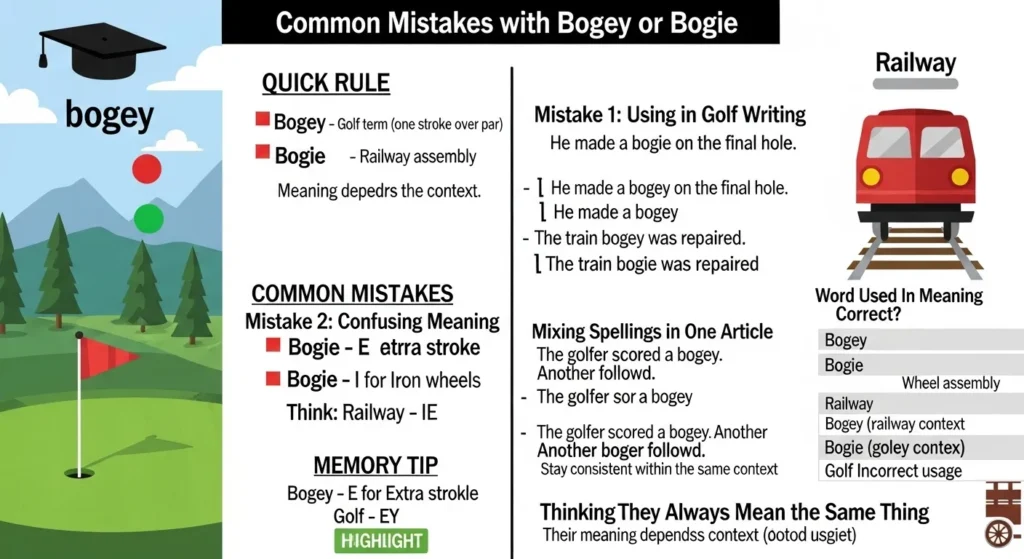
Using Bogie in Golf Writing
❌ He made a bogie on the final hole.
✅ He made a bogey on the final hole.
Confusing Railway Meaning
❌ The train bogey was repaired.
✅ The train bogie was repaired.
Mixing Spellings in One Article
❌ The golfer scored a bogey. Another bogie followed.
✅ The golfer scored a bogey. Another bogey followed.
Thinking They Always Mean the Same Thing
❌ Bogey and bogie are always interchangeable.
✅ Their meaning depends on context (golf or railway).
Bogie or Bogey in Everyday Examples
In Sports News
“The player avoided a bogey on the final hole.”
In Golf Commentary
“That bogey cost him the lead.”
In Railway Reports
“The rear bogie derailed during the incident.”
In Casual Speech
“He had one bogey and two birdies.”
Context makes the difference clear.
Bogey or Bogie: Usage Trends
Search patterns show:
- Bogey is more common globally because of golf.
- “Bogie” appears mainly in British railway contexts.
- Sports websites and golf organizations almost always use “bogey.”
Because golf is popular worldwide, “bogey” dominates online searches.
Comparison Table: Bogey vs Bogie
| Feature | Bogey | Bogie |
| Golf Term | Yes | Rare |
| Railway Term | No | Yes (UK) |
| Most Common Usage | Golf | Railways |
| Standard in Sports | Yes | No |
| Meaning Change | Score over par | Train chassis |
Frequently Asked Questions
1. Is it bogey or bogie in golf?
“Bogey” is correct in golf.
2. What does bogie mean?
In British English, it often refers to a railway wheel assembly.
3. Are bogey and bogie interchangeable?
Not always. Context decides meaning.
4. Which spelling is more common?
“Bogey” is more common worldwide.
5. Do Americans use bogie?
Rarely, except in railway discussions.
6. Why are the words confusing?
They sound the same but have different uses.
7. Which should I use in sports writing?
Always use “bogey.”
Conclusion
Bogey or bogie may look almost identical, but their usage depends on context. In golf, the correct spelling is “bogey.” It means one stroke over par and is used worldwide. In British railway language, “bogie” refers to the wheeled frame under a train carriage.
I once confused the spellings in a sports article. Now I remember this simple rule: golf equals bogey, trains equal bogie. Context is everything.
Language often creates small spelling differences like this. Understanding the topic makes the choice easy. Now you can confidently use the correct spelling based on what you are writing about.
Discover More Articles:

I am Sidney Greenbaum, a linguist who studied how English is actually used, not just how it is taught. I analyzed sentence structure and word differences to make English clearer and more practical. My research helped learners understand real-world English comparisons.