

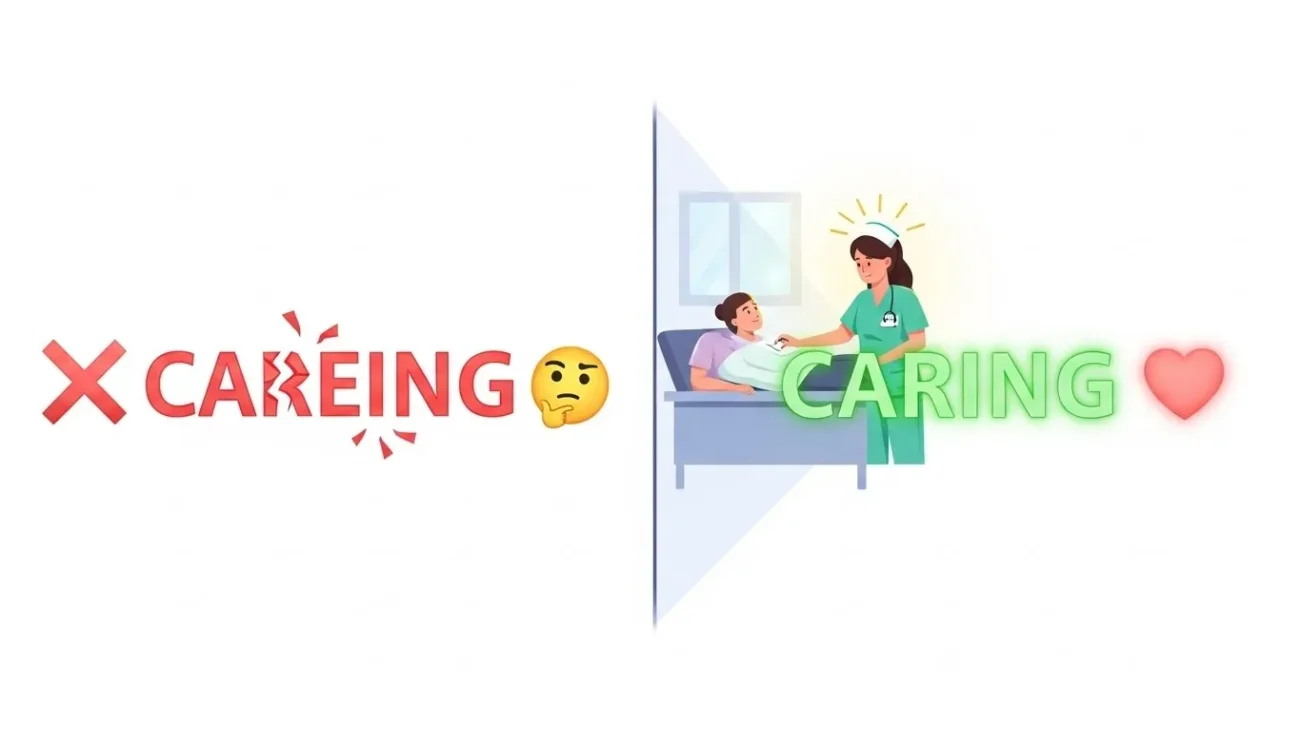
Many people search for careing or caring because the two spellings look similar, but only one is correct in English.
Using the wrong spelling can make your writing look unprofessional, especially in emails, essays, or social media posts.
The confusion usually arises from the tendency to add -ing to verbs without adjusting spelling. This article clears the confusion simply and clearly.
You’ll get a quick answer, learn the origin, see common mistakes, everyday examples, and expert advice.
By the end, you’ll confidently know when to use caring and that careing is incorrect.
Careing or Caring : Quick Answer
- ✅ Caring → correct spelling, present participle of “care”
- ❌ Careing → incorrect
Meaning: Showing concern or kindness toward someone or something.
Examples:
- She is a caring nurse.
- He spends time caring for his parents.
👉 Always use caring in all contexts.
Read More: Prise or Prize : Which One Is Correct in Your Sentence?
The Origin of Caring
- Caring comes from the verb care, which comes from Old English carian, meaning to worry or be concerned.
- Adding -ing forms the present participle caring. The incorrect spelling careing is a common mistake caused by overgeneralizing English spelling rules.
British English vs American English Spelling
There is no difference in spelling between British and American English.
| Word | British English | American English |
| Caring | ✅ Same | ✅ Same |
| Careing | ❌ Incorrect | ❌ Incorrect |
👉 Only caring is correct in all regions.
Which Spelling Should You Use?
Use caring when:
- Describing a person’s attitude or actions
- Talking about concern or kindness
Tip: Remember, verbs ending in -e drop the e before adding -ing: care → caring, not careing.
Common Mistakes with Careing or Caring
❌ She is very careing.
✅ She is very caring.
❌ am careing for my pet.
✅ I am caring for my pet.
❌ Adding extra e before -ing
✅ Drop the e: care → caring
More Explain For Common Mistakes
The most common mistake with careing or caring is assuming that all verbs simply add –ing without spelling changes. Many learners write careing because they follow words like playing or working. However, this rule does *not apply to verbs ending in silent “e.”
In standard English, the final e is dropped before adding –ing, which is why care becomes caring, not careing.
Another frequent mistake appears in professional and academic writing. Sentences such as “She is a very careing manager” may seem minor, but spelling errors like this can reduce credibility. Employers, teachers, and editors often view such mistakes as a lack of attention to detail, even when the meaning is clear.
Some writers also believe careing might be a British spelling, similar to differences like colour vs color. This is incorrect. Careing is not accepted in either British or American English. There is no regional variation here caring is the only correct form worldwide.
A related error is confusion between adjective and verb usage. Some learners think caring can only describe people, not actions. This leads to awkward sentences or avoidance of the word altogether. In reality, caring works perfectly as both:
- an adjective (a caring teacher)
- a verb (caring for patients)
Autocorrect and spellcheck tools can also contribute to mistakes. In casual typing, people may ignore red underlines or assume the spelling is acceptable in informal contexts like social media. However, incorrect spelling habits often carry over into formal writing.
✅ Always remember: verbs ending in –e drop the e before –ing.
❌ If you see careing, it is always wrong.
Mastering this small rule helps you avoid a very common English spelling error and makes your writing clearer, more professional, and more confident.
Caring in Everyday Examples
Personal Life
- He is a caring father.
- She enjoys caring for animals.
Professional
- Nurses are caring professionals.
- Teachers are praised for caring about their students.
Social Media
- “Shoutout to all the caring friends out there!”
- Volunteer groups are full of caring people.
Comparison Table: Careing vs Caring
| Feature | Careing | Caring |
| Correct spelling | ❌ No | ✅ Yes |
| Part of speech | Verb (present participle) | Verb (present participle) |
| Common error | Adding unnecessary e | Correct formation |
| Usage | Incorrect | Formal, informal, professional |
FAQs: Careing or Caring
1. Is careing correct?
No, the correct spelling is caring.
2. Can caring be used as an adjective?
Yes, e.g., “She is a caring teacher.”
3. Do British and American English differ?
No, both use caring.
4. How do you form caring from care?
Drop the e and add -ing: care → caring.
5. Is caring informal or formal?
It is correct in both formal and informal contexts.
6. Can caring describe actions?
Yes, e.g., “He is caring for his grandparents.”
Conclusion
The difference between careing or caring is simple: caring is correct, and careing is always wrong. Use caring to describe concern, kindness, or attention toward people, animals, or things.
A simple tip: drop the “e” before adding -ing. Following this rule ensures your writing is professional, clear, and accurate.
In summary, the confusion between careing and caring comes from misunderstanding a basic English spelling rule. The correct form is always caring, whether you are writing formally or informally.
English verbs that end with a silent “e” drop that letter before adding –ing, which is why care becomes caring, not careing. Using the wrong spelling may seem like a small error, but it can negatively affect clarity and professionalism.
By remembering this simple rule and practicing correct usage, you can write with greater confidence, accuracy, and credibility in all situations.

I am Mark Twain, a writer who loved the English language for its humor, irony, and everyday comparisons. I used simple words to show deep differences between truth and lies, wisdom and foolishness. My writing proves that clear English is always more powerful than complicated English.