

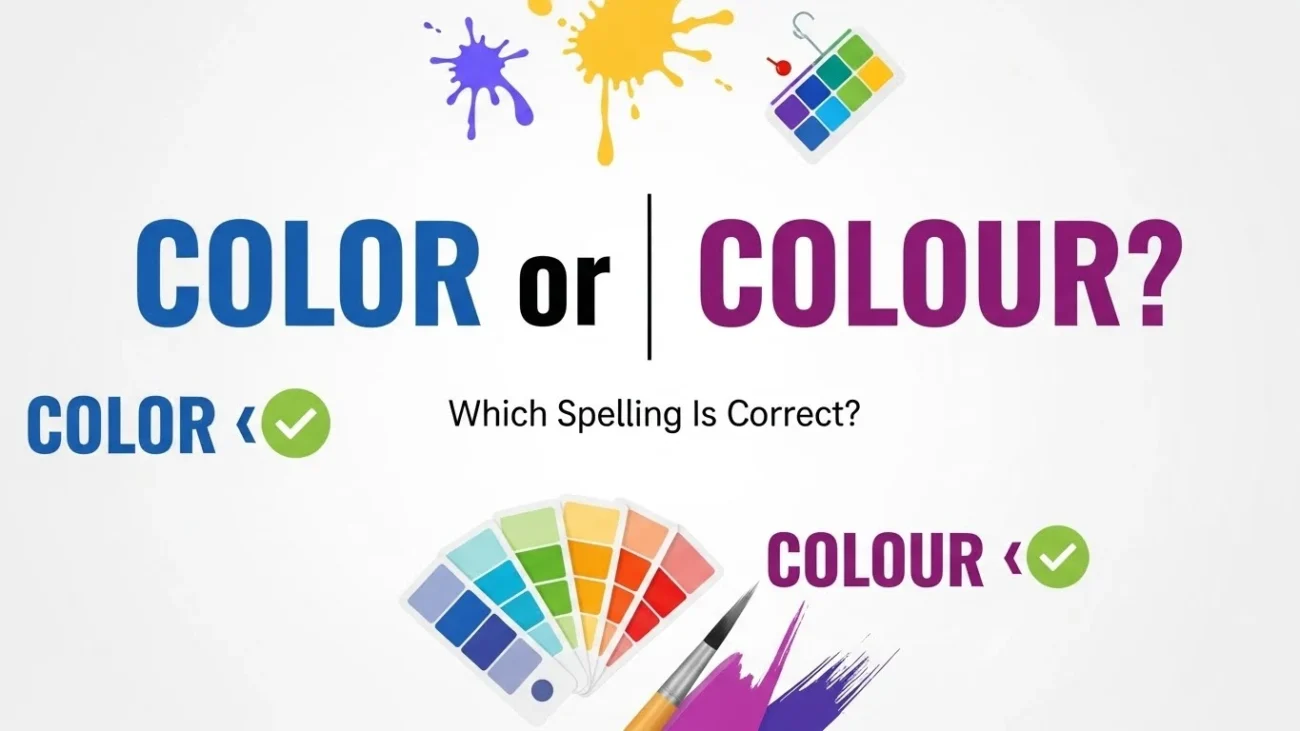
Many people search for color or colour because both spellings appear correct, yet only one is accepted depending on where and how English is used.
I’ve seen students lose marks, bloggers confuse readers, and professionals hesitate while writing simple sentences all because of this one word.
The confusion exists because English has different standards across regions. American English prefers simpler spellings, while British English keeps traditional forms. Both are correct, but mixing them is not.
This article solves that confusion clearly. You’ll get a quick answer first, then learn the origin of the word, British vs American spelling rules, common mistakes, real-life examples, usage trends, and expert advice.
By the end, you’ll know exactly which spelling to use and where.
Color or Colour : Quick Answer
- Color → American English
- Colour → British English
Examples:
- The wall is blue in color. (US)
- The wall is blue in colour. (UK)
👉 Meaning is the same. Only spelling changes.
Read More: Has vs Had in English:Difference, Rules, Examples, and Quick Tips
The Origin of Color or Colour
The word comes from Latin color. When English evolved, British spelling adopted colour, influenced by French couleur. Later, American English reformers like Noah Webster simplified spellings to make writing easier. That’s why American English dropped the “u”, giving us color.
So the difference exists because of spelling reform, not grammar or meaning.
British English vs American English Spelling
This is a classic spelling difference.
| Feature | British English | American English |
| Standard spelling | Colour | Color |
| Education system | UK, Commonwealth | USA |
| Used in exams | Colour | Color |
| Meaning | Same | Same |
👉 Rule applies to similar words too:
- colour / color
- favourite / favorite
- centre / center
Which Spelling Should You Use?
Choose based on your audience:
- United States → color
- United Kingdom → colour
- Canada, Australia, Pakistan, India → colour
- Global or mixed audience → pick one style and stay consistent
Professional tip:
Never mix color and colour in the same document.
Common Mistakes with Color or Colour
❌ Mixing spellings in one article
✅ Use one style consistently
❌ Thinking one spelling is “wrong”
✅ Both are correct, region-based
❌ Changing spelling randomly
✅ Follow your target audience
One of the most common mistakes with color and colour is mixing both spellings in the same piece of writing.
This often happens when writers copy content from different sources or rely on auto correct tools set to a different language variant.
Another frequent error is assuming that one spelling is more “correct” than the other, when in reality both are correct but region specific.
Students sometimes lose marks in exams because they switch between spellings within one answer.
Bloggers and content writers also hurt readability and SEO consistency by using color in headings and colour in body text. Spell checkers may automatically change colour to color if the default setting is American English, creating unintentional inconsistency.
To avoid these issues, always decide your target audience first and set your language preference accordingly. Consistency is more important than the spelling itself. Once you choose one form, use it everywhere in your writing.
Color or Colour in Everyday Examples
Emails
- Please select your preferred color. (US)
- Please select your preferred colour. (UK)
Education
- Learn primary colours.
Design
- This theme has vibrant colors.
Social Media
- Love this outfit’s colour 💙
Color or Colour : Google Trends & Usage Data
Search trends show:
- Color dominates in the United States
- Colour dominates in the UK and Commonwealth
- Both are searched globally
Top regions:
- Color → USA
- Colour → UK, Australia, Pakistan, India
👉 Users mostly want to confirm regional correctness.
Comparison Table: Color vs Colour
| Feature | Color | Colour |
| Correct spelling | Yes | Yes |
| Region | American English | British English |
| Meaning | Same | Same |
| Grammar difference | No | No |
| Recommended usage | US audience | UK/Commonwealth audience |
FAQs: Color or Colour
1. Is color wrong?
No, it’s correct in American English.
2. Is colour outdated?
No, it’s standard in British English.
3. Which spelling should students use?
Follow your exam board or country.
4. Do pronunciation differ?
No, pronunciation is the same.
5. Can I use both in one article?
No, stay consistent.
6. Which spelling is better for SEO?
Use the spelling your audience searches for.
7. Is there a grammar difference?
No, only spelling differs.
Conclusion
The difference between color or colour is not about right or wrong it’s about region and consistency.
Color is the standard spelling in American English, while colour is used in British English and many other countries.
Both mean the same thing and are pronounced the same. The key is to choose the spelling that matches your audience and stick with it throughout your writing.
Once you understand this simple rule, you’ll never be confused by color vs colour again.

I am Michael Swan, an English grammarian known for explaining confusing grammar and word comparisons in a clear way. I focused on real usage, not just rules, helping learners understand why English works the way it does. My work simplifies complex language problems for everyday users.