
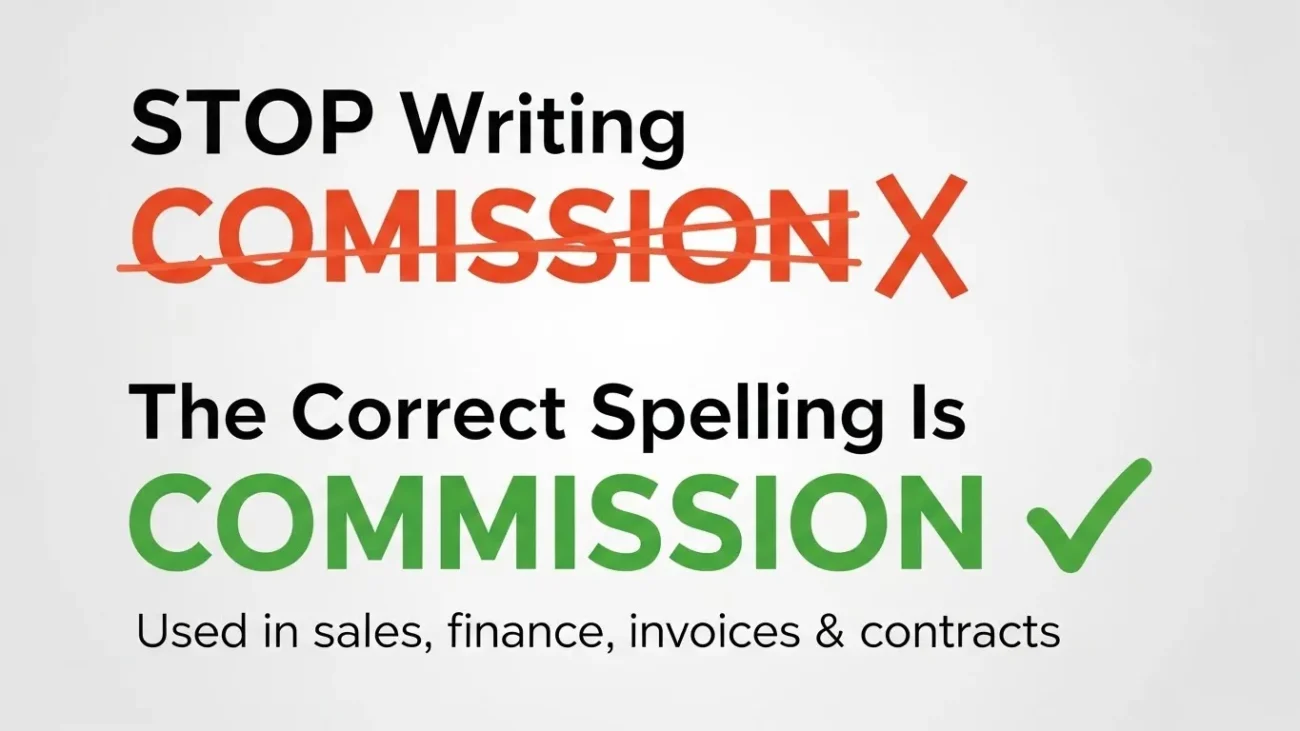
Commission is the correct spelling in all forms of English; comission is a common spelling mistake and is never acceptable.
Many readers also search for comission or commission meaning when they see the word in invoices, job offers, or contracts. The meaning is the same, but the commission correct spelling is the only acceptable form. If you’re checking commission spelling or wondering how to spell commission, remember this simple rule: it always has double “m” and double “s.”
People often type comission spelling because they rely on pronunciation or fast typing. This mistake appears frequently on social media as #comission, but hashtags do not make a spelling correct. Whether you are learning English or polishing professional writing, always use commission.
If your question is simply how to spell commission or confirm the commission correct spelling, the answer never changes. Dictionaries, contracts, and financial documents recognize only one form: commission.
Commission or Comission: Quick Answer
The correct spelling is commission.
Comission is incorrect and not accepted in standard English.
Examples:
- ✅ She earns a sales commission.
- ❌ She earns a sales comission.
- ✅ The agent charged a 5% commission.
- ❌ The agent charged a 5% comission.
Commission always has double “m” and double “s.” There are no exceptions in British or American English.
The Origin of Commision or Commission
The word commission comes from the Latin word commissio, meaning “an act of entrusting.” It passed through Old French (commission) before entering Middle English. From the beginning, the spelling included double consonants, especially mm and ss.
The confusion exists because English learners often simplify spellings based on pronunciation. When spoken quickly, commission sounds like it has one “m.” Over time, people began writing comission, assuming it was acceptable. However, English never officially adopted this simplified form.
Unlike some English words that changed spelling across regions, commission remained consistent in dictionaries, legal texts, and financial documents.
British English vs American English Spelling
There is no difference between British and American English for this word. Both use commission.
| Variant | British English | American English | Correct |
| commission | ✅ Yes | ✅ Yes | ✅ |
| comission | ❌ No | ❌ No | ❌ |
This makes commission easier than many other confusing spellings because there is only one correct form worldwide.
Which Spelling Should You Use?
You should always use “commission”, no matter your audience.
- United States: Commission
- United Kingdom: Commission
- Australia / Canada: Commission
- Global & International English: Commission
If you are writing emails, contracts, resumes, invoices, blogs, or academic work, using commission shows professionalism and strong language skills. Using comission may cause readers to doubt your credibility.
Common Mistakes with Comission or Commission
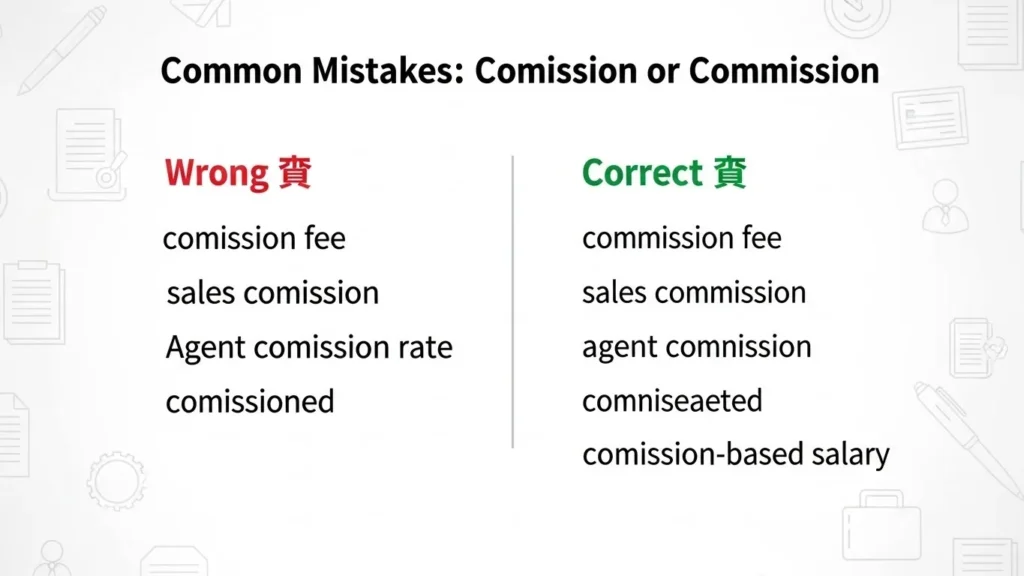
Here are frequent errors people make:
❌ comission fee
✅ commission fee
❌ sales comission
✅ sales commission
❌ agent comission rate
✅ agent commission rate
❌ commissioned spelled as comissioned
✅ commissioned
❌ comission-based salary
✅ commission-based salary
Most mistakes happen when writers drop one m or one s.
Learn MOre : Senselessness vs Silliness: Meaning, Examples, and Usage
Comission or Commision in Everyday Examples
Emails:
- “Please confirm the commission structure before signing.”
News:
- “The real estate commission was reduced nationwide.”
Social Media:
- “I finally earned my first commission as a freelancer!”
Formal Writing:
- “The broker receives a fixed commission per transaction.”
In every context—casual or formal—the spelling remains the same.
Comission or Commission: Google Trends & Usage Data
Search data shows that commission is widely used across English-speaking countries, especially in business, finance, and legal contexts. The misspelling comission appears in searches mainly from regions where English is a second language.
People usually search “commission vs commision” when:
- Writing invoices or contracts
- Applying for sales jobs
- Creating freelance proposals
- Studying English spelling rules
Google treats comission as a spelling error and often suggests commission automatically.
Comparison Table: Comission vs Commission
| Aspect | Comission | Commission |
| Correct English | ❌ No | ✅ Yes |
| Dictionary entry | ❌ None | ✅ Yes |
| Professional use | ❌ Incorrect | ✅ Correct |
| Legal/financial writing | ❌ Unacceptable | ✅ Standard |
| Global acceptance | ❌ No | ✅ Yes |
Frequently Asked Questions (FAQs)
1. Is “comission” ever correct?
No. Comission is always a spelling mistake.
2. Why does commission have double letters?
Because it comes from Latin and French, which preserved double consonants.
3. Is commission British or American English?
It is both. The spelling is identical in all major English variants.
4. Can I use comission informally?
No. Even in informal writing, it is considered incorrect.
5. What is a commission in simple terms?
A commission is money earned for selling or arranging something.
6. Is commissioned spelled differently?
No. It is spelled commissioned, not comissioned.
7. Why do people still search comission?
Because of pronunciation confusion and exposure to incorrect online usage.
8. What is the correct spelling commission?
The correct spelling is commission. Comission is always incorrect.
Conclusion
The confusion between comission or commission is understandable, but the rule is simple and absolute. Commission is the only correct spelling in English.
It applies equally to British, American, and global usage. The misspelling comission comes from pronunciation habits and typing shortcuts, not from any accepted language rule.
In professional settings like sales, finance, law, freelancing, and business communication, spelling accuracy matters more than people realize
. A single incorrect word can reduce trust and credibility. By remembering that commission has double “m” and double “s,” you can avoid common mistakes and write with confidence. Whether you are sending an email, signing a contract, posting online, or learning English, choosing commission ensures clarity, professionalism, and correctness every time.

I am Mark Twain, a writer who loved the English language for its humor, irony, and everyday comparisons. I used simple words to show deep differences between truth and lies, wisdom and foolishness. My writing proves that clear English is always more powerful than complicated English.