

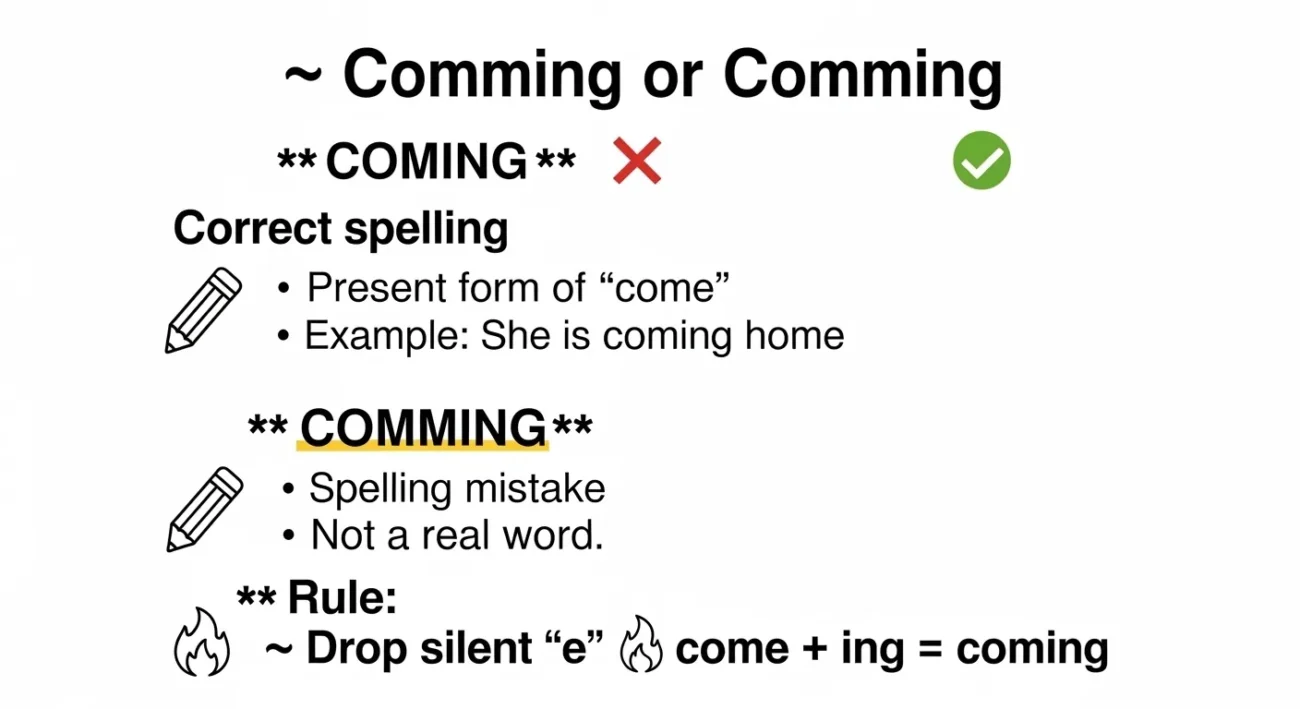
The Short answer is : Coming is correct; comming is a spelling mistake. I see this error all the time, even in emails and posts. Many people search “comming or coming” because English spelling can feel confusing. When we hear the word, it sounds like it has two “m” letters. So we type comming by mistake. I used to pause and think about it too.
This confusion usually happens when we add -ing to a verb. In this article, I will clearly explain the right spelling, the rule behind it, common mistakes, examples, usage data, and how to never get it wrong again.
Comming or Coming: Quick Answer
The correct spelling is coming.
Comming is incorrect.
✅ She is coming home.
❌ She is comming home.
The base word is come. When we add -ing, we remove the final e and add -ing.
Come → Coming
Not → Comming
There is only one “m”.
The Origin of Coming or Comming
The word come is very old. It comes from Old English cuman. Over time, spelling became more fixed.
In English, when a verb ends in silent e, we drop the e before adding -ing:
- Make → Making
- Take → Taking
- Come → Coming
We do not double the consonant here because the rule for doubling applies differently.
We double a consonant when:
- The word ends in one vowel + one consonant
- The stress is on the last syllable
Example:
- Run → Running
- Sit → Sitting
But come does not follow that pattern. So we write coming, not comming.
British English vs American English Spelling
Good news: there is no difference between British and American spelling for this word.
Both use coming.
| Version | Correct Spelling | Incorrect |
| American English | coming | comming |
| British English | coming | comming |
| Australian English | coming | comming |
This makes it easy. No regional confusion here.
Which Spelling Should You Use?
You should always use coming.
If you write for:
- 🇺🇸 US audience → Coming
- 🇬🇧 UK audience → Coming
- 🌍 Global readers → Coming
There is no situation where comming is correct.
If you type comming, spell check will usually mark it as wrong. That is your warning sign.
Common Mistakes with Comming or Coming
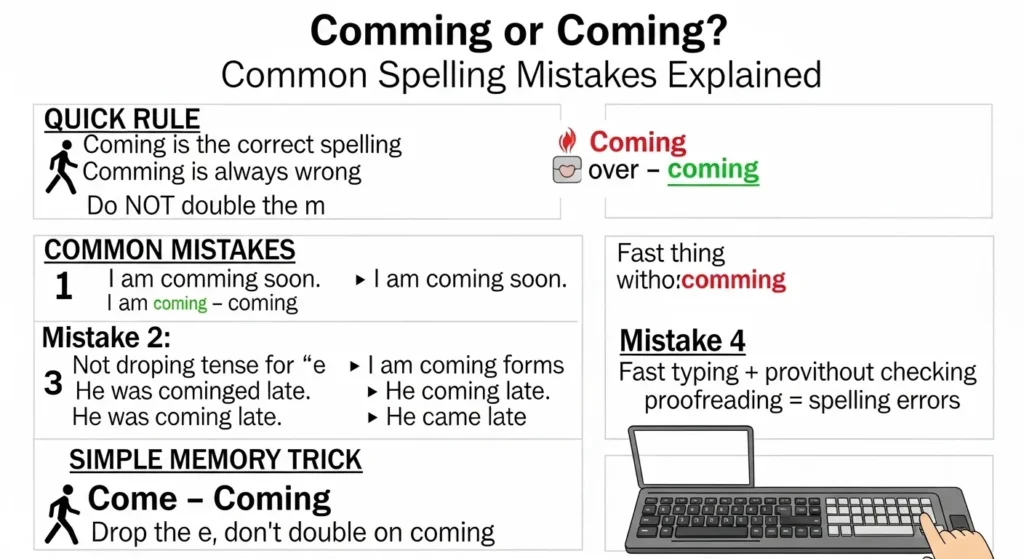
Here are mistakes I often see:
Mistake 1: Doubling the “m”
❌ I am comming soon.
✅ I am coming soon.
Mistake 2: Not dropping the “e”
❌ I am comeing soon.
✅ I am coming soon.
Mistake 3: Mixing past tense forms
❌ He was cominged late.
✅ He was coming late.
✅ He came late.
Mistake 4: Typing fast without checking
Sometimes people just type fast and don’t proofread.
Comming or Coming in Everyday Examples
Here is how we use coming in real life:
In Emails
“I am coming to the meeting at 3 PM.”
In News
“A new policy is coming next month.”
On Social Media
“Big update coming soon!”
In Formal Writing
“The results are coming in stages.”
In Daily Conversation
“I am coming home.”
“Winter is coming.”
It is used everywhere. That is why correct spelling matters.
Comming or Coming: Google Trends & Usage Data
Search data shows many people type “comming or coming” every month. This means the confusion is common.
Countries where people search this:
- India
- Pakistan
- United States
- Philippines
Most searches come from:
- Students
- ESL learners
- Content writers
However, in published books and official writing, coming appears millions of times.
Comming almost never appears unless it is a typo.
Comparison Table Comming vs Coming
Here is a clear side-by-side view:
| Word | Status | Meaning | Correct? |
| Coming | Correct | Moving toward | ✅ Yes |
| Comming | Incorrect | No meaning | ❌ No |
Rule Reminder:
| Base Verb | + ing Form |
| Come | Coming |
| Make | Making |
| Run | Running |
Notice the pattern difference.
FAQs
1. Is comming ever correct?
No. It is always wrong.
2. Why do people write comming?
Because they think the “m” should double.
3. Why don’t we double the “m” in coming?
Because the spelling rule does not require doubling here.
4. What is the past tense of come?
The past tense is came.
5. What is the past participle of come?
It is come (I have come).
6. Is coming used as a noun?
Yes. Example: “His coming was unexpected.”
7. Is coming used in future meaning?
Yes. Example: “The exam is coming.”
Conclusion
Coming is correct. Comming is wrong. That is the simple truth. I know English spelling can confuse us, especially when words sound different from how they look. But once I understood the rule drop the silent “e” and add “-ing” it became easy. There is no regional difference. There is no special exception. If you remember this small rule, you will never make this mistake again. When in doubt, think of other words like making and taking.
Follow the same pattern. Good spelling builds trust and clarity. One small letter can change how professional your writing looks. So next time you type this word, pause for one second and choose coming.

I am Sidney Greenbaum, a linguist who studied how English is actually used, not just how it is taught. I analyzed sentence structure and word differences to make English clearer and more practical. My research helped learners understand real-world English comparisons.