

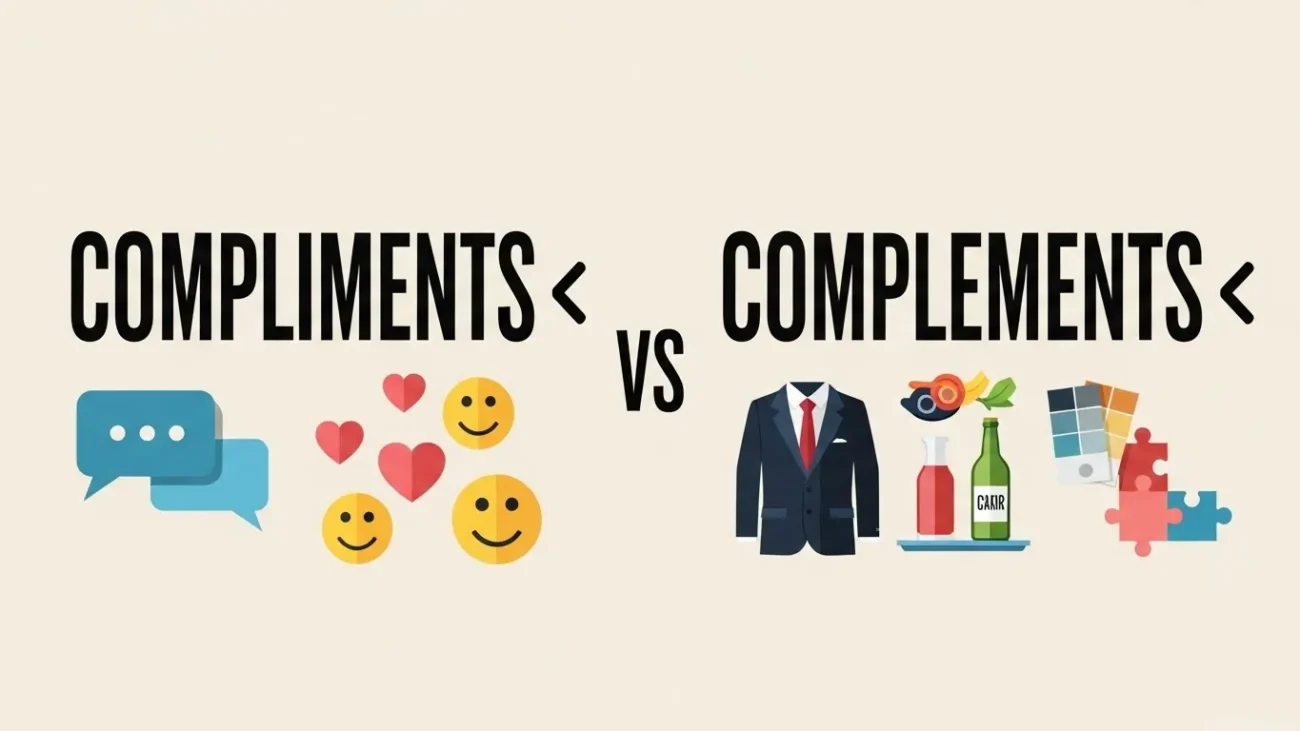
I still remember getting confused between “complements” and “compliments,” and honestly, it almost embarrassed me.
I’d seen students, writers, even professionals use the wrong one in emails and social media, so I assumed both worked the same.
I realized how just one wrong letter can completely change a sentence’s meaning. The confusion makes sense both words sound identical, look similar, and appear in daily English. That’s why I decided to clear this once and for all.
In this article, I’ll give you a quick answer, explain where each word comes from, share real-life examples, and help you choose the right one with confidence every time.
Complements or Compliments : Quick Answer
Compliments are kind words or praise you give to someone.
Complements are things that complete or go well with something else.
Examples:
- She gave me a lovely compliment on my writing.
- The blue tie complements his suit perfectly.
If it’s about praise, use compliments.
If it’s about matching or completing, use complements.
The Origin of Complements or Compliments
Both words come from the Latin word complēre, which means “to fill” or “to complete.” Over time, English split this idea into two meanings.
- Complement kept the meaning of completion. It refers to something that completes or enhances another thing.
- Compliment developed a social meaning. It came to mean polite praise or admiration.
The spelling difference e vs i evolved to separate these meanings clearly. Even though they sound the same, English uses spelling to signal intent.
British English vs American English Spelling
Here’s the good news: British English and American English use the same spellings for both words. The confusion is not regional it’s semantic.
| Word | British English | American English | Meaning |
| Complement | Complement | Complement | Completes or matches |
| Compliment | Compliment | Compliment | Praise or admiration |
Unlike words such as colour/color, there is no spelling variation here only meaning.
Which Spelling Should You Use?
Choose based on context, not country.
- US audience: Use compliment for praise, complement for completion.
- UK/Commonwealth audience: Same rule applies.
- Global or professional writing: Be precise. Editors notice this mistake quickly.
Quick tip I use:
- “I like it” → Compliment (I for I like)
- “It fits together” → Complement
Common Mistakes with Complements or Compliments
Here are mistakes I see most often:
- ❌ She complements my work.
✅ She compliments my work. - ❌ Your shoes are a nice compliment to your dress.
✅ Your shoes are a nice complement to your dress. - ❌ Using compliments when talking about design or food pairings.
✅ Use complements for matching items.
Rule:
People get compliments.
Things give complements.
Learn More: Filing or Filling: Common Writing Error
Complements or Compliments in Everyday Examples
Emails
- Thank you for the compliment on my presentation.
- This chart complements the written report.
News
- The minister received compliments for the new policy.
- The new law complements existing regulations.
Social Media
- Your post deserves so many compliments!
- That filter really complements your photo.
Formal Writing
- Peer compliments were recorded during the review.
- The appendix complements the main research.
Complements or Compliments : Google Trends & Usage Data
Search data shows that “compliments” is searched more often than “complements.” This is because people talk about praise more than matching objects.
- Compliments: Popular in personal, social, and workplace contexts.
- Complements: Common in fashion, food, design, grammar, and science.
By country:
- US, UK, Canada, Australia: High confusion searches.
- Students and ESL learners: Frequently search comparisons like “complements vs compliments.”
This proves users want a quick answer plus clear examples exactly what this guide provides.
Complements vs Compliments : Comparison Table
| Feature | Complement | Compliment |
| Meaning | Completes or enhances | Praise or admiration |
| Used for | Things, ideas, systems | People, work, appearance |
| Verb use | This color complements blue | She complimented my skills |
| Noun use | A perfect complement | A kind compliment |
| Memory tip | Complete | Praise |
FAQs About Complements or Compliments
1. What is the main difference between complements and compliments?
Compliments are praise. Complements complete or match something.
2. Can complements and compliments be used as verbs?
Yes. She complimented me. / The sauce complements the dish.
3. Which one is more commonly used?
Compliments are more common in daily conversation and writing.
4. Is one spelling British and the other American?
No. Both spellings are used the same way in all English varieties.
5. How can I remember the difference easily?
Think “I like it” = compliment.
Think “It completes” = complement.
6. Can a person be a complement?
Yes, in formal usage: She is a perfect complement to the team.
7. Are these homophones?
Yes. They sound the same but have different meanings and spellings.
Conclusion
The confusion between complements or compliments is common, but it doesn’t have to be a problem anymore.
Once you understand the core difference praise versus completion the choice becomes simple. I always remind myself that people receive compliments, while things provide complements.
There is no British or American spelling divide here, only a meaning based one. Using the correct word improves clarity, professionalism, and confidence in writing.
You’re sending an email, posting on social media, writing a blog, or working on formal documents, this distinction matters.
Mastering small details like this makes your English stronger and more precise. With the examples, tables, and tips in this guide, you now have everything you need to use both words correctly every time.

I am Mark Twain, a writer who loved the English language for its humor, irony, and everyday comparisons. I used simple words to show deep differences between truth and lies, wisdom and foolishness. My writing proves that clear English is always more powerful than complicated English.