

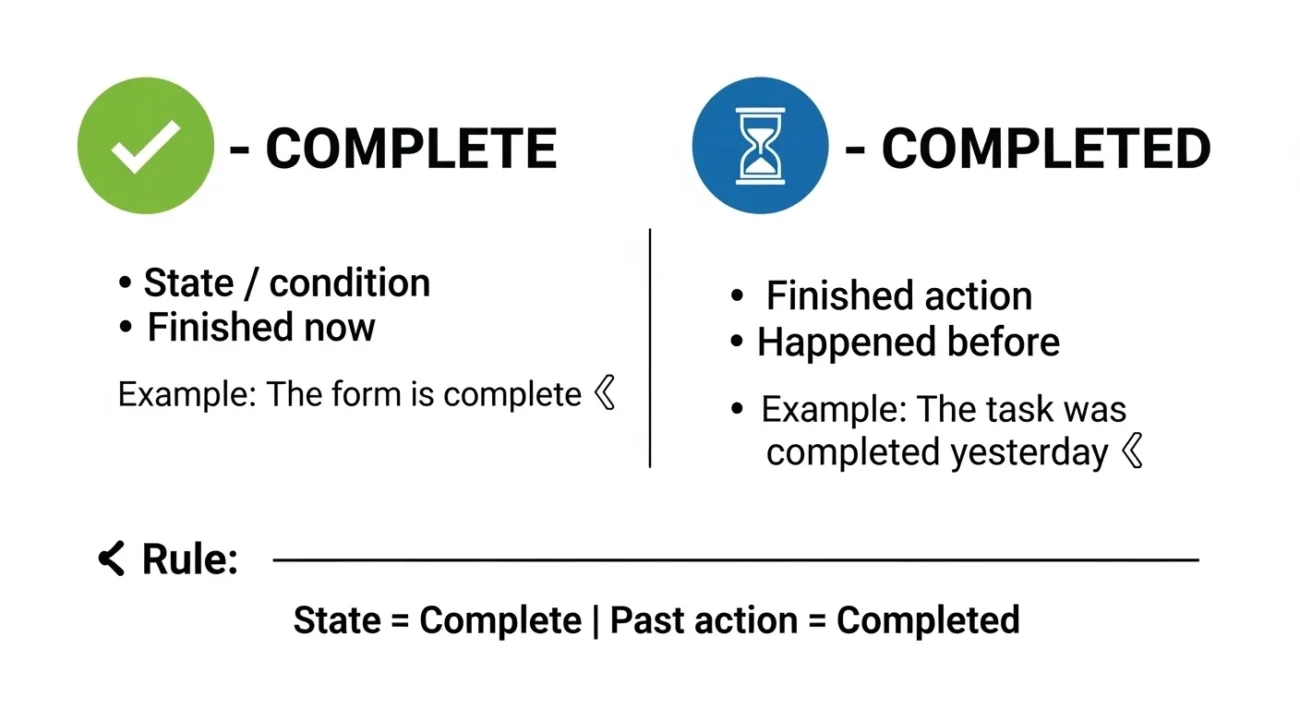
Complete or completed? Here’s the Short answer: complete describes something that is whole or finished now, while completed shows that an action was finished in the past.
I remember writing a report line “The task is completed” then stopping to wonder if complete would sound better. That pause is exactly why people search complete or completed. These words come from the same root, look interchangeable, and often appear in similar sentences. But they don’t always do the same job.
In this article, I’ll break the confusion clearly. I’ll explain meaning, origin, usage, common mistakes, examples, and practical guidance so you always choose the right word with confidence.
Complete or Completed: Quick Answer
Complete = finished, whole, or having all parts.
Completed = an action that has already been finished.
Correct examples:
- The form is complete.
- The project was completed yesterday.
Wrong example:
- ❌ The work is completed now.
✅ The work is complete now.
If you’re describing a state, use complete.
If you’re describing a finished action, use completed.
The Origin of Complete and Completed
Understanding the background helps me remember usage easily.
Complete
- Comes from Latin completus, meaning filled up or finished.
- Used as an adjective and a verb.
- Focuses on the condition or state.
Example:
- The set is complete.
Completed
- Is the past participle form of the verb complete.
- Focuses on the action being finished.
- Often appears with time references.
Example:
- The assignment was completed on Monday.
The confusion happens because both relate to “finishing,” but from different angles.
British English vs American English Usage
Here’s something important: both British and American English use completed and complete the same way.
There is no spelling difference only grammatical role matters.
Comparison Table Completed vs Complete
| Context | Complete | Completed |
| Describing current state | ✅ | ❌ |
| Talking about past action | ❌ | ✅ |
| Used as adjective | Yes | Yes |
| Used as verb | Yes | No |
So the choice depends on time and function, not region.
Which One Should You Use?
I always decide by asking one simple question:
👉 Am I describing a condition or an action?
- Use complete when something is whole, finished, or ready.
- Use completed when emphasizing that someone finished something earlier.
Audience-based guidance
- Formal writing: Be precise wrong choice sounds careless.
- Instructions or checklists: Complete works better.
- Reports or updates: Completed fits past progress.
Clarity improves when the verb tense matches the message.
Common Mistakes with Complete or Completed
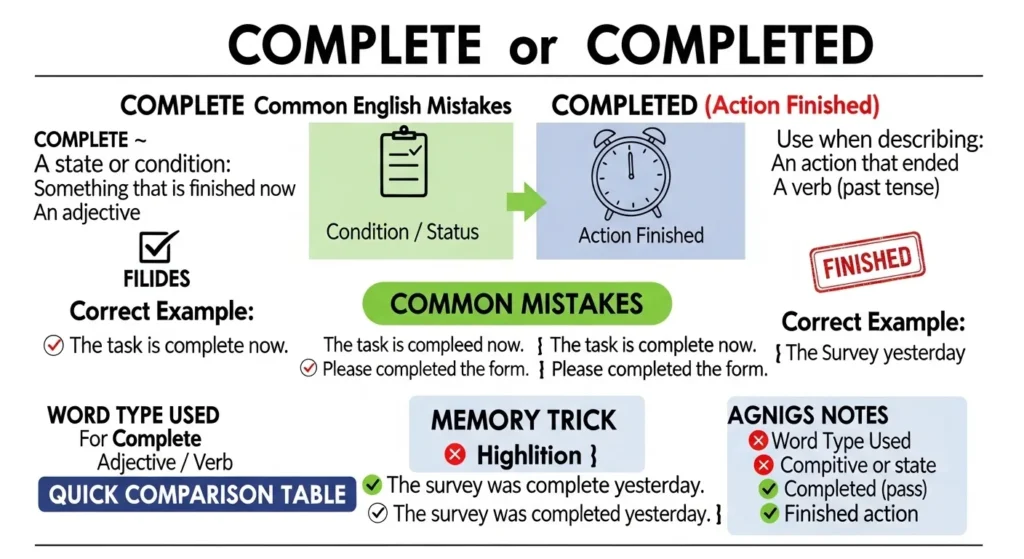
These errors appear often in everyday writing.
Mistake 1
❌ The task is completed now.
✅ The task is complete now.
Mistake 2
❌ Please completed the form.
✅ Please complete the form.
Mistake 3
❌ The survey was complete yesterday.
✅ The survey was completed yesterday.
Memory trick I use:
- Complete = condition
- Completed = action finished
Completed or Complete in Everyday Examples
Emails
- The file is complete.
- I completed the work this morning.
News
- The bridge is nearly complete.
- The investigation was completed last week.
Social Media
- Workout complete!
- I finally completed the challenge.
Formal Writing
- The application must be complete.
- Data collection was completed successfully.
Both words are correct when used in the right role.
Complete or Completed: Google Trends & Usage Data
From general usage patterns:
- Complete appears more in instructions, requirements, and descriptions.
- Completed appears more in reports, timelines, and progress updates.
- Learners often mix them when describing present situations.
Most searches happen because writers are unsure whether to focus on status or action.
Complete vs Completed: Side-by-Side Comparison
| Feature | Complete | Completed |
| Part of speech | Adjective / Verb | Past participle |
| Focus | State or condition | Finished action |
| Time reference | Present | Past |
| Common error | Used for past actions | Used for present state |
| Formal correctness | Yes | Yes |
FAQs: Complete or Completed
1. Is “the task is completed” wrong?
Not wrong, but “the task is complete” sounds more natural for present state.
2. Can completed be an adjective?
Yes, but it still refers to a finished action.
3. Which one is better in instructions?
Complete, because it describes requirement.
4. Can I say “form completed”?
Yes, especially when referring to past action.
5. Is complete always present tense?
Mostly, but it can also be a verb.
6. Which sounds more formal?
Both are equally formal when used correctly.
7. How do I avoid confusion quickly?
Ask whether you’re talking about now or before.
Conclusion
I’ve learned that complete or completed is not about complexity it’s about perspective. Complete tells the reader about the current state of something. Completed tells them about an action that ended earlier. Mixing them doesn’t usually break grammar, but it does blur meaning. Clear writing depends on choosing words that match time and intention.
I now pause, ask one simple question state or action? and the answer becomes obvious. Mastering this small distinction makes your writing sharper, clearer, and more professional every time.

I am Michael Swan, an English grammarian known for explaining confusing grammar and word comparisons in a clear way. I focused on real usage, not just rules, helping learners understand why English works the way it does. My work simplifies complex language problems for everyday users.