Could or can? Here’s the answer right away: can shows ability, certainty, or permission, while could shows possibility, politeness, or a softer tone.
I remember writing an email that said, “Can you help me with this?” Then I stopped and rewrote it as “Could you help me with this?” The meaning stayed similar, but the tone felt completely different. That small shift is exactly why people search could or can.
These two words look interchangeable, yet they quietly change how confident, polite, or realistic a sentence sounds. This article clears the confusion fully. I’ll explain meanings, origins, usage, common mistakes, examples, and practical advice so you always choose the right one without hesitation.
Could or Can: Quick Answer
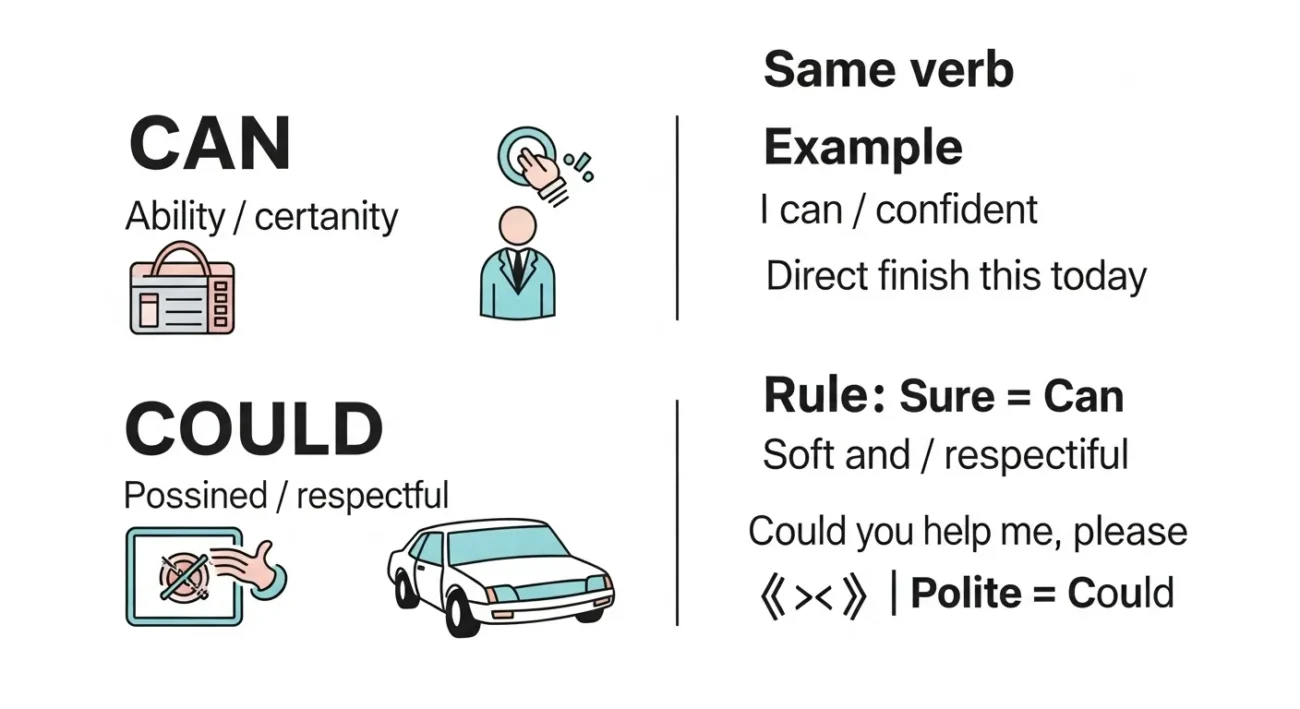
Can = ability, certainty, or direct permission.
Could = possibility, politeness, or hypothetical situations.
Correct examples:
- I can finish this today.
- Could you help me for a moment?
Wrong example:
- ❌ I could swim when I was five.
✅ I could swim when I was five. (Correct past ability)
If you want to sound direct, use can.
If you want to sound polite or unsure, use could.
The Origin of Could and Can
Understanding the history helped me stop guessing.
Can
- Comes from Old English cunnan, meaning to know or be able.
- Always connected with ability or permission.
- Strong, confident, and direct.
Example:
- I can solve this problem.
Could
- Is the past tense form of can.
- Over time, it also began expressing possibility and politeness.
- Softer and less direct.
Example:
- I could help later.
That shift from time-based meaning to tone-based meaning is what causes confusion.
British English vs American English Usage
Here’s something important: both British and American English use can and could in the same way.
There is no spelling difference only tone and context matter.
Comparison Table of Can vs Could
| Context | Can | Could |
| Ability | Yes | Past ability |
| Permission | Direct | Polite |
| Possibility | Rare | Common |
| Requests | Casual | Polite |
So if something feels “too strong” or “too soft,” the choice between can and could is usually why.
Which One Should You Use?
I decide by asking one simple question:
👉 Am I being certain or considerate?
- Use can when you are sure, confident, or stating facts.
- Use could when you want to sound polite, respectful, or uncertain.
Audience based guidance
- Friends or casual chat → can
- Emails, requests, or favors → could
- Formal or sensitive situations → could
Tone matters as much as grammar.
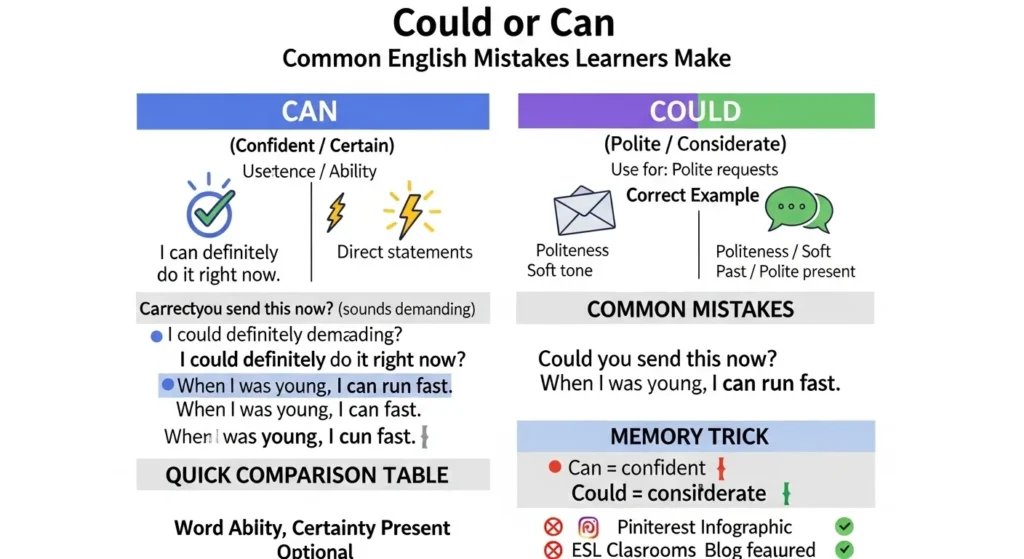
Common Mistakes with Could or Can
These mistakes appear everywhere.
Mistake 1: Using “can” when politeness is needed
❌ Can you send this now?
✅ Could you send this now?
Mistake 2: Using “could” for present certainty
❌ I could definitely do it right now.
✅ I can definitely do it right now.
Mistake 3: Confusing past ability
❌ When I was young, I can run fast.
✅ When I was young, I could run fast.
Memory trick I use:
- Can = confident
- Could = considerate
Could or Can in Everyday Examples
Emails
- Could you please review this?
- I can send the file today.
News
- The policy could affect millions.
- The team can win the match.
Social Media
- I can’t believe this happened.
- This could change everything.
Formal Writing
- These results could indicate a trend.
- The system can handle high demand.
Each choice shapes how strong or cautious the statement feels.
Can or Could: Google Trends & Usage Data
From general usage patterns:
- Can appears more often in direct statements and everyday speech.
- Could appears frequently in polite requests and speculative writing.
- Learners often search this pair to avoid sounding rude or unsure.
People aren’t confused about grammar they’re worried about tone. And that’s a smart concern.
Could vs Can: Side-by-Side Comparison
| Feature | Can | Could |
| Strength | Strong | Soft |
| Certainty | High | Lower |
| Politeness | Neutral | Polite |
| Time reference | Present | Past or hypothetical |
| Common use | Facts, ability | Requests, possibilities |
FAQs: Could or Can
1. Is could more polite than can?
Yes. Could sounds softer and more respectful.
2. Can could replace can everywhere?
No. It weakens certainty in factual statements.
3. Which should I use in questions?
Use could for politeness, can for casual tone.
4. Is could only past tense?
No. It also shows possibility and politeness.
5. Can I say “Could I ask a question?”
Yes. It’s very polite.
6. Is can rude?
Not rude but it can sound blunt in formal situations.
7. Which one is better in professional writing?
Often could, especially for suggestions or requests.
Conclusion
I’ve learned that choosing between could or can isn’t about right or wrong it’s about intention. Can shows confidence, certainty, and ability. Could shows politeness, possibility, and respect. The words are small, but the tone shift is powerful.
I now pause before choosing and ask myself, Do I want to sound sure or gentle? That one question makes the answer clear every time. When you master this pair, your writing becomes not just correct but thoughtful, natural, and effective.

I am Sidney Greenbaum, a linguist who studied how English is actually used, not just how it is taught. I analyzed sentence structure and word differences to make English clearer and more practical. My research helped learners understand real-world English comparisons.