

I still remember pausing at my keyboard, unsure whether discretely or discreetly was correct.
That hesitation showed me why so many people search for discretely or discreetly online.
Both words look almost identical, sound similar, and even share the same root, which confused me too.
I’ve seen this mistake happen in emails, professional messages, academic writing, and social posts, where the wrong choice can completely change meaning. Spellcheck doesn’t always help because both are real words.
In this article, I clear the confusion with a quick answer, simple origins, real examples, and clear guidance so you can confidently choose discretely or discreetly every time.
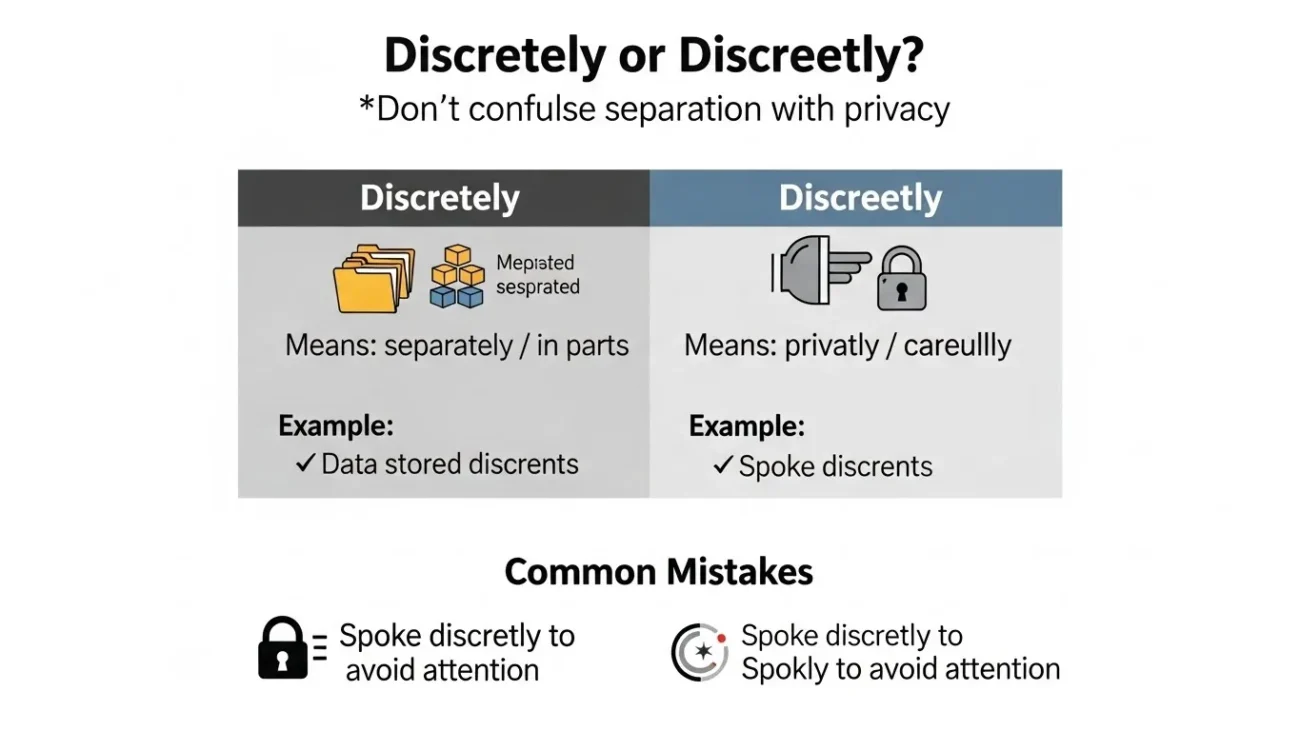
Discretely or Discreetly: Quick Answer
- Discretely means separately, individually, or in distinct parts.
- Discreetly means carefully, privately, or without drawing attention.
Examples:
- ✅ The data was stored discretely in separate files.
- ✅ She spoke discreetly to avoid being heard.
- ❌ She spoke discretely to avoid being heard.
A simple rule:
👉 Discreetly = secrecy or privacy
👉 Discretely = separation or distinction
The Origin of Discretely or Discreetly
Both words come from the Latin root discretus, meaning “separated” or “distinguished.” Over time, English developed two related but distinct meanings from the same root.
- Discreet evolved to describe careful judgment, tact, and privacy.
- Discrete evolved to describe things that are separate or distinct.
As English developed, each adjective gained its own adverb form:
- discreet → discreetly
- discrete → discretely
The confusion exists because the words look nearly identical and share historical roots, but modern English treats them as separate ideas with different meanings.
British English vs American English Spelling
British and American English do not differ in spelling or meaning for these words.
Both use:
- discretely (separately)
- discreetly (privately)
Comparison Table
| Word | British English | American English | Meaning |
| discretely | ✅ Correct | ✅ Correct | Separately |
| discreetly | ✅ Correct | ✅ Correct | Privately |
| discreet | ✅ Correct | ✅ Correct | Careful, tactful |
| discrete | ✅ Correct | ✅ Correct | Separate |
There is no regional variation only a meaning difference.
Which Spelling Should You Use?
Choosing the right word depends on what you want to say, not where your audience is.
Use discretely when:
- Talking about separation
- Referring to distinct parts
- Discussing data, numbers, or categories
Use discreetly when:
- Talking about privacy or secrecy
- Describing careful behavior
- Referring to sensitive situations
Audience-based guidance
- Professional writing: Be precise this mistake is noticeable
- Academic writing: Use discrete/discretely for technical contexts
- Emails & messages: Use discreetly for privacy or tact
- SEO content: Choose correctly to avoid misleading readers
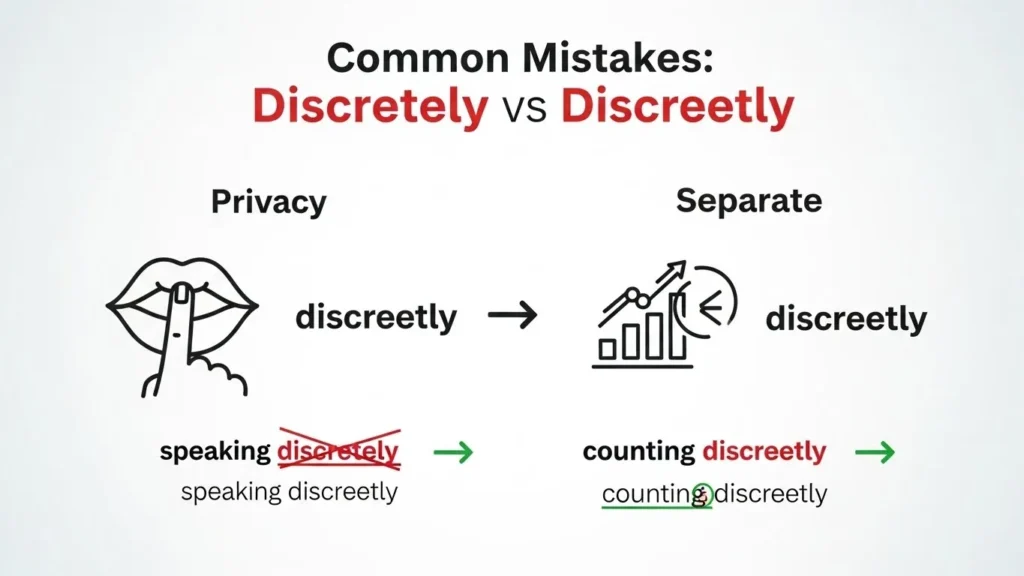
Common Mistakes with Discretely or Discreetly
Here are frequent errors I see:
❌ She asked discretely about the issue
✅ She asked discreetly about the issue
❌ The files were saved discreetly
✅ The files were saved discretely
❌ He handled the matter discretely to avoid attention
✅ He handled the matter discreetly to avoid attention
❌ The data points were treated discreetly
✅ The data points were treated discretely
Most mistakes happen when writers confuse privacy with separation.
Learn More :Somebody or Someone: Which One Should You Use?
Discretely or Discreetly in Everyday Examples
Emails
- ✅ “Please discuss this discreetly with the client.”
- ❌ “Please discuss this discretely with the client.”
News
- ✅ “The investigation was conducted discreetly.”
- ❌ “The investigation was conducted discretely.”
Social Media
- ✅ “I’ll message you discreetly later.”
- ❌ “I’ll message you discretely later.”
Formal Writing
- ✅ “The variables were analyzed discretely.”
- ❌ “The variables were analyzed discreetly.”
Discretely or Discreetly: Google Trends & Usage Data
Search trends show that “discretely or discreetly” is a common confusion keyword, especially among students, professionals, and non-native English writers. The error often appears in:
- Business emails
- Academic papers
- Legal writing
- Technical documentation
Native English sources show clear separation:
- Discretely appears more in technical, scientific, and mathematical contexts
- Discreetly appears more in social, professional, and emotional contexts
This confirms that both words are widely used but only in their correct contexts.
Comparison Table: Discretely vs Discreetly
| Word | Meaning | Correct Usage Example |
| discretely | Separately | Data stored discretely |
| discreetly | Privately | Speak discreetly |
| discrete | Separate | Discrete categories |
| discreet | Tactful | A discreet person |
FAQs: Discretely or Discreetly
1. Are discretely and discreetly interchangeable?
No. They have different meanings.
2. Which word means “privately”?
Discreetly.
3. Which word means “separately”?
Discretely.
4. Do British and American English differ here?
No. Both use the same forms.
5. Is this mistake common in professional writing?
Yes, and it’s very noticeable.
6. Can spellcheck catch this error?
Usually no, because both are correct words.
7. How can I remember the difference?
Think: discreet = secret (both relate to privacy).
Conclusion
The confusion between discretely and discreetly is understandable because the words look alike and share a common origin.
But their meanings are clearly different, and using the wrong one can change your message entirely. Discreetly is about privacy, care, and avoiding attention. Discretely is about separation and distinct parts.
Once you link discreetly with secret and discretely with distinct, the difference becomes much easier to remember. Mastering this small distinction instantly improves clarity and professionalism in your writing.
English is full of tricky word pairs, but this is one you can now use with confidence. Pause, think about meaning, and choose the right word your readers will notice the difference.

I am Sidney Greenbaum, a linguist who studied how English is actually used, not just how it is taught. I analyzed sentence structure and word differences to make English clearer and more practical. My research helped learners understand real-world English comparisons.