

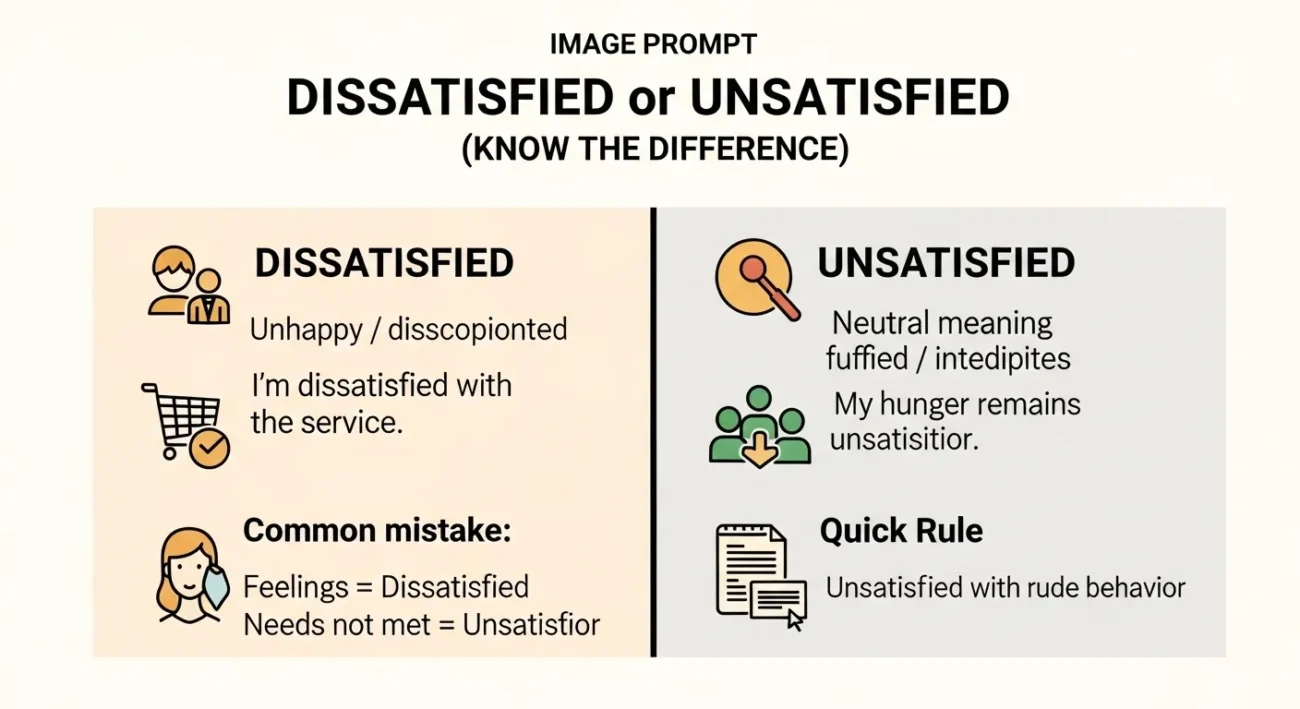
Dissatisfied or unsatisfied? Here’s the Short answer: dissatisfied means unhappy or disappointed, while unsatisfied means not fulfilled or not completed.
I remember stopping mid-sentence while writing feedback for a service: “I am unsatisfied with the support.” It sounded okay but did it really match how I felt? That pause is exactly why people search dissatisfied or unsatisfied. These words look similar, feel interchangeable, and often appear in the same situations. But they don’t mean the same thing.
This guide clears the confusion in a simple way. I’ll walk you through meanings, origins, examples, common mistakes, and usage so you always pick the right word with confidence.
Dissatisfied or Unsatisfied: Quick Answer
Dissatisfied = unhappy, disappointed, or displeased.
Unsatisfied = not fulfilled, not met, or incomplete.
Correct examples:
- I was dissatisfied with the customer service.
- My curiosity remains unsatisfied.
Wrong example:
- ❌ I am unsatisfied with the rude behavior.
If emotions are negative, use dissatisfied.
If something is incomplete or unmet, use unsatisfied.
The Origin of Dissatisfied and Unsatisfied
Understanding where words come from helps me remember how to use them.
Dissatisfied
- Comes from Latin dis (apart) + satisfacere (to satisfy).
- Literally means not satisfied in a displeased way.
- Carries an emotional tone often frustration or disappointment.
Unsatisfied
- Comes from un (not) + satisfied.
- Means something is still lacking or unfinished.
- Neutral in tone, not always emotional.
That emotional vs neutral difference is the real reason confusion exists.
British English vs American English Spelling
Good news again: both British and American English use the same spellings and meanings.
There is no regional spelling change only usage based on context.
Comparison Table of Unsatisfied vs Dissatisfied
| Context | Correct Word | US English | UK English |
| Unhappy feeling | Dissatisfied | ✅ | ✅ |
| Need not fulfilled | Unsatisfied | ✅ | ✅ |
| Complaint or feedback | Dissatisfied | ✅ | ✅ |
| Desire still unmet | Unsatisfied | ✅ | ✅ |
So if you’re unsure, check the emotion, not the region.
Which Spelling Should You Use?
I decide this by asking one question:
👉 Am I talking about feelings or fulfillment?
- Use dissatisfied when expressing complaints, disappointment, or unhappiness.
- Use unsatisfied when something is incomplete, unfinished, or lacking.
Audience-based guidance
- Professional or formal writing: Choose carefully wrong usage sounds careless.
- Emails or reviews: Dissatisfied fits emotional responses.
- Academic or neutral writing: Unsatisfied works for unmet conditions or needs.
Common Mistakes with Dissatisfied or Unsatisfied
I see these errors constantly.
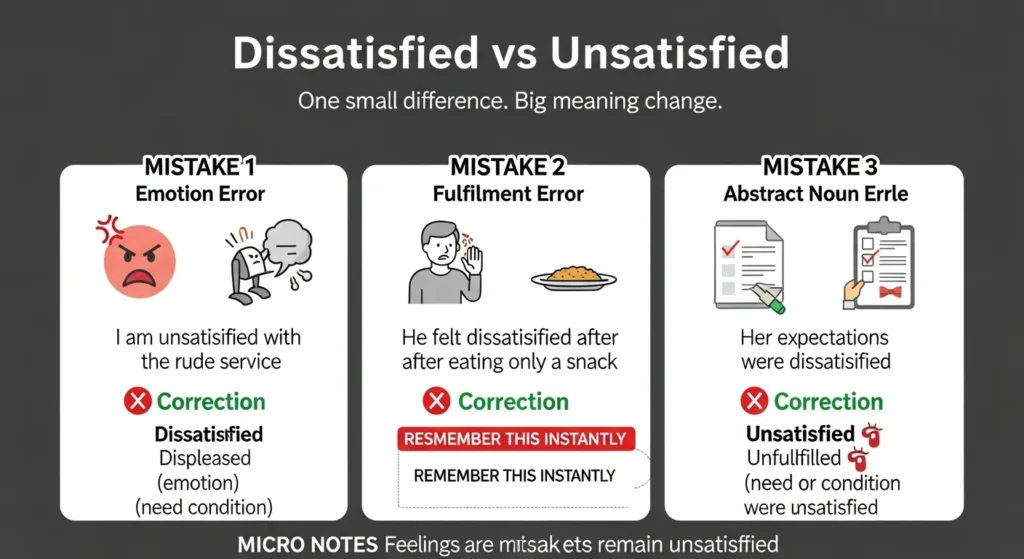
Mistake 1
❌ The customer was unsatisfied with the rude staff.
✅ The customer was dissatisfied with the rude staff.
Mistake 2
❌ He felt dissatisfied after eating only a snack.
✅ He felt unsatisfied after eating only a snack.
Mistake 3
❌ Her expectations were dissatisfied.
✅ Her expectations were unsatisfied.
Memory trick I use:
- Dissatisfied = Displeased
- Unsatisfied = Unfulfilled
Unsatisfied or Dissatisfied in Everyday Examples
Emails
- I am dissatisfied with the delayed response.
- The requirement remains unsatisfied.
News
- Voters are dissatisfied with current policies.
- Basic needs remain unsatisfied in rural areas.
Social Media
- Totally dissatisfied with this update.
- My hunger is still unsatisfied.
Formal Writing
- Participants expressed dissatisfaction with the process.
- Several conditions remained unsatisfied.
Dissatisfied or Unsatisfied: Google Trends & Usage Data
From usage patterns:
- Dissatisfied appears more in complaints, reviews, and feedback.
- Unsatisfied is common in academic, legal, and technical contexts.
- English learners often overuse unsatisfied for emotions, which causes errors.
In polished writing, this distinction matters. Readers may not point it out but they notice.
Dissatisfied vs Unsatisfied: Side-by-Side Comparison
| Feature | Dissatisfied | Unsatisfied |
| Emotional tone | Strong | Neutral |
| Used for feelings | Yes | Rarely |
| Used for needs | No | Yes |
| Common error | Confused with unsatisfied | Used for complaints |
FAQs: Dissatisfied or Unsatisfied
1. Can I use unsatisfied instead of dissatisfied?
Not when expressing unhappiness. Use dissatisfied for emotions.
2. Is unsatisfied grammatically correct?
Yes. It simply means not fulfilled.
3. Which word is stronger emotionally?
Dissatisfied carries stronger emotion.
4. Can a person be unsatisfied?
Yes, but it usually refers to unmet needs, not feelings.
5. Is dissatisfied negative?
Yes, it implies disappointment or displeasure.
6. Which word suits complaints better?
Always dissatisfied.
7. Are they interchangeable?
No. Meaning changes depending on context.
Conclusion
I’ve learned that choosing between dissatisfied or unsatisfied is about understanding intent, not memorizing rules. Dissatisfied speaks from emotion it tells the reader someone is unhappy or disappointed. Unsatisfied stays neutral it simply says something is incomplete or unmet. Mixing them up doesn’t break grammar, but it does weaken clarity.
In clear writing, small choices carry big weight. I always pause and ask: Is this about feelings or fulfillment? Once you do that, the right word becomes obvious. Master this difference, and your writing instantly sounds more confident and precise.

I am Mark Twain, a writer who loved the English language for its humor, irony, and everyday comparisons. I used simple words to show deep differences between truth and lies, wisdom and foolishness. My writing proves that clear English is always more powerful than complicated English.