

If you are confused between “doubts or Watson,” the quick answer is that “doubts” is a real English word, while “Watson” is a name and not a replacement for “doubts.”
I often see people mix these words because of typing mistakes or autocorrect. When I first noticed this confusion, I realized it usually happens when someone wants to write “doubts” but accidentally types something else.
These two words are completely different in meaning. One expresses uncertainty, and the other is a proper name.
In this guide, I will explain the difference, origin, common mistakes, examples, and how to use the correct word.
Doubts or Watson : Quick Answer
The difference between doubts and Dr. John Watson is very clear.
- Doubts: feelings of uncertainty
- Watson: a name (often linked to Sherlock Holmes stories)
Examples
- I have doubts about this plan.
- Watson helped solve the case.
Simple idea
- Doubts = confusion ❓
- Watson = person 👤
The Origin of Doubts and Watson
Doubts
The word “doubt” comes from Latin and French roots meaning “uncertainty” or “fear of something being wrong.” Over time, it became a common English word used in daily conversation.
Watson
The name Dr. John Watson became famous through Sherlock Holmes stories written by Arthur Conan Doyle. It is a proper noun, not a general English word.
British English vs American English Spelling
There is no spelling difference here.
| Word | American English | British English | Meaning |
| Doubts | Doubts | Doubts | Uncertainty |
| Watson | Watson | Watson | A name |
Which Spelling Should You Use?
Choosing between doubts or Watson depends on context.
Use “doubts” if:
- You mean uncertainty or confusion
- You are expressing lack of confidence
Use “Watson” if:
- You are talking about a person’s name
- You are referring to a character like Dr. John Watson
Common Mistakes with Doubts or Watson
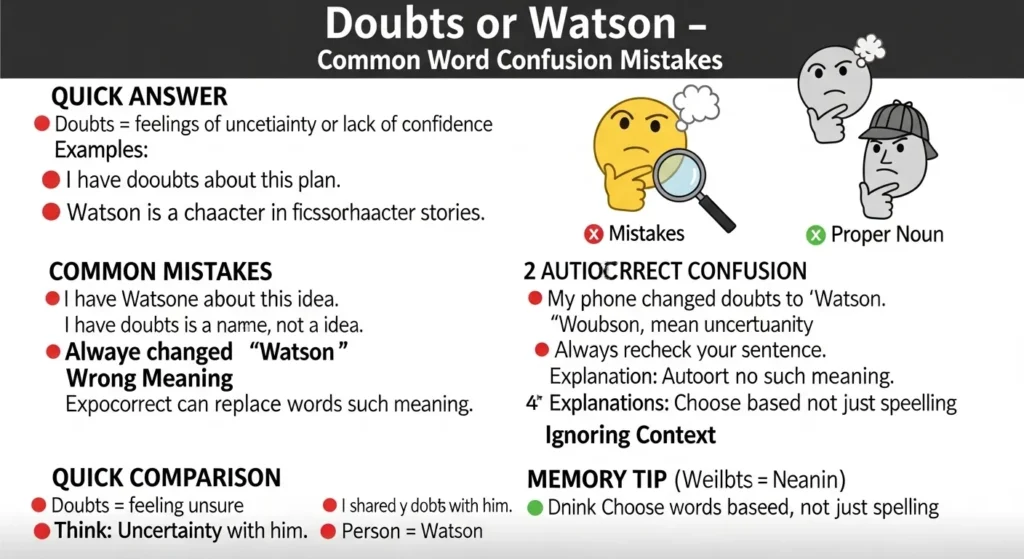
Mistake 1: Typing error
❌ I have Watson about this idea.
✅ I have doubts about this idea.
Mistake 2: Autocorrect confusion
❌ My phone changed doubts to Watson.
✅ Always recheck your sentence.
3) Mistake: Wrong meaning
❌ Watson means uncertainty.
✅ Doubts mean uncertainty.
Mistake 4: Ignoring context
❌ I shared my Watson with him.
✅ I shared my doubts with him.
Watson or Doubts in Everyday Examples
Daily conversation
- “I still have doubts about the result.”
Literature
- “Dr. John Watson assisted Sherlock Holmes.”
Writing
- Use doubts in emotional or thinking context
- Use Watson only as a name
Doubts or Watson : Usage & Popularity
- Doubts is widely used in daily language
- Watson is mainly used as a name or in literature
This confusion is rare and usually happens because of typing mistakes.
Comparison Table Doubts vs Watson
| Feature | Doubts | Watson |
| Type | Common noun | Proper noun |
| Meaning | Uncertainty | Name |
| Usage | Daily language | Names/characters |
| Context | Emotional/thinking | Person identity |
FAQs
1. Is Watson a synonym of doubts?
No, Watson is a name, not a synonym.
2. Why do people confuse doubts and Watson?
Mostly due to typing mistakes or autocorrect.
3. What does doubts mean?
It means uncertainty or lack of confidence.
4. Who is Watson?
A famous character from Sherlock Holmes stories.
5. Can Watson be used in normal sentences?
Only when referring to a name.
6. Which word is correct?
Both are correct, but used in different contexts.
7. How can I avoid mistakes?
Check spelling and understand the meaning before writing.
Conclusion
When I compare doubts or Watson, I clearly see that these two words are completely different and should never be confused. “Doubts” is a common English word used to express uncertainty, hesitation, or lack of confidence. It is widely used in everyday speaking and writing. On the other hand, “Watson” is a proper noun, mainly known as the name of a famous character in literature.
From my experience, this confusion usually happens because of typing errors or autocorrect. People often intend to write “doubts” but end up typing something incorrect. This can make a sentence confusing or even meaningless.
The best way to avoid this mistake is to always check the context. If your sentence is about feelings, uncertainty, or thinking, then “doubts” is the correct word. If you are talking about a person or a character, then “Watson” is correct.
In simple terms, doubts describe a feeling, while Watson is a name. Keeping this difference in mind will help you write clearly and correctly.

I am Sidney Greenbaum, a linguist who studied how English is actually used, not just how it is taught. I analyzed sentence structure and word differences to make English clearer and more practical. My research helped learners understand real-world English comparisons.