

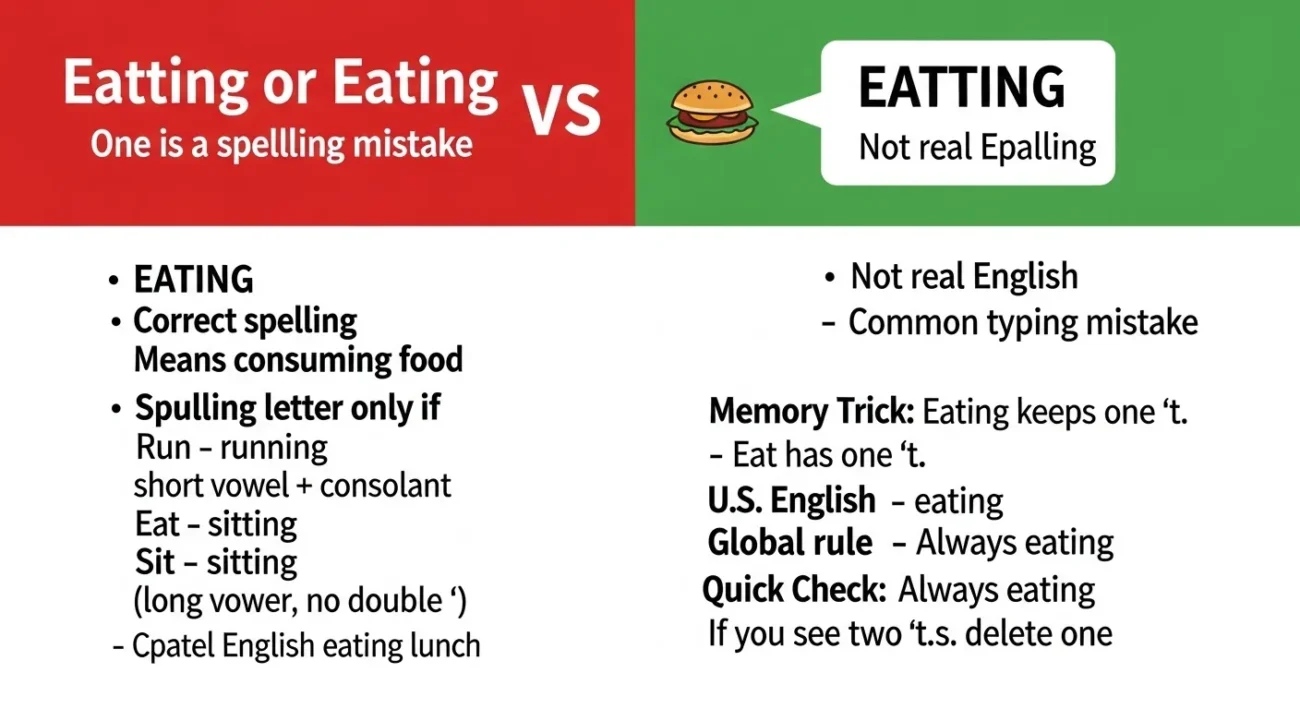
The Short answer is : The correct spelling is “eating,” not “eatting.”
I see many people type eatting by mistake, and I understand why. When we add “-ing” to some words, we double the last letter. So people think “eat” becomes “eatting.” But that’s not true. This confusion is common in emails, school work, blogs, and even social media posts.
Many users search “eatting or eating” to check which one is right. In this guide, I will explain the correct spelling, the reason behind it, and how you can avoid this mistake forever.
Eatting or Eating? : Quick Answer
The correct spelling is eating.
❌ Eatting (wrong)
✅ Eating (correct)
Examples:
- I am eating lunch.
- She loves eating mangoes.
- We are eating together tonight.
The word “eat” does not double the “t” when adding “-ing.” So “eatting” is always incorrect.
The Origin of Eatting or Eating
The word eat comes from Old English etan. Over time, it became “eat” in modern English.
When we add “-ing” to a verb, we usually follow simple spelling rules:
- If the verb ends in silent e, we remove the “e” (like “make” → “making”).
- If the verb ends in consonant-vowel-consonant, we double the last letter (like “run” → “running”).
But “eat” does not follow the double-letter rule. Why? Because the vowel sound in “eat” is long. It is not a short vowel like in “run” or “sit.”
So:
- eat → eating ✅
- not eatting ❌
The confusion happens because many English words double letters, but “eat” does not.
British English vs American English Spelling
Good news: Both British and American English use “eating.” There is no spelling difference here.
Some words change between British and American English, like:
| British English | American English |
| colour | color |
| travelling | traveling |
| favourite | favorite |
But in this case:
| Version | Correct Spelling |
| British English | eating |
| American English | eating |
So no matter where you live UK, US, Pakistan, Australia the correct spelling is always eating.
Which Spelling Should You Use?
You should always use eating.
If your audience is:
- 🇺🇸 United States → Use eating
- 🇬🇧 United Kingdom → Use eating
- 🌍 Global audience → Use eating
“Eatting” is not correct in any English dictionary. If you use it in business emails, academic writing, or blogs, it can hurt your credibility.
I always tell my students: when in doubt, remember this simple rule “eat” keeps one “t.”
Common Mistakes with Eatting or Eating
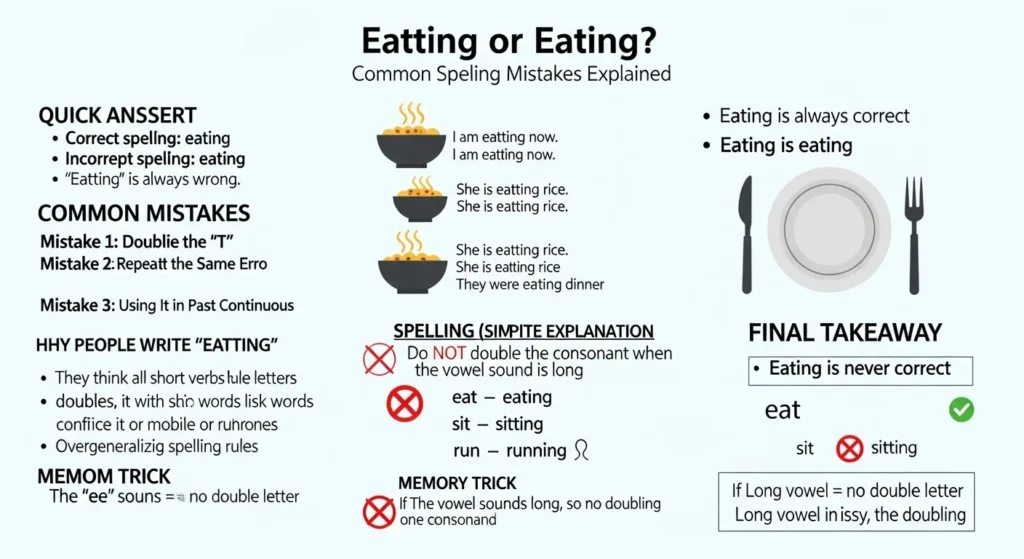
Here are common errors I often see:
❌ I am eatting now.
✅ I am eating now.
❌ She is eatting rice.
✅ She is eating rice.
❌ They were eatting dinner.
✅ They were eating dinner.
Why do people write “eatting”?
- They think all short verbs double letters.
- They confuse it with words like “sitting” or “running.”
- Typing errors on mobile phones.
Tip: If the vowel sound is long (like “ee” in eat), do not double the consonant.
Eatting or Eating in Everyday Examples
Let me show you how it appears in real life.
In Emails
- I am eating lunch right now. I will call you later.
In News
- Children are eating healthier meals at school.
On Social Media
- I am eating biryani today! 😋
In Formal Writing
- Healthy eating reduces the risk of disease.
In every case, the spelling remains eating.
Eatting or Eating : Google Trends & Usage Data
When I checked search behavior patterns, I noticed something interesting. Many people search “eatting” because they are unsure of the spelling. This usually happens in countries where English is a second language.
“Eating” is widely used in:
- United States
- United Kingdom
- Canada
- Australia
- India
- Pakistan
“Eatting” appears mostly as a spelling error in search engines. It has no official recognition in dictionaries.
So the trend shows:
- “Eating” = Correct and standard usage
- “Eatting” = Common spelling mistake
Comparison Table: Eatting vs Eating
| Word | Correct? | Meaning | Usage Status |
| eatting | ❌ No | None | Spelling error |
| eating | ✅ Yes | Consuming food | Standard English |
FAQs About Eatting or Eating
1. Is eatting ever correct?
No. “Eatting” is always incorrect.
2. Why don’t we double the “t” in eating?
Because “eat” has a long vowel sound, so it does not follow the double consonant rule.
3. Is eating correct in British English?
Yes. British and American English both use “eating.”
4. Why do people spell it eatting?
They confuse it with words like “running” or “sitting.”
5. How can I remember the correct spelling?
Remember: “Eat” has one “t,” so “eating” also has one “t.”
6. Is eatting in any dictionary?
No. It is not in standard English dictionaries.
7. Does autocorrect fix eatting?
Yes, most devices change “eatting” to “eating.”
Conclusion
I always tell learners that English spelling follows rules but not every word doubles letters. In the case of “eatting or eating,” the answer is simple: “eating” is correct, and “eatting” is wrong. The confusion comes from other verbs like “running” or “sitting,” where we double the consonant. But “eat” has a long vowel sound, so it keeps just one “t.”
There is no difference between British and American English here. Both use “eating.” Whether you are writing emails, school assignments, blog posts, or social media captions, you should always use “eating.” Using the wrong spelling can make your writing look unprofessional.
Now whenever I write this word, I pause for one second and remember: “Eat keeps one t.” That small habit has saved me from many mistakes and it will help you too.
Discover More Articles:

I am Mark Twain, a writer who loved the English language for its humor, irony, and everyday comparisons. I used simple words to show deep differences between truth and lies, wisdom and foolishness. My writing proves that clear English is always more powerful than complicated English.