

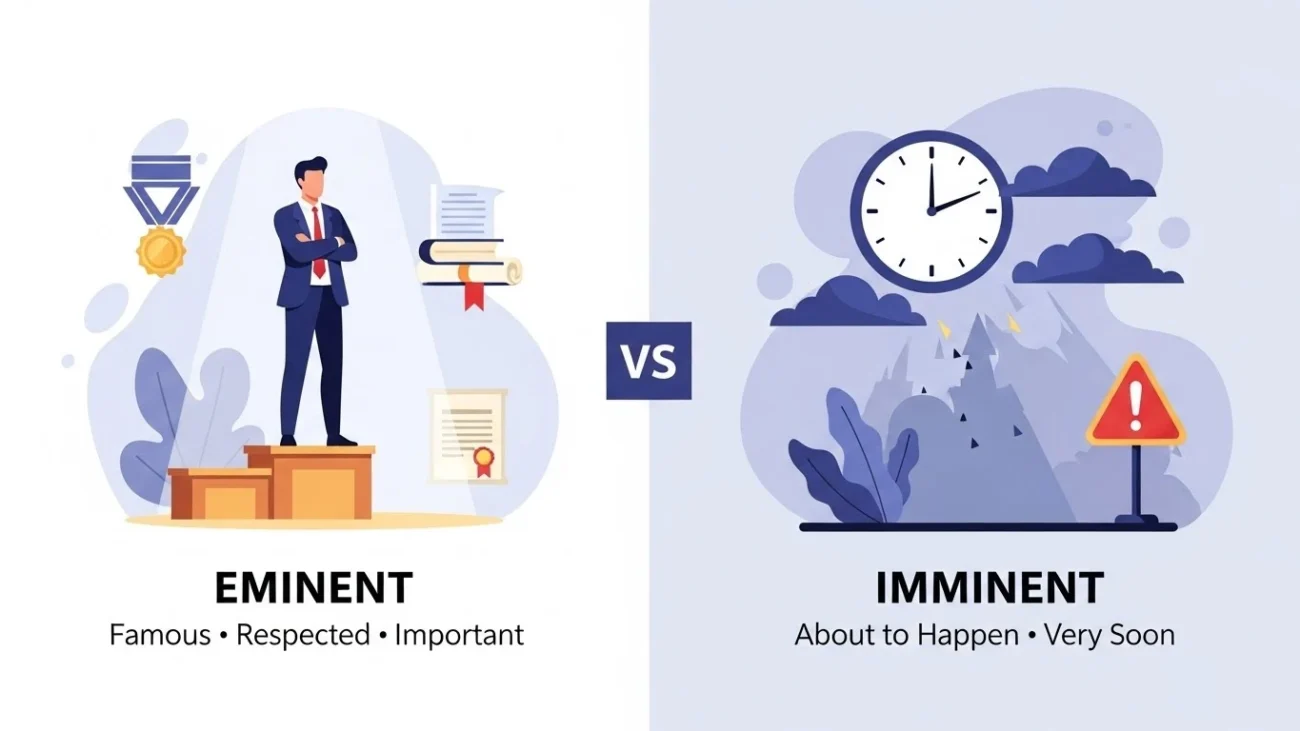
Many people search for eminent or imminent because these two words look and sound similar, yet their meanings are completely different.
I’ve often seen sentences like “The storm is eminent” or “She is an imminent doctor”. The spelling is close, but the meaning becomes wrong.
This confusion happens because both words come from Latin, both are adjectives, and both are used in formal writing.
However, one talks about importance, and the other talks about time. Mixing them up can change the message of your sentence and make your writing unclear or incorrect.
This article clears the confusion in a simple way. You’ll get a quick answer first, followed by word origins, usage rules, common mistakes, real life examples, trend insights, and expert advice.
By the end, you’ll clearly know when to use eminent and when imminent is the right choice.
Eminent or Imminent : Quick Answer
- Eminent → famous, respected, or important
- Imminent → about to happen very soon
Examples:
- She is an eminent scientist.
- A storm is imminent.
👉 Status or reputation → eminent
👉 Near future event → imminent
Learn More: Anticlimactic or Anticlimatic : Which One Is Correct and Why?
The Origin of Eminent or Imminent
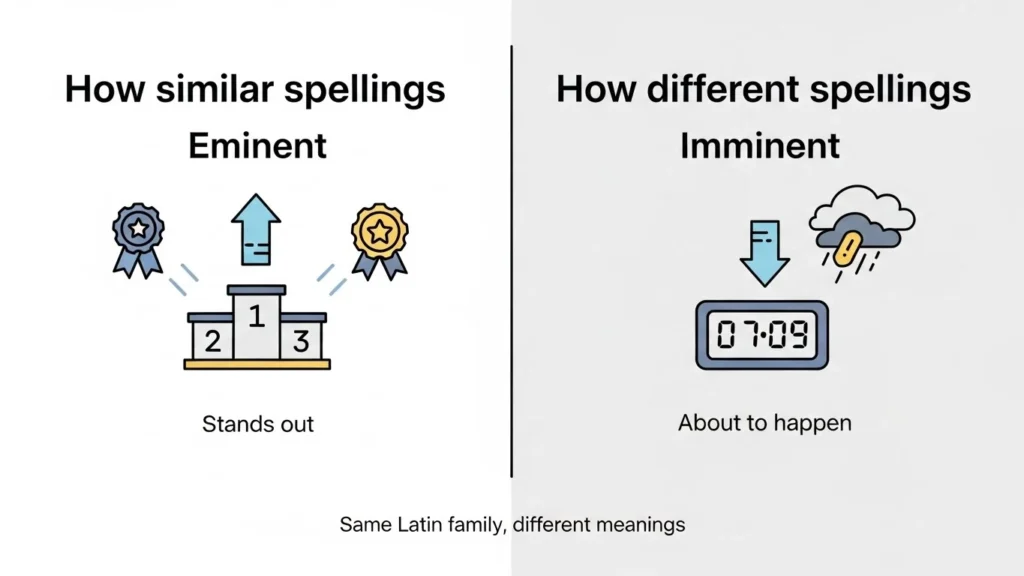
Both words come from Latin but from different roots:
- Eminent comes from eminere, meaning to stand out.
- Imminent comes from imminere, meaning to overhang or threaten.
Because their roots are similar, the spellings stayed close. Over time, English kept both words but gave them very different meanings leading to frequent confusion today.
British English vs American English Spelling
There is no spelling difference between British and American English.
| Aspect | British English | American English |
| Eminent | Eminent | Eminent |
| Imminent | Imminent | Imminent |
| Meaning | Same | Same |
👉 Usage rules are the same worldwide.
Which Spelling Should You Use?
Choose based on meaning, not region.
Use eminent when talking about:
- People
- Reputation
- Status
- Achievement
Use imminent when talking about:
- Events
- Danger
- Change
- Time
Easy memory tip:
- Eminent people are excellent (both start with E).
- Imminent events happen immediately.
Common Mistakes with Eminent or Imminent
❌ An eminent disaster is coming.
✅ An imminent disaster is coming.
❌ He is an imminent lawyer.
✅ He is an eminent lawyer.
❌ The exam is eminent.
✅ The exam is imminent.
One of the most common mistakes with eminent and imminent is using eminent for events or dangers.
For example, phrases like “an eminent storm” or “an eminent exam” are incorrect because eminent only describes people, positions, or reputation.
Another frequent error is calling someone an imminent doctor or imminent professor, which is wrong because imminent refers to something about to happen, not a person’s status.
Writers also confuse these words because both appear in formal or academic contexts, making the mix-up harder to notice.
In news writing, this mistake can be serious, as imminent danger and eminent danger do not mean the same thing.
To avoid errors, pause and ask a simple question: Is this about a respected person or an upcoming event? If it’s a person or reputation, use eminent. If it’s something happening very soon, use imminent.
Eminent or Imminent in Everyday Examples
News
- An imminent weather warning was issued.
Education
- She studied under an eminent professor.
Work
- An imminent deadline caused stress.
Social Media
- Learning from an eminent mentor 🙌
Eminent or Imminent : Google Trends & Usage Data
Search trends show:
- High confusion in academic and news writing
- Imminent often searched with words like danger or storm
- Eminent often searched with person or scholar
Top regions searching this:
- United States
- United Kingdom
- India
- Pakistan
👉 Users mostly want meaning clarity.
Comparison Table: Eminent vs Imminent
| Feature | Eminent | Imminent |
| Meaning | Famous, respected | About to happen |
| Used for | People, status | Events, danger |
| Time related | No | Yes |
| Common context | Careers, honors | Warnings, deadlines |
| Easy link | Excellent | Immediate |
FAQs: Eminent or Imminent
1. Can eminent describe events?
No, it describes people or status.
2. Can imminent describe people?
No, it describes events or situations.
3. Are they interchangeable?
No, meanings are completely different.
4. Is there a US vs UK difference?
No difference.
5. Which word is more formal?
Both are formal.
6. What’s the most common mistake?
Using eminent instead of imminent for events.
7. How can I remember the difference?
Eminent = excellent person, Imminent = immediate event.
Conclusion
The difference between eminent or imminent is all about meaning. Eminent describes someone who is respected, famous, or important. Imminent describes something that is about to happen very soon. There is no British or American spelling difference only meaning matters.
Once you remember that eminent is for people and imminent is for events, the confusion disappears. Mastering this word pair will make your writing clearer, more accurate, and more professional.

I am Sidney Greenbaum, a linguist who studied how English is actually used, not just how it is taught. I analyzed sentence structure and word differences to make English clearer and more practical. My research helped learners understand real-world English comparisons.