

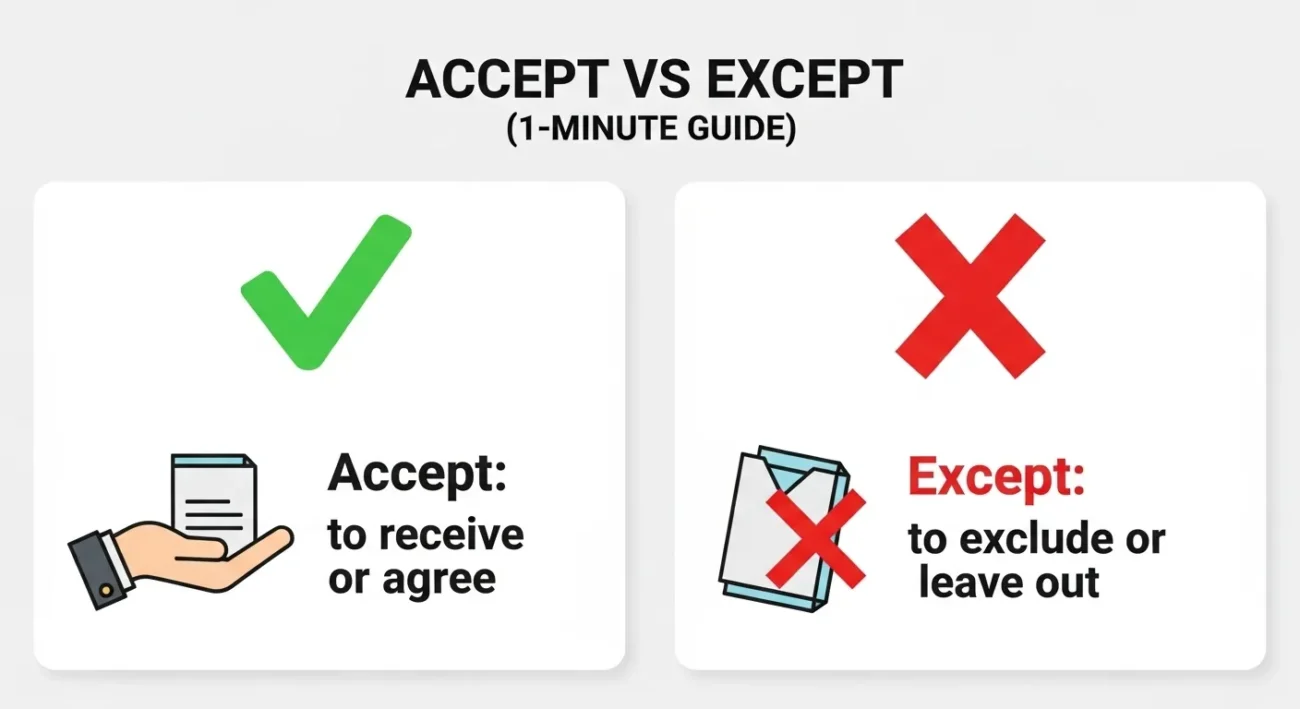
The simple answer is this: accept means to receive or agree, while except means to exclude.
I still remember double checking an email before sending it, stuck on one sentence: “I accept all terms except clause 5.” For a second, I hesitated what if I mixed them up? That tiny confusion is exactly why people search for except or accept so often.
These two words sound similar, look almost the same, and appear frequently in emails, contracts, exams, and formal writing. One wrong choice can completely reverse your meaning. In this article, I’ll break the confusion in the simplest way possible, using real life examples, clear rules, and practical advice so you never second guess yourself again.
Except or Accept: Quick Answer
Accept = to receive, agree to, or take something
Except = to exclude or leave something out
Examples:
✅ I accept your offer.
✅ Everyone came except Ali.
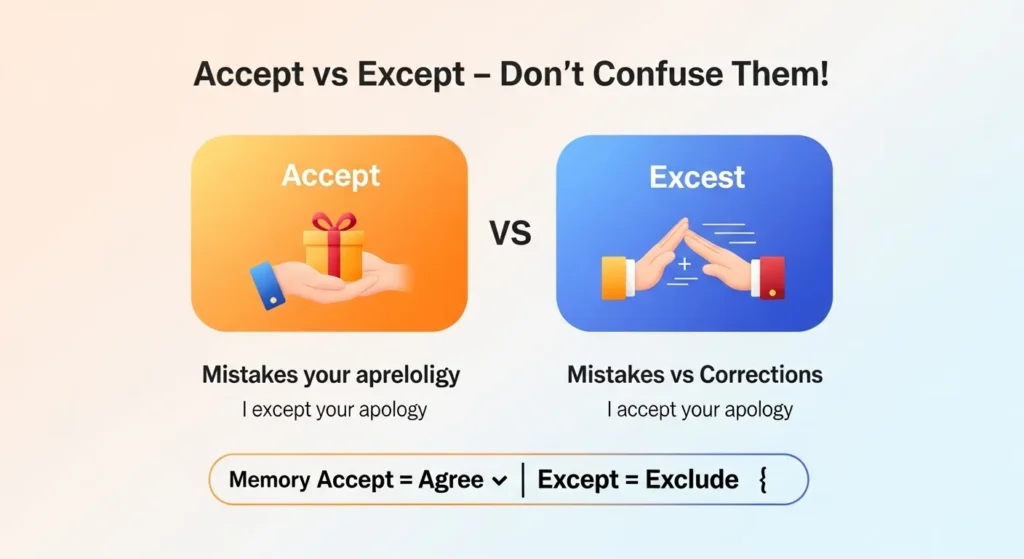
Memory trick I use:
- Accept = Agree
- Except = Exclude
The Origin of Except or Accept
Understanding where words come from helps me remember them better. Accept comes from the Latin acceptare, meaning to receive willingly. That explains why we use it for offers, apologies, invitations, and ideas.
Except comes from Latin excipere, meaning to take out. That’s why it always signals exclusion.
Even though both words share Latin roots and look similar, their meanings moved in opposite directions over time one pulls things in, the other pushes things out.
British English vs American English Spelling
Here’s something that surprises many learners:
👉 There is no spelling difference between British and American English for except or accept.
| Word | US English | UK English | Meaning |
| accept | accept | accept | receive / agree |
| except | except | except | exclude |
The confusion exists globally, not regionally. It’s about meaning not spelling rules.
Which Spelling Should You Use?
I always ask myself one simple question before choosing:
👉 Am I agreeing or removing?
- Agreeing / receiving → accept
- Removing / excluding → except
Audience based advice:
- US writing → Same rule
- UK/Commonwealth → Same rule
- Global/SEO content → Clarity matters more than accent
If the sentence feels positive or approving, it’s almost always accept.
Common Mistakes with Except or Accept
These are errors I see all the time:
❌ I except your apology.
✅ I accept your apology.
❌ All students accept John passed the exam.
✅ All students except John passed the exam.
❌ She did not except the invitation.
✅ She did not accept the invitation.
Quick fix rule:
If you can replace the word with agree, use accept.
If you can replace it with excluding, use except.
Except or Accept in Everyday Examples
Emails
- I accept the meeting invitation.
- I am available every day except Friday.
News
- The company accepted responsibility.
- All flights resumed except international routes.
Social Media
- I finally accepted the challenge!
- I love all fruits except bananas.
Formal Writing
- The committee accepted the proposal.
- The policy applies to all employees except interns.
Except or Accept: Google Trends & Usage Data
Based on search behavior and usage patterns, “except or accept” is most commonly searched by:
- English learners
- Students preparing for exams
- Professionals writing emails or contracts
High search interest appears in:
- India
- Pakistan
- Philippines
- United States
- United Kingdom
Most searches happen because autocorrect doesn’t catch this mistake and grammar tools often miss it too.
Why This Difference Matters in Real Writing
From my own experience, mastering except or accept doesn’t just fix grammar it builds confidence. When you stop second-guessing small words, your writing flows faster and sounds more professional. Native speakers may ignore these slips in casual talk, but in exams, resumes, contracts, and SEO content, accuracy matters. Learning this pair once saves you from repeating the same mistake forever. Small clarity creates big credibility.
Except vs Accept Comparison Table
| Word | Function | Meaning | Example |
| accept | Verb | agree / receive | She accepted the job. |
| except | Preposition / Verb | exclude | Everyone except her agreed. |
FAQs: Except or Accept
1. Is “except” ever used as a verb?
Yes, but rarely. It still means to exclude.
3. Why do people confuse except and accept?
They sound similar and differ by only one letter.
4. Is one more formal than the other?
No. They serve different purposes.
5. Can autocorrect fix this mistake?
Usually no both are real words.
6. Which is correct: “accept for” or “except for”?
Correct phrase: except for.
7. How can I remember fast?
Accept = Agree, Except = Exclude.
Conclusion
Once I stopped relying on sound and started focusing on meaning, the except or accept confusion vanished. These two words may look like twins, but they behave like opposites. Accept brings something in an offer, an apology, an idea.
Except pushes something out it removes, excludes, or limits. This difference matters everywhere: emails, exams, contracts, and professional writing. One wrong word can flip your sentence completely. My advice is simple: slow down for one second, ask what you really mean, and choose accordingly. Mastering this pair instantly makes your writing clearer, more confident, and more professional.

I am Mark Twain, a writer who loved the English language for its humor, irony, and everyday comparisons. I used simple words to show deep differences between truth and lies, wisdom and foolishness. My writing proves that clear English is always more powerful than complicated English.