

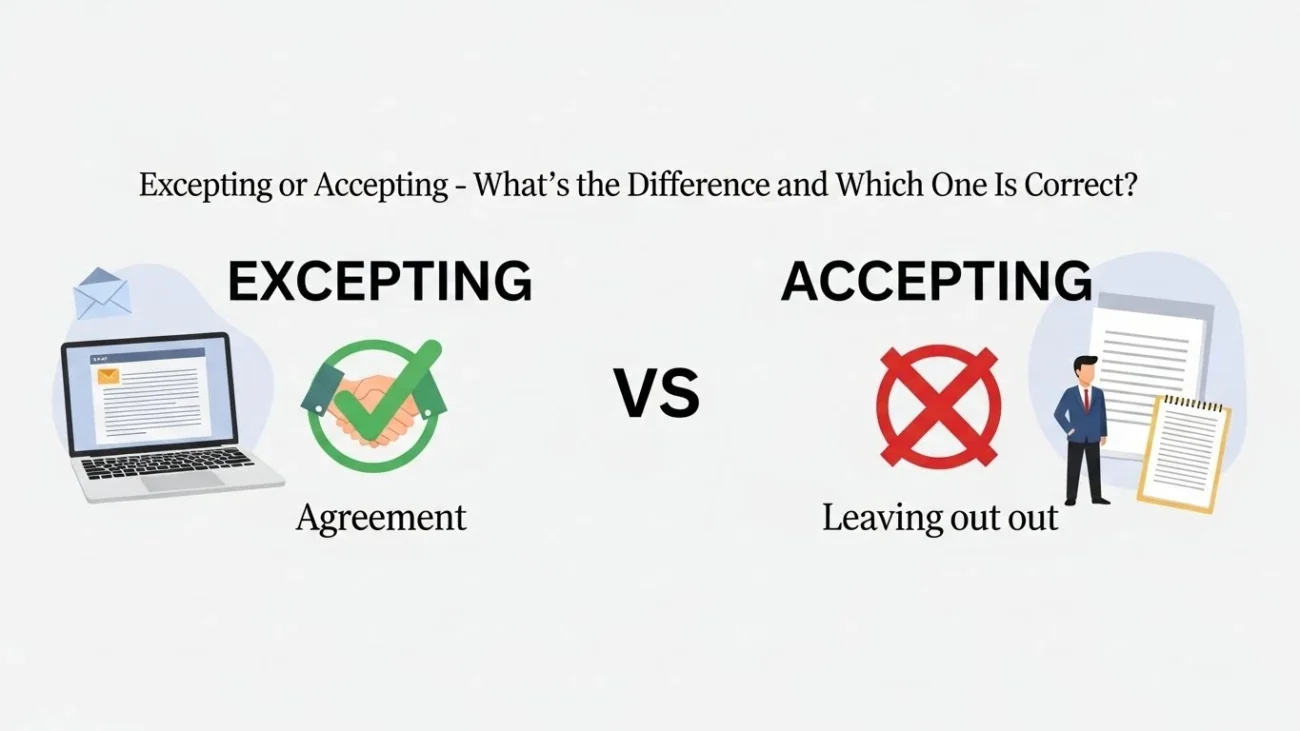
Excepting or Accepting? → The short answer is: use accepting when you mean agreeing or receiving, and excepting when you mean excluding or leaving something out.
English learners and even fluent writers often pause when they see excepting or accepting. At first glance, these two words look similar, sound somewhat alike, and are frequently mixed up in writing.
Many people ask, “is it accepting or excepting?” because the meanings are often confused in writing.That confusion is exactly why people search for this keyword. A single wrong letter can completely change the meaning of a sentence, especially in formal writing like emails, contracts, exams, or news articles.
I’ve seen this mistake many times: someone wants to say they agree with something but accidentally writes a word that means excluding it. The result? Confusion, miscommunication, and sometimes embarrassment. This article solves that problem clearly and quickly.
Here, you’ll get a simple answer first, followed by a deeper explanation of meaning, origin, usage, and spelling rules.
You’ll also learn how British and American English treat these words, see real-life examples, avoid common mistakes, and decide which word you should use based on your audience. By the end, you’ll never confuse excepting and accepting again.
Excepting or Accepting : Quick Answer
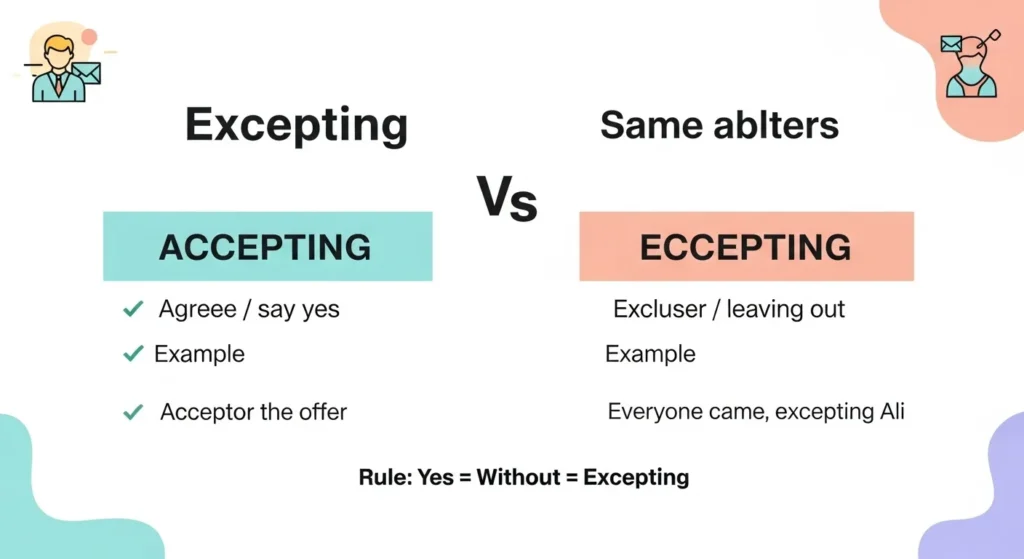
Accepting means agreeing to, receiving, or approving something.
Excepting means excluding or leaving something out.
If you’re asking what does excepting meaning or want to define excepting, it simply means not including something.
Examples:
So, what is excepting? It is the act of excluding a person, item, or situation from a group.
- I am accepting your offer. ✅
- Everyone came, excepting Ali. ✅
👉 If it means yes or agreement, use accepting.
👉This simple contrast explains the core excepting vs accepting meaning.
👉 If it means excluding, use excepting.
Discover More: Soul or Sole:Meaning,Difference and Which One Should You Use?
The Origin of Accepting or Excepting
Accepting comes from the Latin word acceptare, meaning to receive willingly. Over time, it became associated with approval, agreement, and consent.
Excepting comes from the Latin word excipere, meaning to take out. This root explains why it is used for exclusion.
The confusion exists because:
- Both words are verbs
- Both end in -pting
- Both are common in formal English
But historically and linguistically, they are completely different words with different meanings.
British English vs American English Spelling
There is no accepting spelling and Excepting spelling difference between British and American English for these words. Many learners also ask how do you spell accepting; the spelling is the same in both varieties: accepting. The confusion is about meaning, not regional spelling.
| Aspect | British English | American English |
| Accepting | Same spelling, same meaning | Same spelling, same meaning |
| Excepting | Same spelling, same meaning | Same spelling, same meaning |
| Common Errors | Meaning confusion | Meaning confusion |
👉 This is a usage issue, not a spelling variation like colour/color.
Which Spelling Should You Use?
Choose based on meaning, not location.
- US audience → Use accepting for agreement, excepting for exclusion
- UK/Commonwealth → Same rule applies
- Global or SEO content → Be extra careful, as readers may not infer meaning easily
Professional tip:
The phrase not excepting meaning nothing is excluded and the rule applies to everyone. If your sentence feels unclear, rewrite it instead of risking confusion.
Common Mistakes with Excepting or Accepting
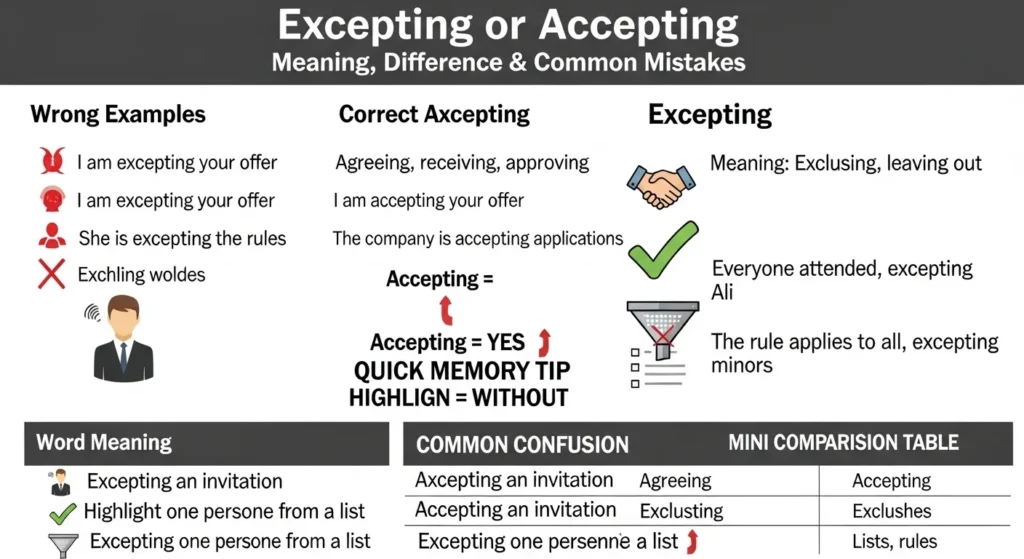
Many learners search how to spell accepting; the correct spelling is accepting, not ecepting.
❌ I am excepting your invitation.
✅ I am accepting your invitation.
❌ All members are accepting the manager.
✅ All members are attending, excepting the manager.
❌ She was excepting the rules.
✅ She was accepting the rules.
Rule to remember:
- Accepting = yes
- Excepting = without
Accepting vs Excepting in Everyday Examples
Emails
- I am accepting the meeting request.
- All staff are invited, excepting interns.
News
- The company is accepting applications this month.
- The policy applies to all regions, excepting rural areas.
Social Media
- Finally accepting myself as I am.
- Everyone tagged me, excepting one friend.
The phrase not excepting means nothing and no one is excluded.
Formal Writing
- The court is accepting the appeal.
- The IRS is accepting extensions, excepting cases that do not meet the criteria.
- Taxes apply to all goods, excepting essentials.
Excepting or Accepting :Google Trends & Usage Data
Search data shows:
Many users specifically search for “excepting or accepting IRS extensions only” to understand the correct usage in tax-related contexts.
- Accepting is far more popular globally
- Excepting is used mainly in legal and formal contexts
- High confusion searches come from students and non-native speakers
Countries with frequent searches:
- India
- Pakistan
- United States
- United Kingdom
👉 Most users search this keyword to avoid writing mistakes, not spelling differences.
Comparison Table: Excepting vs Accepting
| Feature | Accepting | Excepting |
| Meaning | Agreeing or receiving | Excluding or leaving out |
| Usage | Common | Less common |
| Tone | Neutral, positive | Neutral, restrictive |
| Context | Offers, requests, ideas | Lists, rules, exceptions |
| Common Error | Confused with excepting | Confused with accepting |
FAQs: Excepting or Accepting
1. Is “excepting” a real word?
Yes, but it is less common than accepting.
2. Can I replace “excepting” with “except”?
Often yes, especially in simple sentences.
3. Which word is more formal?
Excepting sounds more formal and legal.
4. Is this a spelling difference like UK vs US?
No, it is a meaning difference.
5. Why do people confuse these words?
Because they look and sound similar.
6. Can accepting ever mean excluding?
No, never.
7. Which word is better for Content writing?
Use the correct word based on meaning, not popularity.
Conclusion
The confusion between excepting or accepting is small but powerful. One word means agreement, the other means exclusion. Mixing them up can change the entire message of a sentence.
That’s why this keyword is searched so often people want clarity, speed, and confidence in their writing.
Remember the simple rule:
- Accepting = yes, approval, receiving
- Excepting = excluding, leaving out
There is no British or American spelling difference here, only correct and incorrect usage. In emails, academic writing, content, or professional documents, choosing the right word shows clarity and credibility.
If you ever feel unsure, pause and ask yourself: Am I agreeing, or am I excluding? The answer will always guide you to the correct choice.
Mastering small word pairs like this is what turns average English into professional English.

I am Michael Swan, an English grammarian known for explaining confusing grammar and word comparisons in a clear way. I focused on real usage, not just rules, helping learners understand why English works the way it does. My work simplifies complex language problems for everyday users.