


Many people search for exiting or exciting because these two words look almost the same but mean completely different things.
A single missing letter can change the meaning of a sentence and even cause embarrassment. For example, “This is an exiting opportunity” does not mean what many writers intend to say.
The confusion usually happens because exiting and exciting are close in spelling and pronunciation, especially for non-native English speakers.
They are also commonly mistyped in emails, social media posts, advertisements, and professional writing.
This article solves that confusion clearly and simply. You’ll get a quick answer first, then learn the origin of both words, common mistakes, real-life examples, and expert advice.
By the end, you’ll confidently know when to use exiting and when exciting is the correct choice.
Exiting or Exciting : Quick Answer
- 🚪 Exiting → leaving or going out
- 🎉 Exciting → thrilling or interesting
Examples:
- Please use the door when exiting the building.
- This is an exciting new project.
👉 Leaving = exiting
👉 Fun or thrill = exciting
Read More: Allusion vs Illusion Explained: Meaning, Examples, and Tips
The Origin of Exiting or Exciting
- Exiting comes from the verb exit, from Latin exire, meaning to go out.
- Exciting comes from excite, from Latin excitare, meaning to stir up or energize.
Although the words look similar, they come from different roots and express completely different ideas.
British English vs American English Spelling
There is no spelling difference between British and American English.
| Word | British English | American English |
| Exiting | Same | Same |
| Exciting | Same | Same |
👉 Only meaning matters, not region.
Which Spelling Should You Use?
Use exiting when:
- Talking about leaving a place
- Giving directions or instructions
Use exciting when:
- Describing something fun or thrilling
- Expressing enthusiasm or emotion
Tip:
If you can replace it with leaving, use exiting.
If you can replace it with thrilling, use exciting.
Common Mistakes with Exiting or Exciting
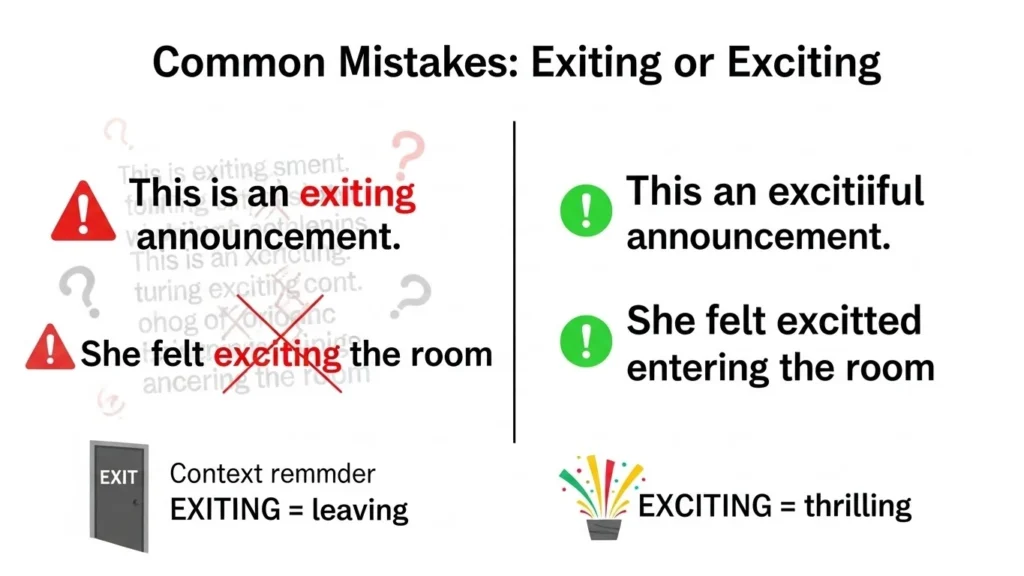
❌ This is an exiting announcement.
✅ This is an exciting announcement.
❌ She felt exciting the room.
✅ She felt excited entering the room.
❌ Mixing meanings
✅ Match the word to the situation
Usage Tips, Context Awareness, and Writing Advice for Exiting vs Exciting
Understanding the difference between exiting and exciting depends entirely on context and intention. Many writing errors occur because people type quickly and rely on spellcheck, which often fails to catch this mistake.
Since both words are grammatically correct, software may not flag the error even when the meaning is wrong. This makes careful proofreading essential, especially in professional or marketing content.
The word exiting should almost always involve physical movement, directions, or procedures. It is commonly used in safety instructions, travel announcements, building signage, and formal notices.
If the sentence answers the question “leaving from where?”, exiting is likely the correct choice.
In contrast, exciting is emotional and descriptive. It expresses enthusiasm, interest, or anticipation.
Advertisements, job postings, social media captions, and storytelling frequently use exciting to capture attention and emotion. Using exiting in these situations can confuse readers and reduce credibility.
A helpful editing trick is substitution. Replace the word with leaving or thrilling. If leaving fits, use exiting. If thrilling fits, use exciting.
Mastering this small distinction improves clarity, prevents awkward misunderstandings, and makes your English sound polished, confident, and professional across all types of writing.
Exiting or Exciting in Everyday Examples
Work
- We have an exciting opportunity for you.
Travel
- Please remain seated while exiting the plane.
Marketing
- An exciting offer awaits you.
Safety
- Follow the signs when exiting the building.
Exiting or Exciting : Google Trends & Usage Data
- Exciting is searched far more often
- Exiting searches relate to safety and directions
- Typos between the two are very common
👉 Most users intend to write exciting, not exiting.
Comparison Table: Exiting vs Exciting
| Feature | Exiting | Exciting |
| Meaning | Leaving | Thrilling |
| Verb base | Exit | Excite |
| Emotional meaning | ❌ No | ✅ Yes |
| Common mistakes | Often confused | Often mistyped |
| Interchangeable | ❌ No | ❌ No |
FAQs: Exiting or Exciting
1. Is “exiting opportunity” correct?
No. It should be exciting opportunity.
2. Can exiting describe emotions?
No. It only means leaving.
3. Which word is used in safety signs?
Exiting.
4. Which word is used in ads and promotions?
Exciting.
5. Are they pronounced the same?
No, exciting has a stronger “site” sound.
6. Do British and American English differ?
No.
Conclusion
The difference between exiting or exciting is simple but very important. Exiting means leaving or going out, while exciting means something fun, thrilling, or interesting. Because they look similar, many writers confuse them, especially in fast typing.
Remember this rule: if it’s about leaving, use exiting; if it’s about excitement, use exciting. Keeping this in mind will help you avoid common mistakes and make your writing clear, confident, and professional.

I am Sidney Greenbaum, a linguist who studied how English is actually used, not just how it is taught. I analyzed sentence structure and word differences to make English clearer and more practical. My research helped learners understand real-world English comparisons.