

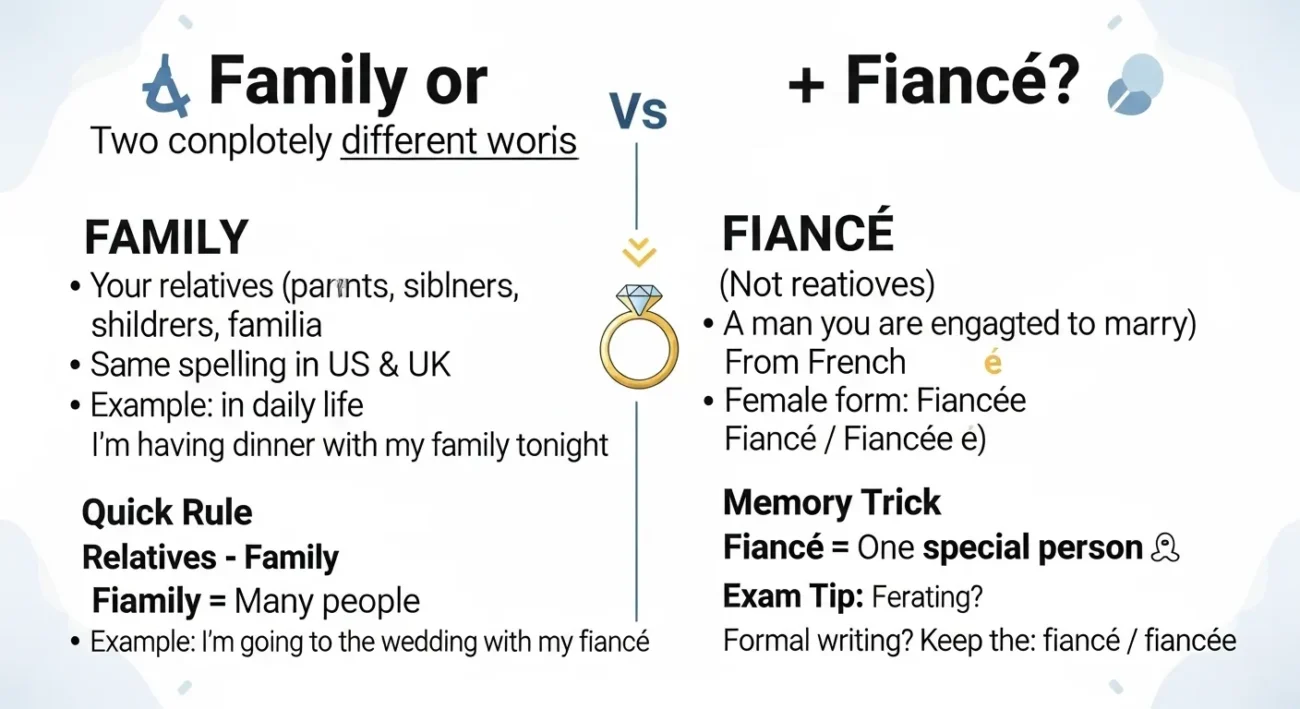
Family or fiance? The quick answer is simple: “family” means your relatives, while “fiance” means the person you are engaged to marry.
I once saw someone write, “I’m meeting my fiance tonight,” but they meant their whole family. That small word changed the meaning completely.
Many people search this keyword because the words look and sound different but sometimes appear in emotional messages, wedding posts, or formal writing where clarity matters. One word talks about blood relations. The other talks about love and engagement.
In this guide, I will clearly explain the difference, origin, spelling rules, common mistakes, real life examples, and usage trends so you never confuse them again.
Family or Fiance : Quick Answer
Family = your relatives (parents, siblings, children, etc.)
Fiance = the man you are engaged to marry
(Fiancee = the woman you are engaged to marry)
examples:
- ✅ I’m having dinner with my family tonight.
- ✅ I’m going to the wedding with my fiance.
One word is about relatives.
The other is about engagement.
They are not related in meaning.
The Origin of Family and Fiance
The word family comes from the Latin word familia, meaning household. Over time, it became common in english to describe parents, children, and close relatives.
The word fiance comes from French. It means “promised.” It refers to a man promised in marriage. The female version, fiancee, adds an extra “e.”
French spelling influences english here. That is why the accent mark appears in fiance. In english writing, many people drop the accent, but the correct form keeps it.
British english vs American english Spelling
There is no major US vs UK difference for family. It is spelled the same everywhere.
For fiance, both British and American english use the same spelling. However, Americans often drop the accent mark in casual writing.
Comparison Table
| Word | British english | American english | Notes |
| Family | Family | Family | Same spelling |
| Fiance | Fiance | Fiance / Fiance | Accent sometimes removed in US |
| Fiancee | Fiancee | Fiancee / Fiancee | extra “e” for female |
The meaning does not change between countries.
Which Spelling Should You Use?
Use family when talking about relatives or household members.
If you Use fiance if referring to an engaged man.
Use fiancee for an engaged woman.
If writing formally (wedding invites, news, legal papers), keep the accent: fiance / fiancee.
If writing casually (text message or social media), people may write “fiance,” but the correct form includes the accent.
Choose based on context not preference.
Common Mistakes with Family or Fiance
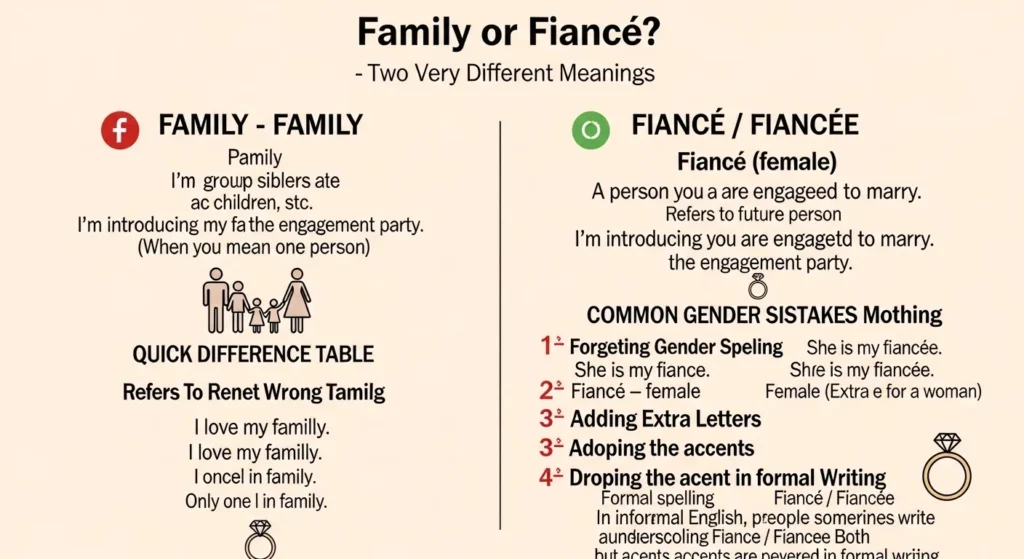
Mistake 1: Using the wrong word
❌ I’m introducing my family at the engagement party.
(Meaning one person, not relatives.)
✅ I’m introducing my fiance at the engagement party.
Mistake 2: Forgetting gender spelling
❌ She is my fiance.
✅ She is my fiancee.
Mistake 3: Adding extra letters
❌ I love my familly.
✅ I love my family.
Mistake 4: Dropping the accent in formal writing
❌ The bride and her fiance attended.
✅ The bride and her fiance attended.
Fiance or Family in everyday examples
email:
“I will attend the meeting with my family.”
Wedding Card:
“Me and my fiance are excited to celebrate with you.”
News Article:
“The actress appeared with her fiance at the award show.”
Social Media Post:
“Sunday dinner with family ❤️”
Formal Announcement:
“She and her fiance plan to marry in June.”
Clear context makes meaning obvious.
Family or Fiance : Google Trends & Usage Data
Search data shows:
- Family is searched worldwide every day because it is a common word.
- Fiance searches increase during engagement and wedding seasons.
- Countries like the United States and United Kingdom show high engagement related searches.
- Wedding blogs often clarify fiance vs fiancee spelling.
Family is a daily use word.
Fiance is seasonal and event based.
Quick Comparison Table
| Feature | Family | Fiance |
| Meaning | Relatives | engaged man |
| Origin | Latin | French |
| Accent Mark | No | Yes |
| Gender Form | Same for all | Fiance (male), Fiancee (female) |
| Usage | Daily life | engagement context |
FAQs
1. Is family related to fiance?
No. They have completely different meanings.
2. What is the female form of fiance?
Fiancee.
3. Can I write fiance without accent?
Yes in casual writing, but formal writing should keep the accent.
4. Does family mean only parents?
No. It includes parents, siblings, children, and sometimes extended relatives.
5. Is fiance used before or after marriage?
Before marriage. After marriage, the person becomes a husband.
6. Why does fiancee have two e’s?
The extra “e” shows it refers to a woman in French grammar.
7. Is family singular or plural?
It is usually singular but can act plural in British english depending on context.
Conclusion
Family or fiance the difference is clear once you understand the meaning. Family refers to your relatives, the people connected by blood or marriage. Fiance refers to the person you are promised to marry. One word describes a group.
The other describes one special person. I have seen small spelling mistakes change the meaning of wedding posts and formal announcements. That is why clarity matters.
Remember this simple rule: if it is about relatives, write family. If it is about engagement, write fiance (or fiancee for a woman). Always check context before writing. Correct spelling shows confidence and care, especially in emotional or formal situations.
Discover More Articles:

I am Michael Swan, an English grammarian known for explaining confusing grammar and word comparisons in a clear way. I focused on real usage, not just rules, helping learners understand why English works the way it does. My work simplifies complex language problems for everyday users.