

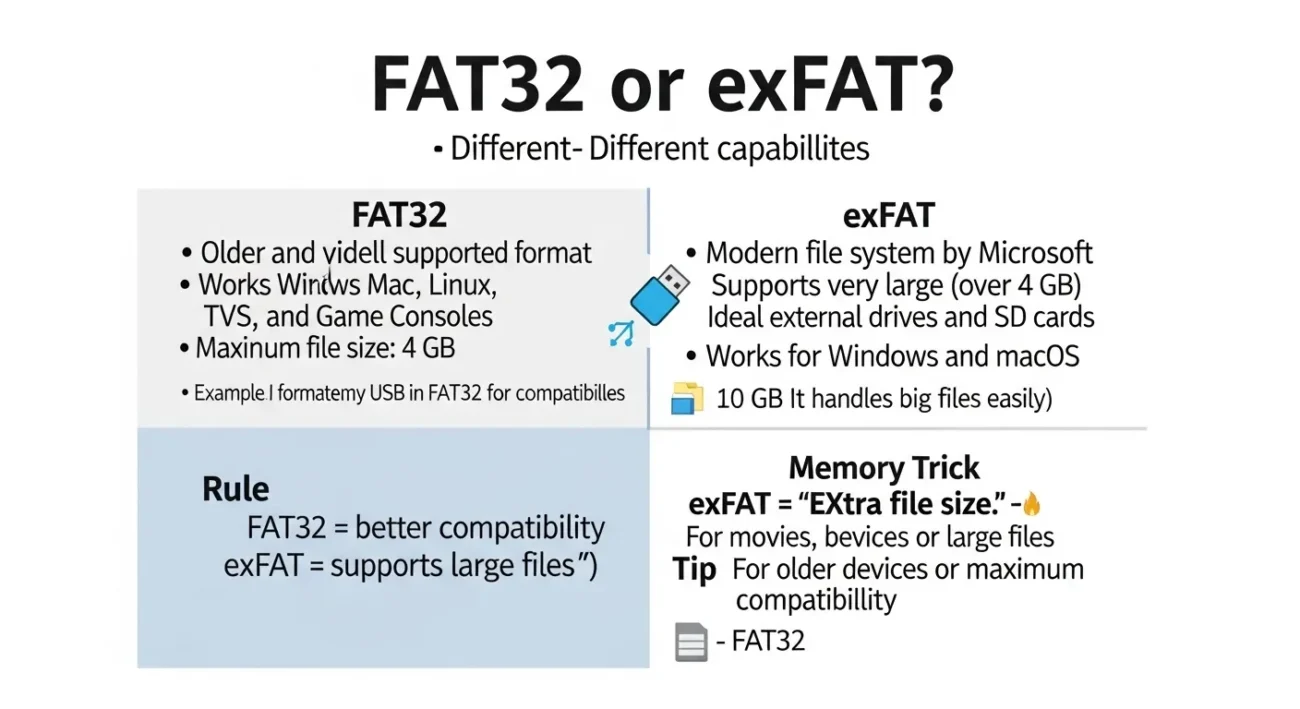
The quick answer to “fat32 or exfat” is that FAT32 is better for compatibility, while exFAT is better for large files and modern storage devices.
A few months ago, I helped a friend transfer videos from his laptop to a USB drive. When we tried copying a large movie file, an error appeared. That’s when I realized the drive was formatted in FAT32. We reformatted it to exFAT, and suddenly everything worked perfectly. Situations like this make the choice between fat32 or exfat very practical in real life.
When people compare fat32 or exfat, they are deciding how their storage device will manage files. The right format prevents transfer errors and improves performance. Understanding fat32 or exfat helps both beginners and experts use USB drives, memory cards, and external storage efficiently.
🔑 Key Difference Between FAT32 and exFAT
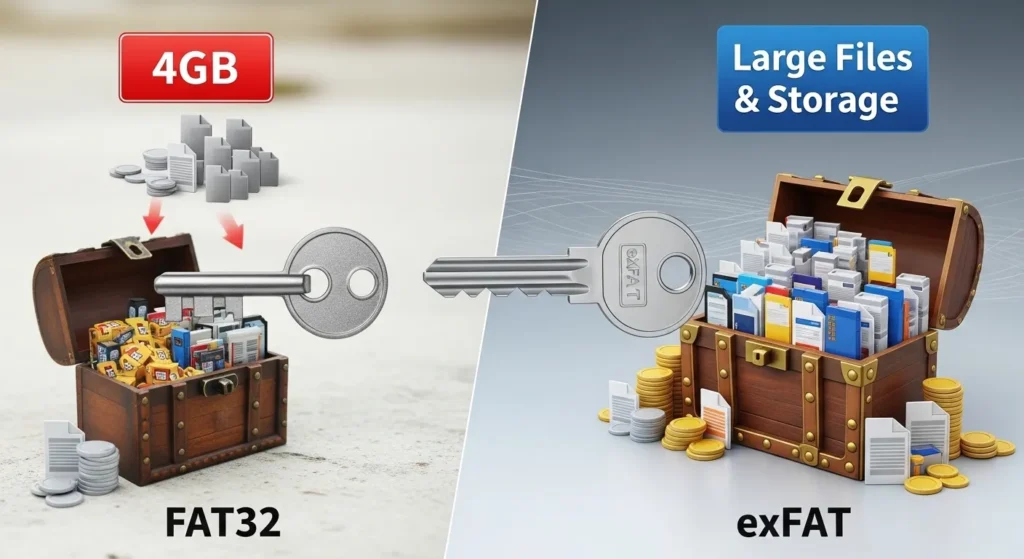
The main difference is that FAT32 is an older file system with a 4GB file size limit, while exFAT is a modern system designed to handle very large files and large storage devices.
🌍 Why Knowing Their Difference Is Important
Understanding fat32 or exfat is important for learners, professionals, and everyday users. Storage devices are used everywhere from schools and offices to homes and businesses.
Students transfer assignments, photographers store high-resolution images, and companies manage huge data files. If someone formats a drive in FAT32 while transferring very large files, they may face errors. Knowing the difference helps people choose the correct format and avoid technical problems.
🔊 Pronunciation (US & UK)
FAT32
- US: /ˌef-eɪ-ti ˌθɜːrti tuː/
- UK: /ˌef-eɪ-ti ˌθɜːti tuː/
exFAT
- US: /ˌeks-ef-eɪ-ti/
- UK: /ˌeks-ef-eɪ-ti/
➡️ Now that we know the basics, let’s explore the detailed differences between FAT32 and exFAT.
⚖️ Difference Between exFAT and FAT32
1️⃣ File Size Limit
FAT32: Maximum file size is 4GB.
Examples:
- A 5GB movie cannot be copied.
- Large backup files fail to transfer.
exFAT: Supports extremely large files.
Examples:
- A 20GB video transfers easily.
- Large software files copy without errors.
2️⃣ Storage Capacity Support
FAT32: Best for small drives.
Examples:
- 16GB USB drives.
- Small memory cards.
exFAT: Designed for large storage.
Examples:
- 128GB USB drives.
- Large SDXC cards.
3️⃣ Compatibility
FAT32: Works with many older devices.
Examples:
- Old gaming consoles.
- Older operating systems.
exFAT: Supports modern systems.
Examples:
- Latest Windows versions.
- Modern macOS systems.
4️⃣ Performance
FAT32: Slower with large files.
Examples:
- Longer transfer times.
- Reduced efficiency.
exFAT: Faster data transfer.
Examples:
- Quick video copying.
- Faster backups.
5️⃣ File Management
FAT32: Simple structure.
Examples:
- Easy file access.
- Basic storage functions.
exFAT: Advanced file handling.
Examples:
- Better storage allocation.
- Efficient large-file management.
6️⃣ Device Usage
FAT32: Common in older hardware.
Examples:
- Legacy USB drives.
- Old embedded systems.
exFAT: Used in modern devices.
Examples:
- Digital cameras.
- Portable SSD drives.
7️⃣ Efficiency With Large Files
FAT32: Poor efficiency with big data.
Examples:
- HD video storage fails.
- Large archives cannot copy.
exFAT: Designed for multimedia files.
Examples:
- 4K videos transfer easily.
- Large photo libraries store smoothly.
8️⃣ Fragmentation
FAT32: Higher chance of fragmentation.
Examples:
- Slower reading speed over time.
- Needs frequent defragmentation.
exFAT: Handles fragmentation better.
Examples:
- Stable performance.
- Less maintenance required.
9️⃣ Use in Modern Devices
FAT32: Rare in modern technology.
Examples:
- Legacy USB drives.
- Old computer systems.
exFAT: Standard for modern storage.
Examples:
- SDXC memory cards.
- New gaming consoles.
🔟 Data Handling Capability
FAT32: Limited flexibility.
Examples:
- Restricted file sizes.
- Limited storage optimization.
exFAT: Highly flexible system.
Examples:
- Large media storage.
- Professional data transfer.
🧠 Nature and Behaviour of Both
FAT32:
FAT32 behaves like a traditional storage system. It is simple, reliable, and widely compatible with older devices but limited when dealing with large files.
exFAT:
exFAT behaves like a modern storage system designed for large data transfers and modern devices.
🤔 Why People Are Confused About Their Use
People often confuse fat32 or exfat because both are file systems used in USB drives and memory cards. Their names look similar, and many devices support both formats.
📊 Table: Difference and Similarity
| Feature | FAT32 | exFAT |
| Technology Era | Older | Modern |
| File Size Limit | 4GB | Very large files |
| Compatibility | Very wide | Mostly modern devices |
| Storage Size | Small drives | Large drives |
| Performance | Moderate | Fast |
| Typical Use | Legacy systems | Modern storage |
| Similarity | Both manage files on storage devices |
🏆 Which Is Better in What Situation?
FAT32:
FAT32 is better when compatibility is the priority. Older computers, consoles, and embedded systems easily recognize it.
exFAT:
exFAT is better for modern devices and large files like movies, backups, and high-resolution images.
🪞 Metaphors and Similes
- FAT32 is like an old bookshelf reliable but limited in space.
- exFAT is like a modern warehouse built for massive storage.
🎭 Connotative Meaning
FAT32: Neutral technological meaning.
Example: The USB drive is formatted in FAT32.
exFAT: Positive modern-technology connotation.
Example: The new camera uses exFAT to store large videos.
💬 Idioms or Proverbs
Old is gold.
Example: FAT32 is old but still useful.
Bigger is better.
Example: exFAT supports bigger files.
📚 Works in Literature (Technical)
- File System Concepts Computer Science Textbook, 2010
- Modern Storage Technologies Technology Guide, 2015
🎬 Movies or Documentaries Related to Digital Storage
- Inside the Hard Drive 2013, USA
- Digital Storage Revolution 2018, UK
❓ Frequently Asked Questions
1. What is the biggest limitation of FAT32?
The 4GB file size limit.
2. Why is exFAT popular today?
Because it supports large files.
3. Can exFAT work on older systems?
Sometimes with updates.
4. Which format is faster?
exFAT.
5. Which format is best for USB drives?
Usually exFAT for modern devices.
🌱 How Both Are Useful for Our Surroundings
Both file systems help manage digital storage. FAT32 ensures compatibility with older devices, while exFAT supports modern storage needs.
✨ Final Words for FAT32 and exFAT
FAT32 represents traditional reliability, while exFAT represents modern efficiency.
🧾 Conclusion
Choosing between fat32 or exfat depends on your needs and the devices you use. FAT32 remains valuable because of its wide compatibility with older systems, making it useful for basic storage and small file transfers. On the other hand, exFAT is designed for modern computing environments where large files and high capacity storage devices are common.
Understanding the differences between fat32 or exfat helps users avoid file transfer errors, improve device performance, and manage data more efficiently. By selecting the correct file system, you ensure that your storage devices work smoothly and reliably.
Discover More Articles:

I am Mark Twain, a writer who loved the English language for its humor, irony, and everyday comparisons. I used simple words to show deep differences between truth and lies, wisdom and foolishness. My writing proves that clear English is always more powerful than complicated English.