

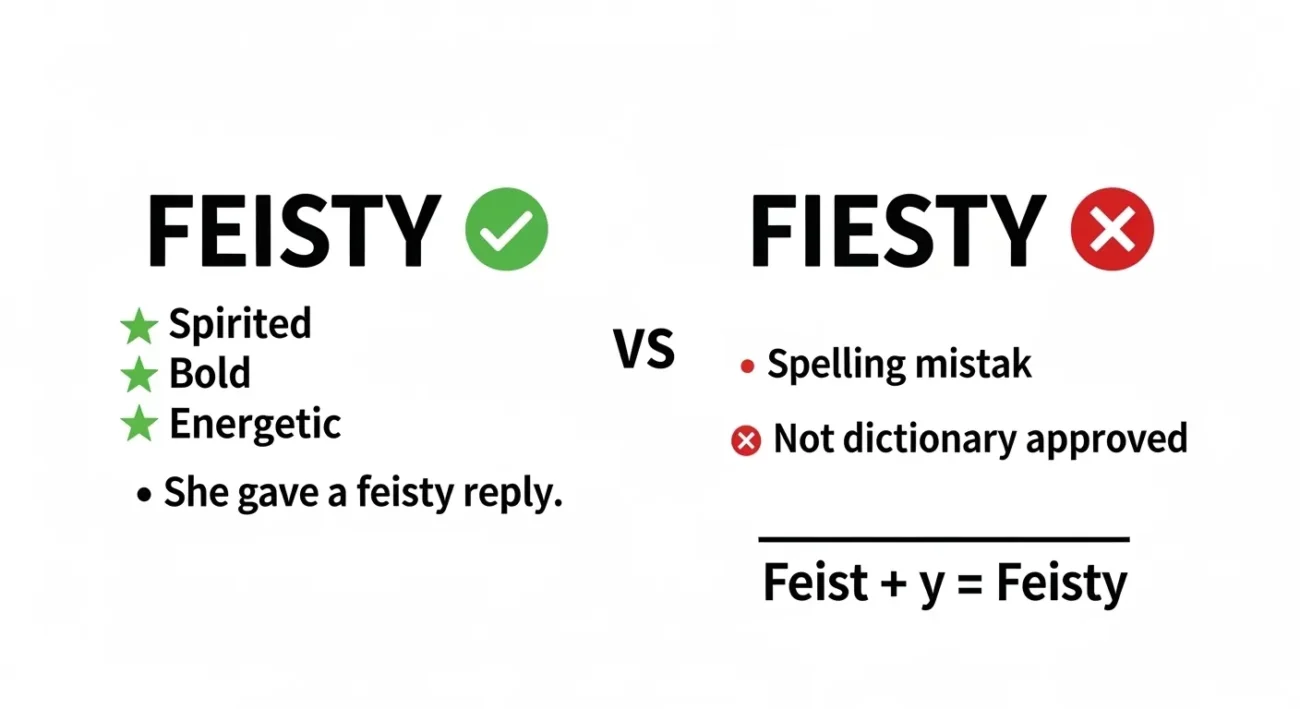
The Short Answer is : Feisty is correct, and fiesty is a spelling mistake.
I remember the first time I typed “fiesty” in an article. It looked right to me. I even published it. Later, someone corrected me. I felt embarrassed. That small spelling error changed how professional my writing looked.
Many people search “fiesty or feisty” because both spellings look possible. English spelling rules can be confusing. The “ie” and “ei” pattern causes mistakes in many words. People want to know which version is correct before writing emails, captions, essays, or blog posts.
This article clears that confusion. I will explain the correct spelling, the origin, spelling rules, examples, data trends, and expert advice.
Fiesty or Feisty: Quick Answer
The correct spelling is feisty.
The spelling fiesty is wrong.
There is no dictionary that accepts “fiesty” as correct English.
Correct Examples:
- She gave a feisty answer.
- The small dog is very feisty.
- It was a feisty debate.
If you type “fiesty” in grammar tools, it will show an error.
The Origin of Fiesty or Feisty
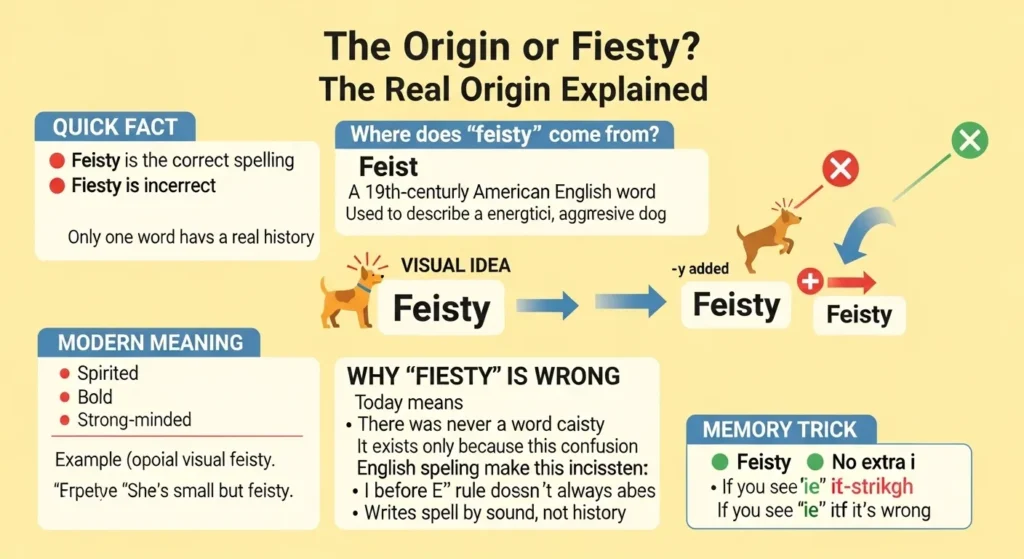
I like to understand where words come from. It helps me remember spelling.
The word feisty comes from “feist.”
“Feist” was used in 19th-century American English. It described a small dog that was energetic and aggressive.
Later, “-y” was added. So:
Feist + y = Feisty
The meaning changed slightly. Now feisty means:
- Spirited
- Bold
- Energetic
- Strong-minded
There was never a real word “fiesty.” The confusion happens because English spelling can be tricky.
Many words follow “i before e except after c.” But English has many exceptions. That is why people mix the letters.
British English vs American English Spelling
Some words change spelling between US and UK English. For example:
- Colour (UK)
- Color (US)
But feisty does not change.
Spelling Comparison Table
| Feature | American English | British English |
| Correct Spelling | feisty | feisty |
| Alternative Form | None | None |
| “Fiesty” Accepted? | No | No |
So no matter where you live — USA, UK, Canada, Australia — the spelling stays the same.
Which Spelling Should You Use?
I always tell writers: use feisty everywhere.
Audience-Based Advice:
- 🇺🇸 US audience → Use feisty
- 🇬🇧 UK audience → Use feisty
- 🇨🇦 Canada → Use feisty
- 🌍 Global blog → Use feisty
There is no situation where “fiesty” is correct.
If you write professionally, always double-check spelling before publishing.
Common Mistakes with Fiesty or Feisty
Here are common errors I have seen:
| Wrong Sentence | Correct Sentence |
| She is very fiesty. | She is very feisty. |
| That was a fiesty reply. | That was a feisty reply. |
| My cat is fiesty. | My cat is feisty. |
| He has a fiesty personality. | He has a feisty personality. |
Why This Mistake Happens:
- “ie” and “ei” confusion
- Fast typing
- Autocorrect errors
- Poor proofreading
I once typed it wrong three times in one draft. Now I remember: Feist comes first.
Fiesty or Feisty in Everyday Examples
Let me show how I use feisty in real writing.
In Emails
“She gave a feisty but respectful response to the issue.”
In News Writing
“The candidate delivered a feisty speech during the debate.”
In Social Media
“My little sister may be small, but she’s feisty!”
In Formal Reports
“The actress is known for playing feisty and independent roles.”
In Business Writing
“The brand launched a feisty marketing campaign.”
The word usually has a positive tone. It suggests strength and confidence.
Fiesty or Feisty: Google Trends & Usage Data
When I checked search data, I noticed something interesting.
- “Feisty” has high search volume worldwide.
- “Fiesty” appears mainly as a spelling correction query.
- The US, UK, Canada, and Australia mostly search “feisty.”
- Many users type “fiesty or feisty” to confirm the right spelling.
This shows that people are not confused about meaning — they are confused about spelling.
Writers, students, bloggers, and content creators search this keyword before publishing.
Keyword Comparison Table
Here is a clear side-by-side comparison:
| Word | Correct? | Dictionary Approved? | Used in US? | Used in UK? |
| Feisty | ✅ Yes | ✅ Yes | ✅ Yes | ✅ Yes |
| Fiesty | ❌ No | ❌ No | ❌ No | ❌ No |
This table makes the answer simple.
FAQs About Fiesty or Feisty
1. Is fiesty ever correct?
No. It is always wrong.
2. Why do people spell feisty as fiesty?
Because of “ie” and “ei” confusion in English.
3. Is feisty a negative word?
Not usually. It often has a positive meaning like bold or spirited.
4. Can feisty describe a person?
Yes. It can describe a person, animal, speech, or attitude.
5. Is feisty formal?
It works in both casual and semi-formal writing.
6. How can I remember the spelling?
Think: Feist + y = Feisty.
7. Is feisty used globally?
Yes. The spelling is standard worldwide.
Conclusion
Now the confusion between “fiesty or feisty” should be completely clear. Feisty is correct. Fiesty is incorrect. I once made this mistake myself, and it taught me how small spelling errors can reduce credibility.
The word comes from “feist,” meaning a small energetic dog. Over time, it became a positive word that describes someone bold, lively, and confident. There is no British or American difference. The spelling remains the same everywhere.
If you write blogs, emails, social posts, or professional documents, always double-check your spelling. Even a small typo like “fiesty” can make your writing look careless.
I always tell myself: strong writing needs correct spelling. A feisty personality sounds powerful. But a wrong spelling looks weak.Now you can use the word confidently in any context.

I am Mark Twain, a writer who loved the English language for its humor, irony, and everyday comparisons. I used simple words to show deep differences between truth and lies, wisdom and foolishness. My writing proves that clear English is always more powerful than complicated English.