


Many people search for flak or flack because these two words sound exactly the same but have different meanings.
Using the wrong one can make your writing confusing or inaccurate. For example, “He got a lot of flack for his idea” is correct, while “He got a lot of flak for his idea” has a different origin and usage.
This confusion is common among English learners, journalists, and casual writers because both words are pronounced the same. This article clears the confusion in a simple way.
You’ll get a quick answer, learn the origins, see common mistakes, real-life examples, and expert advice. By the end, you’ll know exactly when to use flak and when flack is correct.
Flak or Flack : Quick Answer
- 💣 Flak → criticism or anti-aircraft fire
- 📣 Flack → public relations person or press agent
Examples:
- The politician received heavy flak for his comments.
- The movie studio hired a flack to manage publicity.
👉 Criticism or fire = flak
👉 PR professional = flack
Read More: Mines vs Mine: Which One Is Correct in English?
The Origin of Flak or Flack
- Flak comes from German Flugabwehrkanone, meaning anti-aircraft gun. Later, it became slang for criticism.
- Flack comes from American slang for a public relations agent. Its origin is less clear, possibly linked to newspaper slang in the early 20th century.
Although they sound the same, their meanings and histories are different.
British English vs American English Spelling
There is no difference in spelling between British and American English.
| Word | British English | American English |
| Flak | Same | Same |
| Flack | Same | Same |
👉 The difference is meaning, not region.
Which Word Should You Use?
Use flak when:
- Talking about criticism
- Referring to metaphorical or literal fire
Use flack when:
- Talking about a public relations professional
- Referring to press management
Tip: If unsure, check the context: negative feedback = flak, PR agent = flack.
Common Mistakes with Flak or Flack
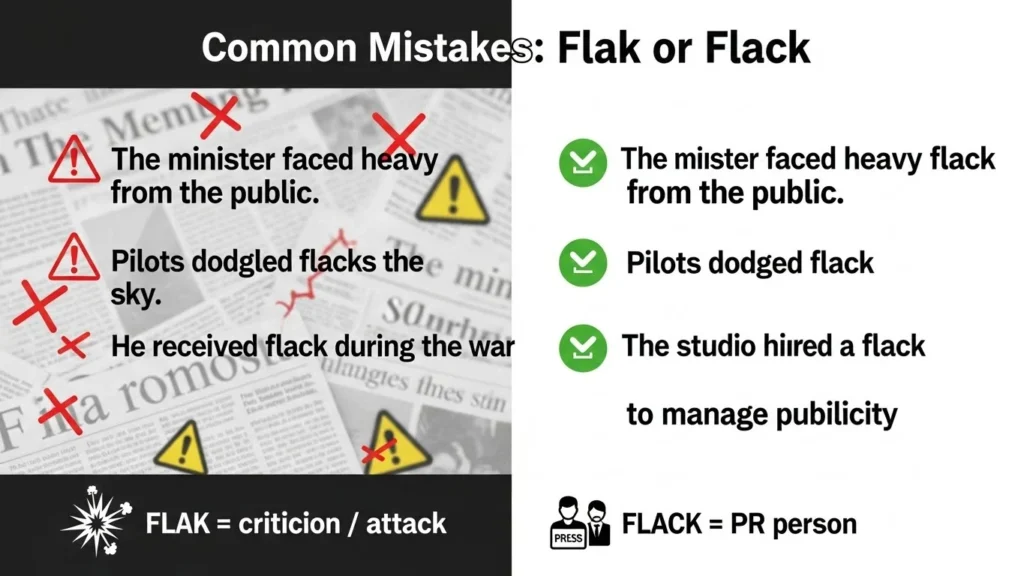
❌ He received flack from critics. (if you mean criticism, it’s correct)
✅ He received flak from critics.
❌ The studio hired flak to handle media.
✅ The studio hired a flack to handle media.
❌ Mixing meanings
✅ Match the word to context
Because flak and flack are pronounced exactly the same, writers often choose the wrong word based on sound rather than meaning. This leads to frequent errors, especially in news articles, blogs, and professional writing.
- Using “flack” to mean criticism
❌ The minister faced heavy flack from the public.
✅ The minister faced heavy flak from the public.
Why it’s wrong: Flack is a person (PR agent), not criticism. - Using “flak” for a PR professional
❌ The studio hired a flak to manage publicity.
✅ The studio hired a flack to manage publicity.
Tip: If you’re talking about a person handling media, always use flack. - Assuming both words are interchangeable
❌ He received flack during the war.
✅ He received flak during the war.
Explanation: Wartime fire or attacks are always flak, never flack. - Overcorrecting because of familiarity
❌ Critics gave the film flack. (incorrect despite common usage)
✅ Critics gave the film flak.
Rule: Popular misuse doesn’t make it correct. - Ignoring historical meaning
❌ Pilots dodged flacks in the sky.
✅ Pilots dodged flak in the sky.
Remember: Flak originally meant anti-aircraft fire.
Avoiding these mistakes will make your writing more accurate, professional, and credible, especially in journalism, media, and formal English.
Flak or Flack in Everyday Examples
Criticism
- The manager got flak for the decision.
- Politicians often take flak from the media.
PR
- The company’s flack answered questions from reporters.
- Hollywood studios employ several flacks.
History
- Pilots dodged flak during wartime bombing runs.
Media
- The press flack organized the press conference.
Comparison Table: Flak vs Flack
| Feature | Flak | Flack |
| Meaning | Criticism / Anti-aircraft fire | Public relations agent |
| Usage | Casual, professional | Media, PR |
| Common error | Using for PR | Using for criticism |
| Origin | German | American slang |
FAQs: Flak or Flack
1. Are flak and flack pronounced the same?
Yes, they are homophones.
2. Which word means criticism?
Flak.
3. Which word means PR agent?
Flack.
4. Do British and American English differ?
No, both use the same spellings.
5. Can flak refer to literal anti-aircraft fire?
Yes.
6. Is it okay to use flack in newspapers?
Yes, for PR professionals.
Conclusion
The difference between flak or flack is about meaning, not pronunciation or spelling. Flak refers to criticism or anti-aircraft fire, while flack refers to a public relations professional. Because they sound identical, mixing them up is common, but understanding the context makes it easy to choose the correct word.
A simple rule to remember: negative feedback = flak; PR agent = flack. Using this guide will ensure your writing is clear, professional, and accurate.

I am Sidney Greenbaum, a linguist who studied how English is actually used, not just how it is taught. I analyzed sentence structure and word differences to make English clearer and more practical. My research helped learners understand real-world English comparisons.