


Many people search for flu or flue because the two words sound exactly the same but mean completely different things.
You might read about someone having the flu in winter, then see a builder talking about cleaning a flue. Since their pronunciation is identical, it’s easy to mix them up in writing.
This confusion is common in everyday English, school exams, and even professional content. A single wrong letter can change the meaning of your sentence entirely.
That’s why people often search for this keyword to avoid embarrassing or confusing mistakes.This article solves that problem clearly and quickly.
You’ll get a quick answer, then learn about word origins, usage differences, common mistakes, real-life examples, and expert advice.
By the end, you’ll confidently know when to use flu and when flue is the correct word.
Flu or Flue : Quick Answer
- 🦠 Flu → a viral illness
- 🔥 Flue → a pipe or duct for smoke and gases
Examples:
- I missed work because of the flu.
- Smoke escaped through the chimney flue.
👉 Same sound, different meanings.
Read MOre: Knelt vs Kneeled: Common Mistakes and Correct Usage
The Origin of Flu or Flue
- Flu is short for influenza, from Italian influentia, meaning influence.
- Flue comes from Old French flue and Latin fluere, meaning to flow, referring to flowing gases.
Different origins explain why these words look similar but have unrelated meanings.
British English vs American English Spelling
There is no spelling difference between British and American English.
| Word | British English | American English |
| Flu | Same | Same |
| Flue | Same | Same |
👉 The difference is meaning, not region.
Which Spelling Should You Use?
Use flu when:
- Talking about illness or health
- Referring to influenza symptoms
Use flue when:
- Talking about chimneys, furnaces, or fireplaces
- Referring to smoke or gas ventilation
Tip:
If it’s about health → flu
If it’s about fire or smoke → flue
Common Mistakes with Flu or Flue
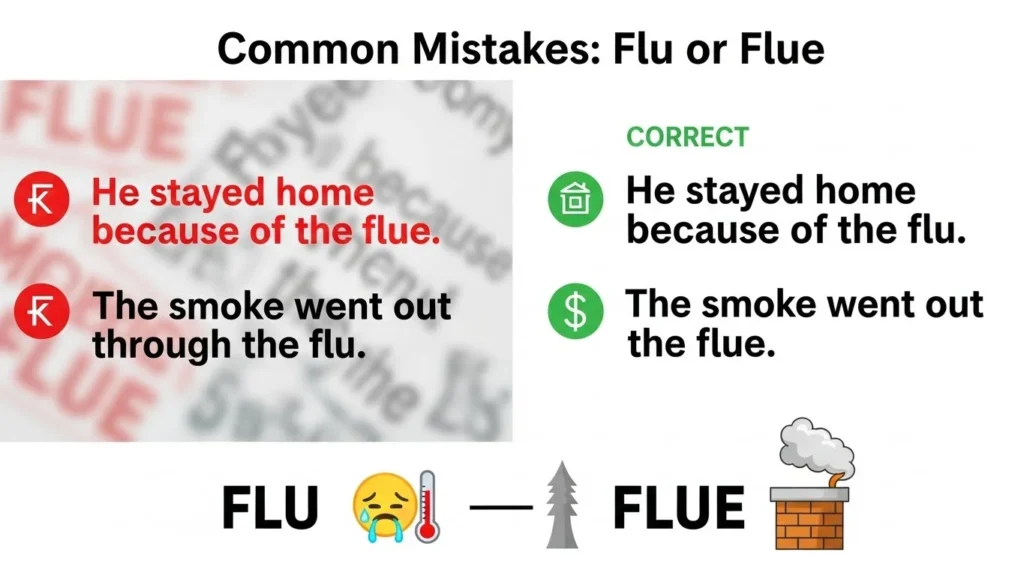
❌ He stayed home because of the flue.
✅ He stayed home because of the flu.
❌ The smoke went out through the flu.
✅ The smoke went out through the flue.
❌ Mixing meanings
✅ Match the word to the context
Usage Tips and Memory Tricks for Flu and Flue
Choosing between flu and flue becomes easy once you focus on context instead of pronunciation. Because these words are homophones, readers rely entirely on spelling to understand meaning.
In health-related writing such as medical articles, school essays, or news reports, flu should always be used to refer to influenza or viral illness. Writing flue in this context instantly looks like a spelling error.
On the other hand, flue belongs to construction, housing, and safety topics. It appears in discussions about fireplaces, chimneys, boilers, and ventilation systems.
Using flu here can cause serious confusion, especially in technical or safety instructions.A simple memory trick helps: flu makes you feel unwell, while flue helps smoke flow out both start with F, but flue relates to fire.
Always proofread homophones carefully, as spell-checkers may not catch context errors. Accurate usage improves clarity, credibility, and professional writing quality.
Flu or Flue in Everyday Examples
Health
- The flu spreads quickly in winter.
Home
- The fireplace flue needs cleaning.
News
- Hospitals are full due to the flu season.
DIY
- Blocked flue can be dangerous.
Flu or Flue : Google Trends & Usage Data
- Flu is searched heavily during winter
- Flue searches increase during home repairs
- Confusion is common due to identical pronunciation
👉 Search intent depends entirely on context.
Comparison Table: Flu vs Flue
| Feature | Flu | Flue |
| Part of speech | Noun | Noun |
| Meaning | Illness | Smoke duct |
| Pronunciation | Same | Same |
| Usage field | Medical | Construction |
| Interchangeable | ❌ No | ❌ No |
FAQs: Flu or Flue
1. Are flu and flue pronounced the same?
Yes, they are homophones.
2. Can flu ever mean a chimney pipe?
No, that is flue.
3. Is flue related to illness?
No, it relates to ventilation.
4. Which word is more common?
Flu, especially in winter.
5. Do British and American English differ here?
No, both use the same spellings.
6. Is flu short for influenza?
Yes.
Conclusion
The difference between flu or flue is simple but important. Flu refers to a viral illness, while flue refers to a pipe or channel that carries smoke or gases out of a building.
They sound the same, but their meanings are completely different.Remember this easy trick: health equals flu, fire equals flue.
Using the correct word keeps your writing clear and professional and helps avoid confusion. Once you know the context, choosing the right word becomes effortless.

I am Sidney Greenbaum, a linguist who studied how English is actually used, not just how it is taught. I analyzed sentence structure and word differences to make English clearer and more practical. My research helped learners understand real-world English comparisons.