

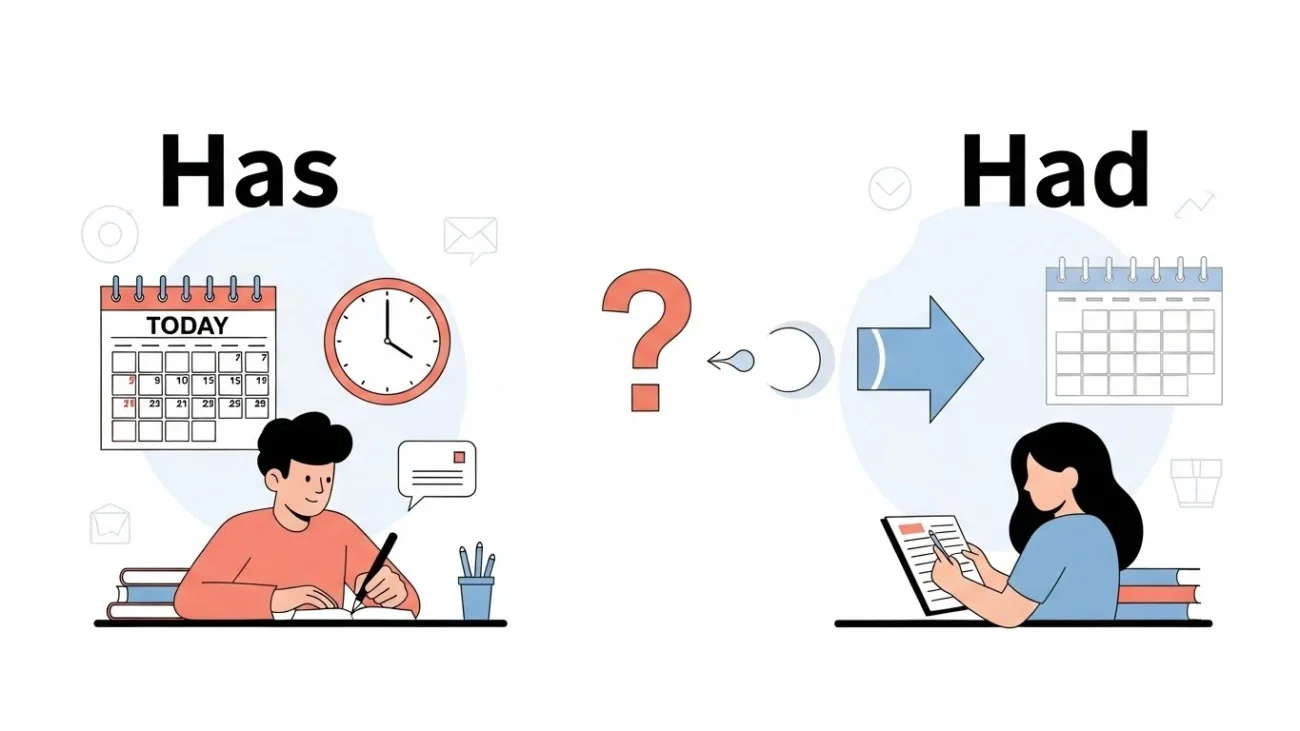
Many people search for has or had because these two small words cause big confusion in English grammar.
I often see sentences like “She has went there” or “He had a car yesterday and still has it”, and writers are unsure which form is correct. The problem usually comes from understanding time present vs past.
Both has and had are forms of the verb have, but they are used in different tenses and situations.
If you choose the wrong one, your sentence may sound confusing or incorrect, especially in exams, emails, or professional writing.
This article clears everything step by step. You’ll get a quick answer first, then a simple explanation, common mistakes, everyday examples, and practical advice.
By the end, you’ll confidently know when to use has and when had is the right choice.
Has or Had : Quick Answer
- Has is used for the present (with he, she, it).
- Had is used for the past (with all subjects).
Examples:
- She has finished her work.
- He had finished his work yesterday.
- The company has new rules.
- The company had old rules last year.
👉 Present relevance → has
👉 Past only → had
Read More:Caretaker or Caregiver: Meaning,Difference and Proper Usage
The Origin of Has or Had

The verb have comes from Old English habban, meaning to possess. Over time, English developed different forms to show tense.
- Has → present tense (third-person singular)
- Had → past tense (all subjects)
This change helps show whether something is still true now or only true in the past.
British English vs American English Spelling
There is no spelling difference between British and American English.
| Aspect | British English | American English |
| Has | Has | Has |
| Had | Had | Had |
| Grammar rule | Same | Same |
👉 Usage rules are the same worldwide.
Which Spelling Should You Use?
Use has when:
- Talking about something true now
- The subject is he, she, or it
Use had when:
- Talking about something true in the past
- The time is finished
Easy check:
If the situation still matters now → has
If it’s over → had
Common Mistakes with Has or Had
❌ She has went home.
✅ She has gone home.
❌ He had a phone and still uses it.
✅ He has a phone and still uses it.
❌ They has completed the work.
✅ They have completed the work.
Many learners confuse has and had because they focus on the sentence structure instead of the time reference.
A common mistake is using has for past events, such as “She has visited Lahore last year”, which is incorrect because the time is finished. Another frequent error is using had for situations that are still true, like “He had a car and still drives it”.
Learners also mix has with the wrong verb form, writing “has went” instead of “has gone”. Remember, has connects the action to the present, while had is only for completed past situations.
Has or Had in Everyday Examples
Emails
- She has sent the report.
- She had sent the report before the meeting.
Office
- The manager has approved the plan.
- The manager had approved it last year.
Daily Life
- He has a car now.
- He had a bike as a child.
Social Media
- I had the best day yesterday! 😊
Has or Had : Google Trends & Usage Data
Search trends show:
- High confusion among ESL learners
- Frequent grammar checks for tense usage
- Common in academic and professional writing
Top regions searching this:
- United States
- United Kingdom
- India
- Pakistan
👉 Most users want help choosing the correct tense.
Comparison Table: Has vs Had
| Feature | Has | Had |
| Tense | Present | Past |
| Used with | He, she, it | All subjects |
| Shows current relevance | Yes | No |
| Used in past perfect | No | Yes |
| Common mistake | Used for past | Used for present |
FAQs: Has or Had
1. Is “has” used for the past?
No, has is for the present.
2. Can “had” be used with he/she/it?
Yes, had works with all subjects.
3. Which one is used with yesterday?
Had.
4. Is there a US vs UK difference?
No difference.
5. What comes after has/had?
The past participle (e.g., has eaten, had eaten).
6. Is “has did” correct?
No. Use has done.
7. Which is safer in exams?
Use based on time reference present (has) or past (had).
Conclusion
The difference between has or had depends on time. Has is used for present situations that still matter now, mainly with he, she, it. Had is used for past situations that are finished.
There is no British or American difference only grammar rules apply.
Once you focus on whether the action is present or past, choosing the correct word becomes easy. Mastering has and had will greatly improve your English accuracy in writing and speaking.

I am Michael Swan, an English grammarian known for explaining confusing grammar and word comparisons in a clear way. I focused on real usage, not just rules, helping learners understand why English works the way it does. My work simplifies complex language problems for everyday users.