

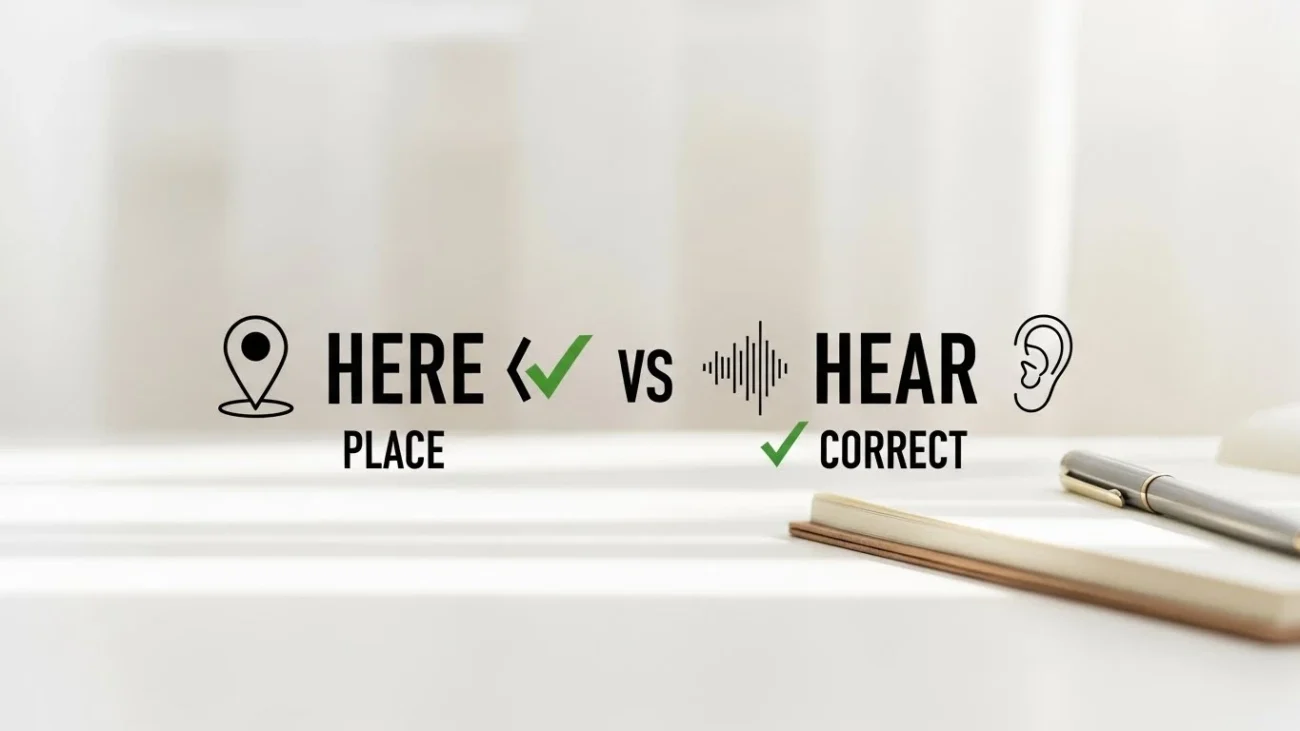
Many English learners and even fluent speakers often confuse here or hear. These two words sound exactly the same, but their meanings are completely different.
That’s why people search for this keyword so often. A small mistake between here and hear can change the meaning of a sentence and make your writing unclear or incorrect.
I’ve seen this confusion happen in emails, exams, social media posts, and even professional writing.
Someone wants to talk about listening, but they accidentally write a word that refers to place. Because English has many such sound-alike words, this mistake is very common, especially for non-native speakers.
This article solves that confusion step by step. You’ll get a quick answer first, then a clear explanation of meanings, origins, usage, common mistakes, and real-life examples.
By the end, you’ll easily know when to use here and when to use hear, without hesitation.
Here or Hear: Quick Answer
Here refers to a place or location.
Hear refers to the ability to listen or perceive sound.
Examples:
- I am here right now.
- Can you hear the music?
👉 Place or position → Here
👉 Sound or listening → Hear
Discover More Article:Either or Eather : Meaning, Difference and Which One Is Correct?
The Origin of Here or Hear
Here comes from Old English hēr, meaning in this place. Its meaning has always been related to location.
Hear comes from Old English hīeran, meaning to listen or perceive sound. This root explains why it is connected to ears and sound.
The confusion exists because:
- Both words are pronounced the same
- Both are very common
- English spelling does not always match pronunciation
But historically, they come from completely different roots.
British English vs American English Spelling
There is no spelling difference between British and American English for here or hear.
| Aspect | British English | American English |
| Here | Same spelling, same meaning | Same spelling, same meaning |
| Hear | Same spelling, same meaning | Same spelling, same meaning |
| Difference | Meaning-based | Meaning-based |
👉 This is a homophone issue, not a regional spelling issue.
Which Spelling Should You Use?
Always choose based on meaning, not accent or country.
- US audience → Same rule applies
- UK/Commonwealth → Same rule applies
- Global writing → Context must be clear
Easy tip:
- If you can replace the word with listen → use hear
- If you can replace it with this place → use here
Common Mistakes with Here or Hear
❌ I am happy to hear with you.
✅ I am happy to be here with you.
❌ Please here me out.
✅ Please hear me out.
❌ Can you here the noise?
✅ Can you hear the noise?
Memory trick:
- Hear has ear inside it → related to listening
- Here relates to where
Why Mixing Up Here and Hear Can Cause Misunderstanding
Confusing here and hear may seem like a minor error, but it can easily confuse the reader. In spoken English, the meaning is often clear from tone or situation, but in writing, the reader only relies on words. If you write “I am glad to here you,” the reader may pause and reread the sentence to understand your intention.
In professional emails, instructions, or academic writing, such mistakes can reduce clarity and credibility. Readers may focus more on the error than on your message. This is why writers should always double check homophones . A quick meaning check before submitting or publishing can prevent misunderstanding and make your writing sound more confident and polished.
Here or Hear in Everyday Examples
Emails
- I am here to help you.
- I’m glad to hear from you.
News
- The minister is here for the meeting.
- We hear reports of heavy rain.
Social Media
- Finally here after a long day.
- Love to hear your thoughts.
Formal Writing
- The document is attached here.
- The court will hear the case tomorrow.
Here or Hear : Google Trends & Usage Data
Search trends show:
- Both words are very common
- Confusion searches are high among ESL learners
- Hear appears more in communication contexts
- Here appears more in location-based phrases
Top regions searching this keyword:
- India
- Pakistan
- United States
- United Kingdom
👉 Users mostly want clear examples, not grammar rules.
Comparison Table: Here vs Hear
| Feature | Here | Hear |
| Meaning | Location | Listening |
| Type | Adverb | Verb |
| Context | Place, position | Sound, communication |
| Memory Tip | Where | Ear |
| Common Error | Used for listening | Used for place |
FAQs: Here or Hear
1. Are here and hear pronounced the same?
Yes, they sound exactly the same.
2. Is this a UK vs US spelling issue?
No, both use the same spelling.
3. Can hear mean understand?
Yes, informally, it can mean listen or pay attention.
4. Can here be used in emails?
Yes, very commonly.
5. Which word is more common in speech?
Both are equally common.
6. Does hear always involve sound?
Yes, directly or indirectly.
7. Can here be a noun?
No, it is mainly an adverb.
Conclusion
The difference between here or hear is simple once you focus on meaning. Here talks about place, while hear talks about sound and listening.
Because they sound the same, writers often confuse them, but context always gives the correct answer.
If your sentence is about location, presence, or position, use here. If it is about listening, sound, or communication, use hear.
There is no spelling difference between British and American English only correct or incorrect usage.
Mastering small word pairs like here or hear makes your English clearer, more professional, and more confident.

I am Mark Twain, a writer who loved the English language for its humor, irony, and everyday comparisons. I used simple words to show deep differences between truth and lies, wisdom and foolishness. My writing proves that clear English is always more powerful than complicated English.