

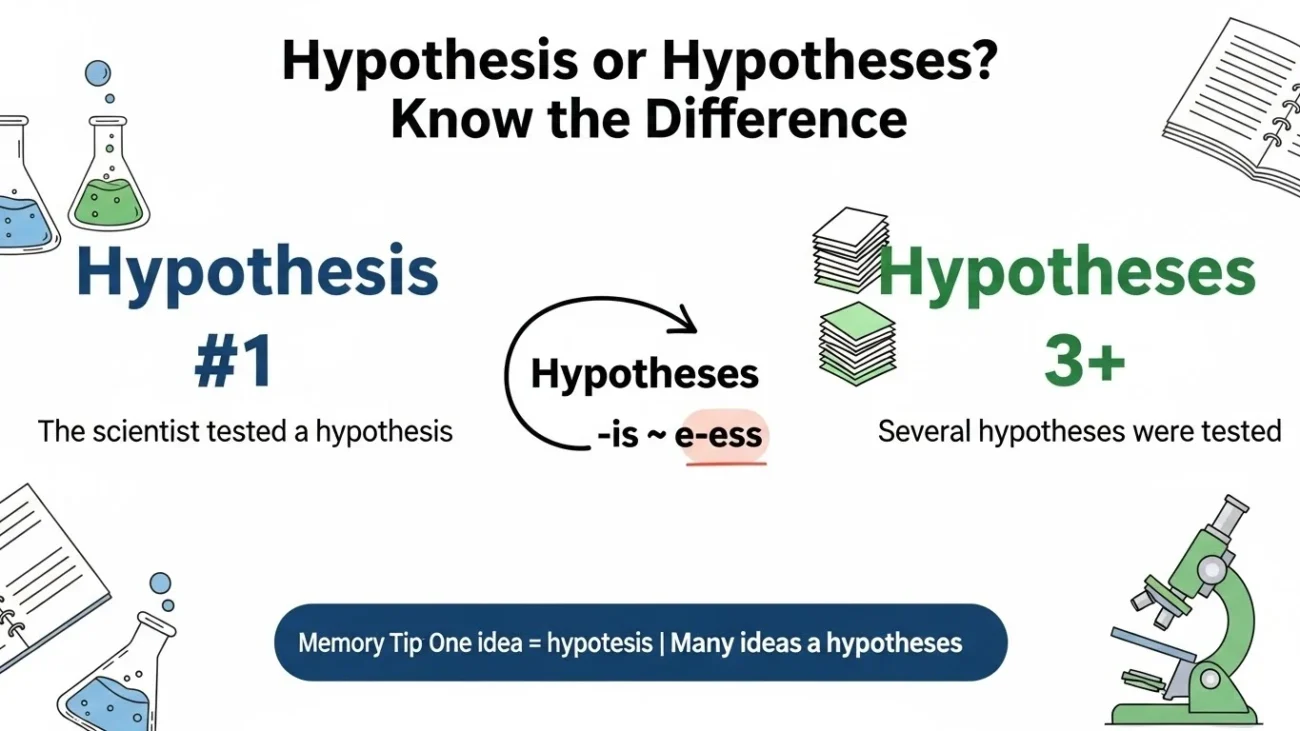
Many people search for hypothesis or hypotheses because the two words look similar, and it’s easy to confuse them when writing academic papers, essays, or research reports.
Using the wrong form can make your writing grammatically incorrect or unclear.
The confusion comes from singular vs. plural forms in English, especially with words borrowed from Greek or Latin. This article clears the confusion in a simple, clear way.
You’ll get a quick answer, learn the origin, common mistakes, real-life examples, and expert advice.
By the end, you’ll confidently know when to use hypothesis and when hypotheses is correct.
Hypothesis or Hypotheses : Quick Answer
- 🔹 Hypothesis → singular, one idea or assumption
- 🔹 Hypotheses → plural, multiple ideas or assumptions
Examples:
- The scientist tested a hypothesis about plant growth.
- Several hypotheses were considered before the experiment.
👉 One idea = hypothesis
👉 More than one = hypotheses
Read More : Flak or Flack :Which One Is Correct in English?
The Origin of Hypothesis or Hypotheses
- Hypothesis comes from Greek hypotithenai, meaning to suppose or to put under.
- Hypotheses is simply the plural form in Greek style, ending with -es instead of adding -s.
The plural follows Greek rules rather than standard English, which is why it looks different from regular plurals.
British English vs American English Spelling
There is no difference in spelling between British and American English.
| Word | British English | American English |
| Hypothesis | Same | Same |
| Hypotheses | Same | Same |
👉 The difference is number (singular vs plural), not region.
Which Word Should You Use?
Use hypothesis when:
- Referring to a single assumption or scientific idea
Use hypotheses when:
- Referring to multiple assumptions or ideas in research
Tip: Count the number of ideas: one = hypothesis, many = hypotheses.
Common Mistakes with Hypothesis or Hypotheses
❌ The scientists tested several hypothesis.
✅ The scientists tested several hypotheses.
❌ I have three hypotheses about this. (correct)
✅ Correct ✅
❌ Mixing singular and plural in one sentence
✅ Make sure singular and plural match the context
Because hypothesis and hypotheses come from Greek, many writers apply normal English plural rules and make mistakes. These errors are extremely common in academic writing, exams, and research papers.
- Using hypothesis as a plural
❌ The study tested several hypothesis.
✅ The study tested several hypotheses.
Why wrong: Hypothesis is singular; hypotheses is the plural form. - Adding “-s” incorrectly
❌ Many hypothesis were rejected.
✅ Many hypotheses were rejected.
Rule: Do not add -s to hypothesis. The plural changes to -es. - Mismatch between subject and verb
❌ These hypotheses is interesting.
✅ These hypotheses are interesting.
Tip: Plural nouns must take plural verbs. - Mixing singular and plural in one idea
❌ This hypotheses explains the result.
✅ This hypothesis explains the result.
Be consistent: one idea = hypothesis, many ideas = hypotheses. - Pronunciation-based spelling errors
❌ Hypothesies / hypothisis
✅ Hypotheses
These spellings are incorrect and often cost marks in exams. - Overusing plural unnecessarily
❌ The research has one main hypotheses.
✅ The research has one main hypothesis.
Avoiding these mistakes improves academic accuracy, clarity, and professionalism, especially in scientific and research writing.
Hypothesis vs Hypotheses in Everyday Examples
- Each hypothesis must be tested carefully.
- The experiment evaluated multiple hypotheses.
Education
- Teachers explain how to form a hypothesis.
- Students brainstorm several hypotheses for their projects.
Research
- A good research paper discusses alternative hypotheses.
- Only one hypothesis can be tested in a specific trial.
Comparison Table: Hypothesis vs Hypotheses
| Feature | Hypothesis | Hypotheses |
| Number | Singular | Plural |
| Meaning | One assumption | Multiple assumptions |
| Usage | One idea | Multiple ideas |
| Common error | Using as plural | Using as singular |
| Origin | Greek | Greek plural form |
FAQs: Hypothesis or Hypotheses
1. Can hypothesis mean more than one idea?
No, it is singular. Use hypotheses for more than one.
2. Is hypotheses pronounced differently?
Yes, hy-PO-thuh-seez.
3. Do British and American English differ?
No, both use the same forms.
4. Can I use hypothesis in casual writing?
Yes, when referring to a single idea.
5. Can hypotheses appear in research papers?
Yes, when discussing multiple assumptions.
6. Is the plural formed regularly with -s?
No, it follows Greek rules: hypothesis → hypotheses.
Conclusion
The difference between hypothesis or hypotheses is about singular vs plural. Hypothesis refers to a single assumption or idea, while hypotheses refers to multiple assumptions. Using the wrong form can make academic writing incorrect or confusing.
A simple tip: one = hypothesis; more than one = hypotheses. Understanding this small but important distinction ensures clear, professional, and accurate writing in science, research, and everyday use.

I am Sidney Greenbaum, a linguist who studied how English is actually used, not just how it is taught. I analyzed sentence structure and word differences to make English clearer and more practical. My research helped learners understand real-world English comparisons.