

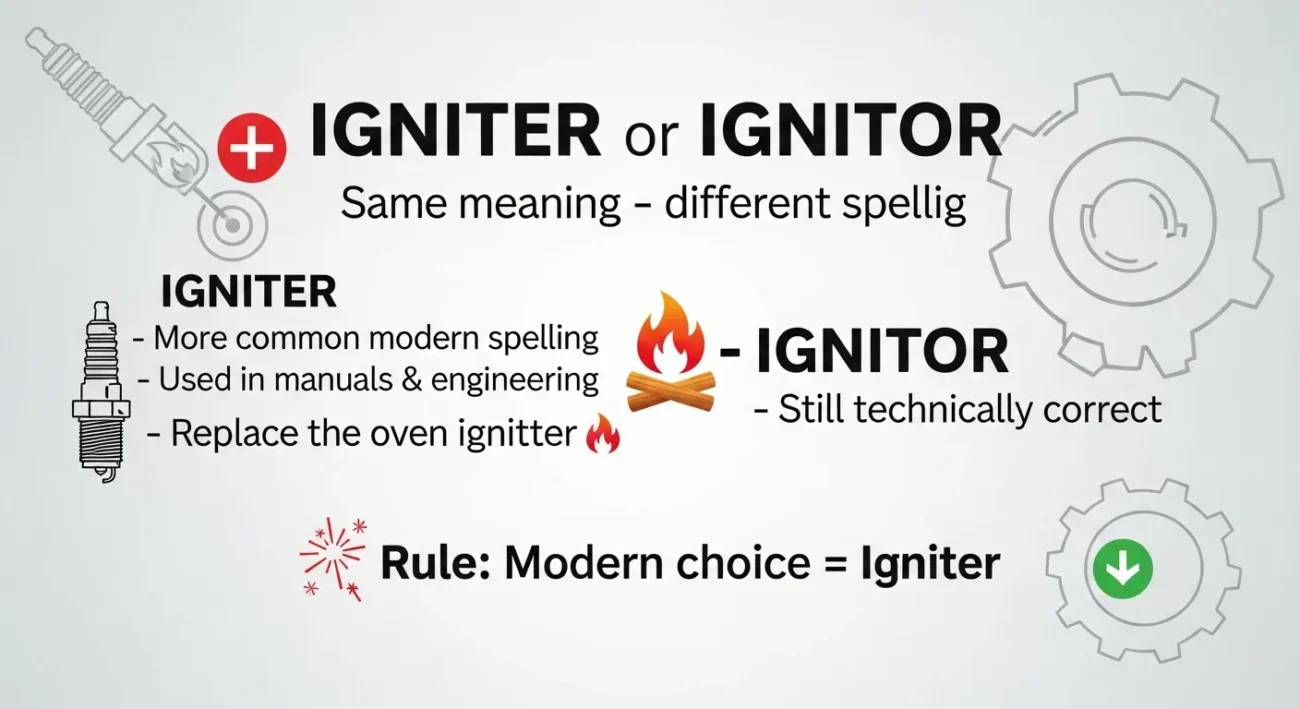
Ignitor or igniter? The quick answer: both are correct, but “igniter” is more common in modern English.
I once paused while writing about a gas stove because I was unsure which spelling looked right. I searched it, just like many people do. Mechanics, engineers, students, and home users often face this confusion. Is one American? Is one technical? Which spelling appears on product manuals?
In this guide, I will explain the difference, origin, spelling patterns, common mistakes, real-life examples, and which version you should choose.
Ignitor or Igniter: Quick Answer
Both words mean the same thing:
A device that starts combustion or creates a spark.
- Igniter → More common modern spelling
- Ignitor → Less common but still correct
Example:
- The gas stove igniter stopped working.
- The rocket ignitor failed during testing.
The meaning stays the same. Only spelling changes.
The Origin of Ignitor and Igniter
Both words come from the verb ignite, which means “to set on fire.”
The base word comes from Latin ignis, meaning “fire.”
English often forms agent nouns (things that do an action) using:
- -er (writer, burner, driver)
- -or (actor, motor, creator)
Because “ignite” ends in “-ite,” the natural modern pattern forms igniter.
Over time, both spellings appeared in technical writing and manuals.
British English vs American English Spelling
Unlike words such as color/colour, this difference is not strictly US vs UK.
However, spelling patterns give a clue.
| Pattern Type | Example | Common Form |
| Verb + -er | write → writer | Very common |
| Verb + -or | act → actor | Common |
| ignite → ? | igniter | More common |
In both American and British English, “igniter” is more frequently used today.
Technical manuals, appliance parts, and engineering documents usually prefer “igniter.”
Which Spelling Should You Use?
Here is simple advice:
For Modern Writing
Use igniter. It is more common and widely accepted.
For Technical or Engineering Context
“Igniter” appears more often in product descriptions and manuals.
If You See “Ignitor” on a Product
It is not wrong. Some manufacturers still use it.
For Consistency
Choose one spelling and use it throughout your document.
When I write about appliances or engines, I prefer “igniter” because it feels more natural.
Common Mistakes with Ignitor or Igniter
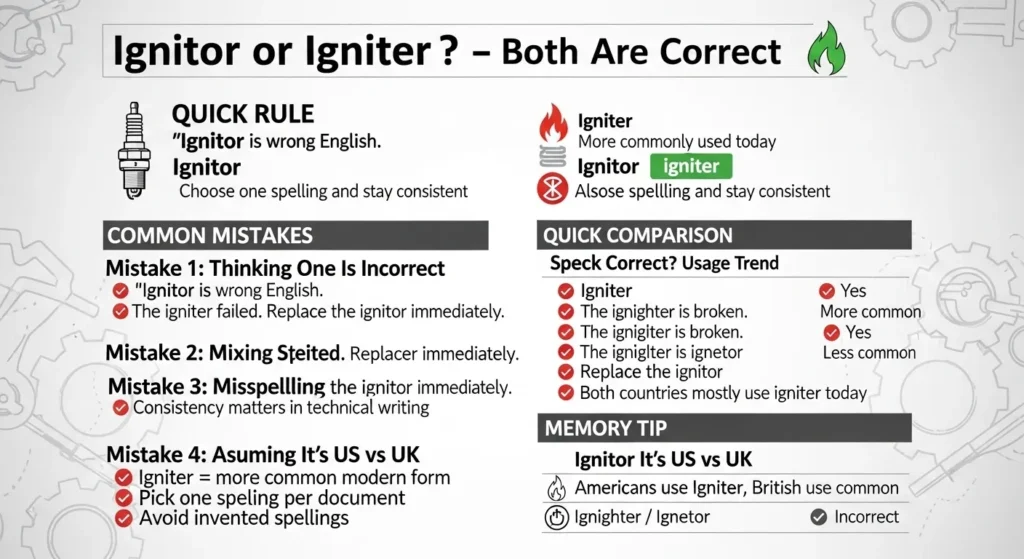
Mistake 1: Thinking One Is Incorrect
❌ “Ignitor” is wrong English.
✅ Both “ignitor” and “igniter” are correct.
Mistake 2: Mixing Both Spellings in One Document
❌ The igniter failed. Replace the ignitor immediately.
✅ The igniter failed. Replace the igniter immediately.
Mistake 3: Misspelling the Word
❌ The ignighter is broken.
✅ The igniter is broken.
❌ Replace the ignetor.
✅ Replace the ignitor.
Mistake 4: Assuming It’s a US vs UK Difference
❌ Americans use igniter, British use ignitor.
✅ Both countries mostly use “igniter” today.
Igniter or Ignitor in Everyday Examples
You may see the word in many places.
In Appliance Manuals
“Replace the oven igniter if it does not spark.”
In Automotive Repair
“The engine igniter controls the spark timing.”
In Rocket Science
“Engineers tested the solid rocket igniter.”
In Online Shopping
“Gas grill igniter replacement kit.”
Most listings today use “igniter.”
Ignitor or Igniter: Google Trends & Usage Data
Search patterns show:
- Igniter has higher search volume globally.
- “Ignitor” appears less often but still shows up in product listings.
- Technical documents increasingly prefer “igniter.”
Across the United States, United Kingdom, Canada, and Australia, “igniter” dominates in online searches.
The trend shows that “igniter” is becoming the standard modern spelling.
Comparison Table: Igniter vs Ignitor
| Feature | Igniter | Ignitor |
| Meaning | Device that starts combustion | Same meaning |
| Common Usage | Very common | Less common |
| Modern Preference | Yes | Less preferred |
| Technically Correct | Yes | Yes |
| Seen in Manuals | Often | Sometimes |
Frequently Asked Questions
1. Is ignitor or igniter correct?
Both are correct. “Igniter” is more common today.
2. Which spelling is more popular?
“Igniter” has higher global usage.
3. Do they mean different things?
No. Both refer to a device that creates ignition.
4. Which spelling appears in appliance manuals?
Most manuals use “igniter.”
5. Is ignitor outdated?
Not outdated, but less common in modern writing.
6. Should I use igniter in technical writing?
Yes. It is the safer and more widely accepted choice.
7. Can I mix both spellings?
No. Choose one and stay consistent.
Conclusion
Ignitor or igniter may look different, but they mean the same thing: a device that starts fire or combustion. The difference is mainly spelling preference. Modern English, especially in technical and product contexts, prefers “igniter.” “Ignitor” still appears but is less common.
When I first faced this choice, I felt unsure. Now I simply use “igniter” because it matches modern usage and product manuals. The key is consistency. Pick one spelling and stick with it throughout your writing.
Language evolves over time. Usage trends show that “igniter” is becoming the standard. Now you can confidently choose the right spelling based on context and clarity.
Discover More Articles:

I am Mark Twain, a writer who loved the English language for its humor, irony, and everyday comparisons. I used simple words to show deep differences between truth and lies, wisdom and foolishness. My writing proves that clear English is always more powerful than complicated English.