

Many people search for inexcusable or unexcusable because both words seem correct and are often used to describe bad behavior or serious mistakes.
You may have seen sentences like “His delay was unexcusable” and “Her actions were inexcusable” and wondered if one is more correct than the other.
The confusion happens because both words share the same meaning and are formed using different prefixes: in- and un-.
English allows both in some cases, but usage trends and style guides show a clear preference.
This article clears the confusion step by step. You’ll get a quick answer first, then learn word origins, usage differences, British vs American preferences, common mistakes, everyday examples, and professional advice.
By the end, you’ll know exactly which word to use and why.
Inexcusable or Unexcusable : Quick Answer
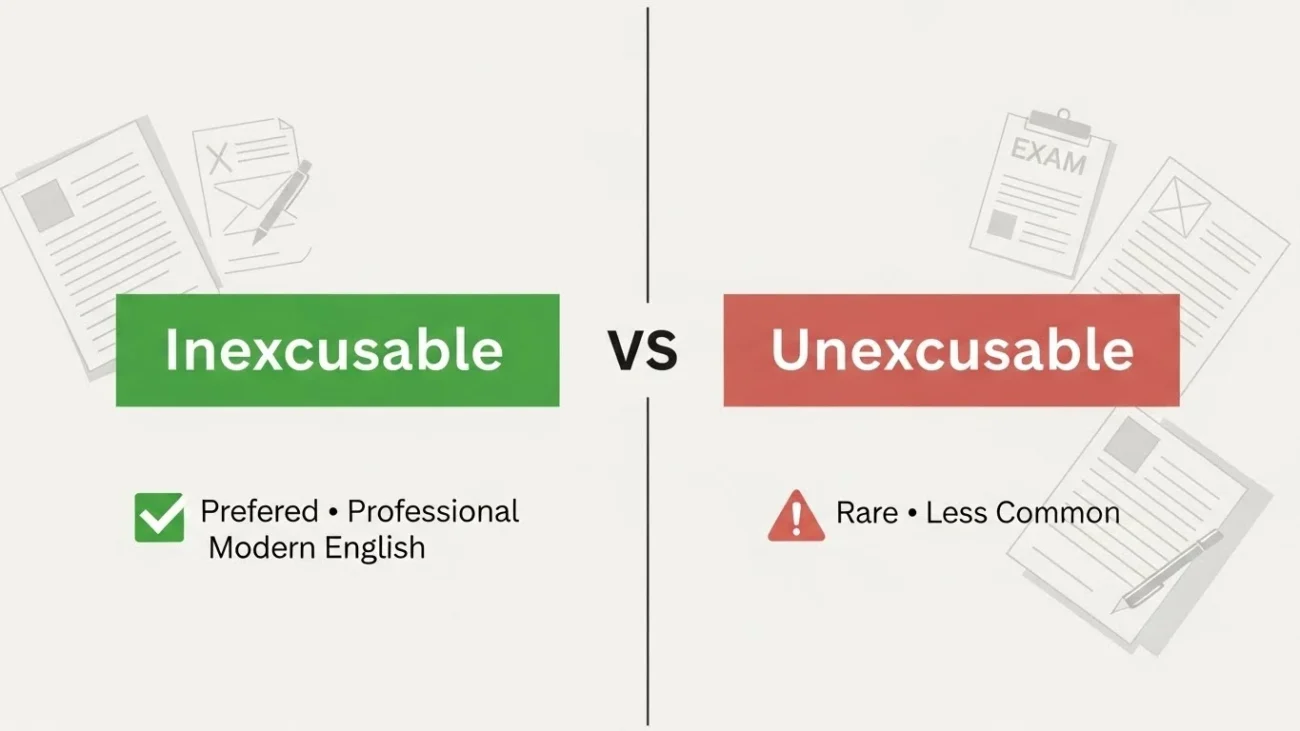
- ✅ Inexcusable → correct and preferred in modern English
- ⚠️ Unexcusable → understandable but less common
Examples:
- His behavior was inexcusable.
- The delay is inexcusable.
👉 Use inexcusable for safe, professional writing.
Read More : Genius or Genious : Which Spelling Is Correct and Why?
The Origin of Inexcusable or Unexcusable
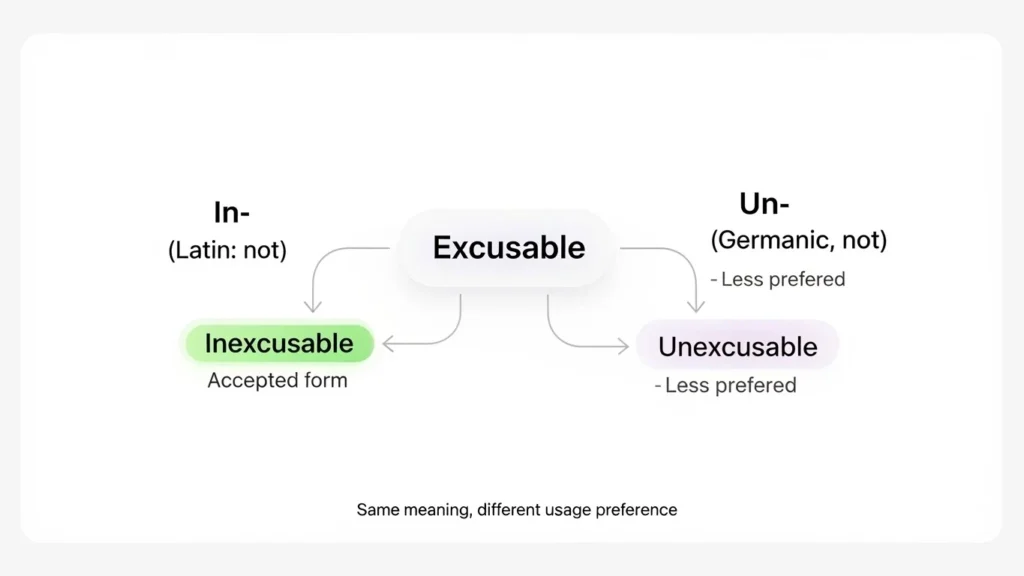
Both words come from excuse, which originates from Latin excusare, meaning to free from blame.
- In- means not (Latin origin)
- Un- also means not (Germanic origin)
English sometimes allows both prefixes, but over time, usage settles on one preferred form. In this case, inexcusable became the dominant and accepted form in modern English.
British English vs American English Spelling
There is no spelling difference between British and American English.
| Aspect | British English | American English |
| Preferred form | Inexcusable | Inexcusable |
| Unexcusable usage | Rare | Rare |
| Meaning | Same | Same |
👉 Both varieties strongly favor inexcusable.
Which Spelling Should You Use?
Use inexcusable when:
- Writing formally
- Writing professionally
- Writing for exams or publications
- Expressing strong disapproval
Professional advice:
If you want your writing to sound polished and correct, always choose inexcusable.
Common Mistakes with Inexcusable or Unexcusable
❌ His mistake was unexcusable.
✅ His mistake was inexcusable.
❌ The service delay is unexcusable.
✅ The service delay is inexcusable.
❌ Using unexcusable in formal writing.
✅ Use inexcusable instead.
One common mistake with inexcusable and unexcusable is assuming that both forms are equally accepted in modern English.
While unexcusable may sound logical, it is far less common and often avoided in formal writing.
Another frequent error is using unexcusable in professional emails, academic papers, or exam answers, where style guides clearly prefer inexcusable.
Writers also mistakenly believe that British English prefers one form and American English the other, but in reality, both varieties strongly favor inexcusable.
Some learners overgeneralize the prefix un- and apply it automatically, ignoring usage trends. In critical or serious contexts such as describing misconduct, delays, or ethical failures using unexcusable can make the writing sound informal or nonstandard. To avoid mistakes, remember this rule: if the context is formal, serious, or professional, always choose inexcusable. This small word choice improves clarity, credibility, and correctness instantly.
Inexcusable or Unexcusable in Everyday Examples
Workplace
- The missed deadline was inexcusable.
Education
- Cheating is inexcusable behavior.
Customer Service
- This level of delay is inexcusable.
Social Media
- That comment was totally inexcusable 😠
Inexcusable or Unexcusable : Google Trends & Usage Data
Search trends show:
- Inexcusable dominates global usage
- Unexcusable appears mainly in informal writing
- Editors and grammar guides recommend inexcusable
Top regions searching this:
- United States
- United Kingdom
- India
- Pakistan
👉 Most users want the correct and preferred form.
Comparison Table: Inexcusable vs Unexcusable
| Feature | Inexcusable | Unexcusable |
| Grammatically correct | ✅ Yes | ⚠️ Yes |
| Preferred usage | ✅ Yes | ❌ No |
| Formal writing | ✅ Yes | ❌ Avoid |
| Common in modern English | High | Low |
| Recommended choice | Always | Rarely |
FAQs: Inexcusable or Unexcusable
1. Is unexcusable wrong?
Not wrong, but uncommon and discouraged.
2. Which word is better for exams?
Inexcusable.
3. Do British and American English differ?
No, both prefer inexcusable.
4. Which sounds more professional?
Inexcusable.
5. Can unexcusable be used casually?
Yes, but it’s still less common.
6. What does inexcusable mean?
Something that cannot be forgiven.
7. Which word should writers avoid?
Unexcusable, in formal contexts.
Conclusion
The confusion between inexcusable or unexcusable comes from English allowing multiple prefixes with the same meaning. While both forms exist, inexcusable is clearly the preferred, accepted, and professional choice in modern English.
There is no British or American difference here both varieties strongly favor inexcusable. If you want your writing to sound accurate, formal, and confident, always choose inexcusable. This small choice can make a big difference in how your writing is judged.

I am Sidney Greenbaum, a linguist who studied how English is actually used, not just how it is taught. I analyzed sentence structure and word differences to make English clearer and more practical. My research helped learners understand real-world English comparisons.