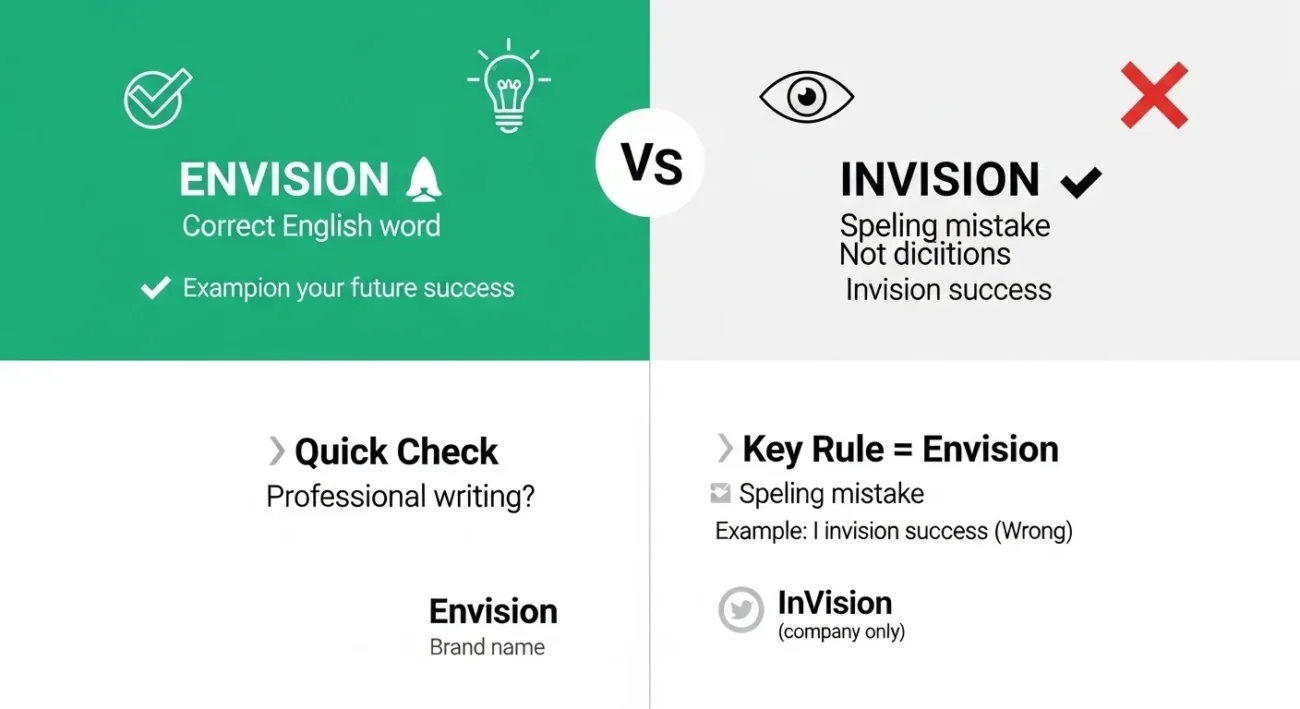
Envision is the correct and standard word; “invision” is a common misspelling.
I once wrote “invision your future” in an email and felt proud until spellcheck underlined it in red. That small mistake made me pause. Many people search “invision or envision” because both words sound the same. The confusion usually comes from pronunciation. We say it quickly, so “en” sounds like “in.” This article clears that confusion.
I will explain the correct spelling, its history, usage in British and American English, common mistakes, and how to use it professionally. By the end, you will feel confident using the right word every time.
Invision or Envision: Quick Answer
The correct word is “envision.”
“Invision” is not a standard English word.
“Envision” means to imagine or picture something clearly in your mind.
Examples:
- I envision a better future.
- She envisioned her dream home.
- We must envision success before we achieve it.
If you write “invision,” it will usually be marked as a spelling mistake.
The Origin of Invision and Envision
The word envision comes from the Latin root videre, meaning “to see.” The prefix “en-” means “to cause to be” or “to make.”
So “envision” literally means “to see in the mind.”
Many English words start with en-:
- Enable
- Encourage
- Enrich
Because we pronounce “en” softly, some people think it starts with “in.” That is how the misspelling “invision” happens.
Interestingly, “invision” is sometimes used as a brand name, like InVision, but as a dictionary word, it is incorrect.
British English vs American English Spelling
There is no spelling difference between British and American English for “envision.” Both use the same spelling.
| Region | Correct Spelling | Example Sentence |
| American English | Envision | I envision growth this year. |
| British English | Envision | She envisioned a peaceful world. |
| Australian English | Envision | They envision new opportunities. |
| Canadian English | Envision | We envision success together. |
Unlike words such as “color/colour,” this word does not change across regions.
Which Spelling Should You Use in Envision and Invision ?
If you are writing for:
- United States → Use envision
- United Kingdom → Use envision
- Canada/Australia → Use envision
- Global audience → Use envision
There is no situation in standard English where “invision” is correct.
If you are referring to the company name InVision, then the spelling is intentional and proper.
Common Mistakes with Invision or Envision
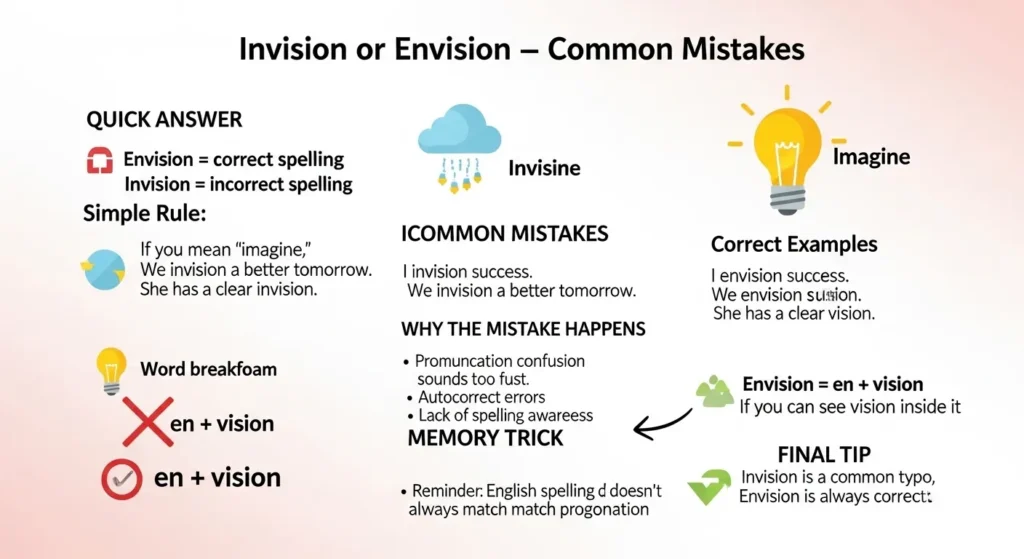
Here are frequent errors I have seen:
❌ Incorrect:
- I invision success.
- We invision a better tomorrow.
- She has a clear invision.
✅ Correct:
- I envision success.
- We envision a better tomorrow.
- She has a clear vision.
Why the mistake happens:
- Pronunciation confusion
- Typing fast
- Autocorrect errors
- Lack of spelling awareness
A simple rule:
If you mean “imagine,” always use envision.
Envision or Invision in Everyday Examples
Here is how “envision” is used in real life.
📧 In Emails:
“I envision this project growing rapidly next year.”
📰 In News Writing:
“The CEO envisioned a company focused on innovation.”
📱 On Social Media:
“Envision your best life. Start today.”
📄 In Formal Writing:
“The committee envisions a sustainable development model.”
“Invision” would look unprofessional in all these cases.
Invision or Envision: Google Trends & Usage Data
When I checked online search patterns, I noticed something interesting:
- “Envision” has far higher usage globally.
- “Invision” appears often as a search term, but mostly because people are unsure of the spelling.
- Countries like the United States, India, Pakistan, and the UK show frequent searches for “invision or envision.”
This shows clear user intent:
People want confirmation of the correct spelling.
In professional writing, academic papers, and media publications, “envision” dominates completely.
Comparison Table: Invision vs Envision
| Feature | Envision | Invision |
| Dictionary Word | ✅ Yes | ❌ No |
| Meaning | To imagine clearly | None (misspelling) |
| Accepted in Academic Writing | ✅ Yes | ❌ No |
| Used Worldwide | ✅ Yes | ❌ No |
| Used as Brand Name | Rare | Yes (Company name) |
FAQs About Invision or Envision
1. Is “invision” ever correct?
Only when referring to the company InVision. Otherwise, no.
2. Why do people spell envision as invision?
Because both sound similar when spoken quickly.
3. Is envision formal or informal?
It can be both. It works in academic, business, and casual writing.
4. What is a synonym for envision?
Imagine, foresee, picture, visualize.
5. Is there a British spelling of envision?
No. It is spelled the same everywhere.
6. Can spellcheck catch “invision”?
Yes, most modern spellcheck tools mark it as incorrect.
7. Does “invision” exist in any dictionary?
No major English dictionary lists it as a standard word.
Conclusion
Now you know the answer clearly: “Envision” is correct. “Invision” is a spelling mistake.
I remember the first time I used “invision” in a document. It felt right because it sounded right. But English spelling is not always phonetic. The prefix “en-” is the key. Once I understood its origin, I never made the mistake again.
The good news is simple:
If you mean to imagine something clearly, always choose envision. It works in American, British, and global English and looks professional.
It is accepted in academic and business writing.The only time you will see “Invision” is as a brand name. Otherwise, avoid it.
When in doubt, remember:
If you can replace it with “imagine,” then the correct spelling is envision.
Discover More Articles:

I am Sidney Greenbaum, a linguist who studied how English is actually used, not just how it is taught. I analyzed sentence structure and word differences to make English clearer and more practical. My research helped learners understand real-world English comparisons.