

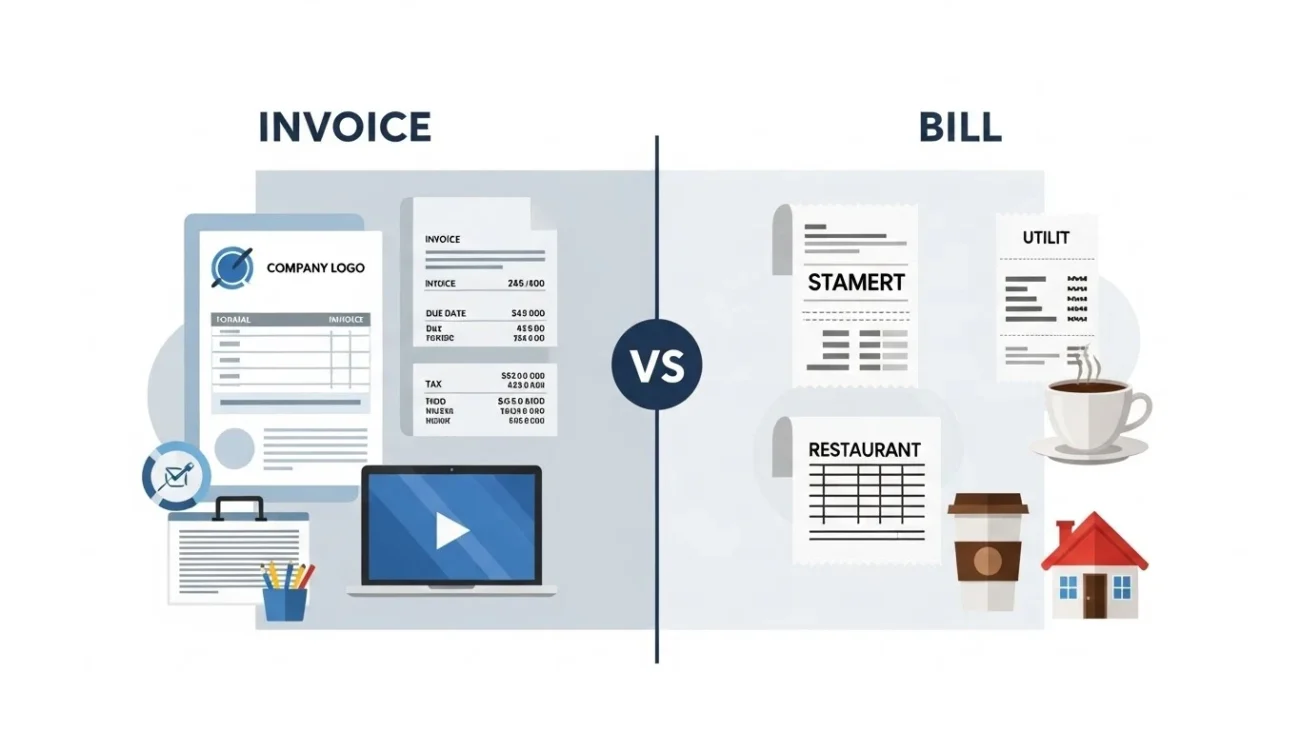
Many people search for invoice or bill because these words are often used interchangeably in daily life, business, and online payments. You might hear someone say, “Send me the bill,” while another asks, “Where is the invoice?” This creates confusion especially for freelancers, business owners, students, and office workers.
I’ve seen emails where a client asks for a bill when they actually need an invoice for accounting. I’ve also seen customers wait for an invoice when the restaurant already gave them a bill. The mixup happens because both words relate to payment, but they serve different purposes.
This article clears that confusion in a simple way. You’ll get a quick answer, then learn origins, British vs American usage, common mistakes, everyday examples, and professional advice. By the end, you’ll clearly know when to use invoice and when bill is the correct word.
Invoice or Bill : Quick Answer
An invoice is a formal document requesting payment, usually issued before payment.
A bill is a statement of charges, often given at or after payment time.
Examples:
- The company sent an invoice for services.
- The waiter brought the bill after dinner.
👉 Business & formal → Invoice
👉 Daily expenses & services → Bill
Read More: Need or Needs: What’s the Difference and Which One Is Correct?
The Origin of Invoice or Bill
Invoice comes from the French word envoi, meaning dispatch or list of goods. Over time, it became a formal document listing items, prices, and payment terms.
Bill comes from the Latin bulla, meaning document or seal. It later evolved into a general term for a written statement of charges.
The confusion exists because:
- Both involve money
- Both list amounts owed
- Both are used in payment contexts
But their formality and timing differ.
British English vs American English Spelling
There is no spelling difference, but usage preference varies.
| Aspect | British English | American English |
| Invoice | Common | Common |
| Bill | Very common | Very common |
| Business usage | Invoice | Invoice |
| Daily usage | Bill | Bill |
👉 Meaning stays the same in both varieties.
Which Spelling Should You Use?
Choose based on context and audience.
- Freelancers & businesses → Invoice
- Restaurants & utilities → Bill
- Accounting & tax records → Invoice
- Casual conversation → Bill
Professional tip:
If payment terms, dates, or tax details are included, use invoice.
Common Mistakes with Invoice or Bill
❌ Please pay the bill within 30 days.
✅ Please pay the invoice within 30 days.
❌ The restaurant emailed an invoice.
✅ The restaurant gave a bill.
❌ Attach the bill for accounting.
✅ Attach the invoice for accounting.
Memory trick:
- Invoice → official & formal
- Bill → everyday payment
Understanding the difference between invoice and bill is especially important for anyone involved in payments, bookkeeping, or client communication. Using the wrong term can lead to confusion, delayed payments, or unprofessional impressions.
For example, businesses rely on invoices because they include essential details such as invoice numbers, tax information, due dates, and payment terms. These details are critical for accounting and legal records. Bills, on the other hand, are designed for quick settlement and are usually simple summaries of charges.
This is why restaurants, utility companies, and service providers prefer the word bill. Another key point is expectation: an invoice signals that payment is expected later, while a bill often suggests immediate or near-immediate payment. By choosing the correct term, you set clear expectations and avoid unnecessary follow up questions.
Invoice or Bill in Everyday Examples
Business Email
- Please find the attached invoice.
Restaurant
- Can I get the bill, please?
Utilities
- The electricity bill is due.
Freelancing
- I sent an invoice for last month’s work.
Invoice or Bill : Google Trends & Usage Data
Usage trends show:
- Invoice searched more in business contexts
- Bill searched more for utilities and dining
- High confusion among freelancers and startups
Top regions searching this:
- United States
- United Kingdom
- India
- Pakistan
👉 Users mainly want professional clarity.
Comparison Table: Invoice vs Bill
| Feature | Invoice | Bill |
| Purpose | Request payment | Show charges |
| Formality | Formal | Informal |
| Timing | Before payment | At or after service |
| Used in business | Yes | Sometimes |
| Used in daily life | Rare | Very common |
FAQs: Invoice or Bill
1. Is an invoice the same as a bill?
No. An invoice is more formal.
2. Which comes first, invoice or bill?
Usually, an invoice comes first.
3. Can a bill be used for accounting?
Sometimes, but invoices are preferred.
4. Do restaurants give invoices?
No, they usually give bills.
5. Are utility statements invoices or bills?
They are usually called bills.
6. Is invoice a legal document?
Yes, in business contexts.
7. Which word is safer professionally?
Invoice.
Conclusion
The difference between invoice or bill lies in formality and purpose. An invoice is a formal request for payment used in business, freelancing, and accounting. A bill is a more casual statement of charges, commonly used in restaurants, utilities, and everyday life.
There is no British or American spelling difference only correct usage based on context. If you are working professionally or handling records, invoice is the safer and clearer choice.
For daily expenses, bill sounds natural and correct. Understanding this difference helps you communicate clearly and professionally.

I am Mark Twain, a writer who loved the English language for its humor, irony, and everyday comparisons. I used simple words to show deep differences between truth and lies, wisdom and foolishness. My writing proves that clear English is always more powerful than complicated English.