

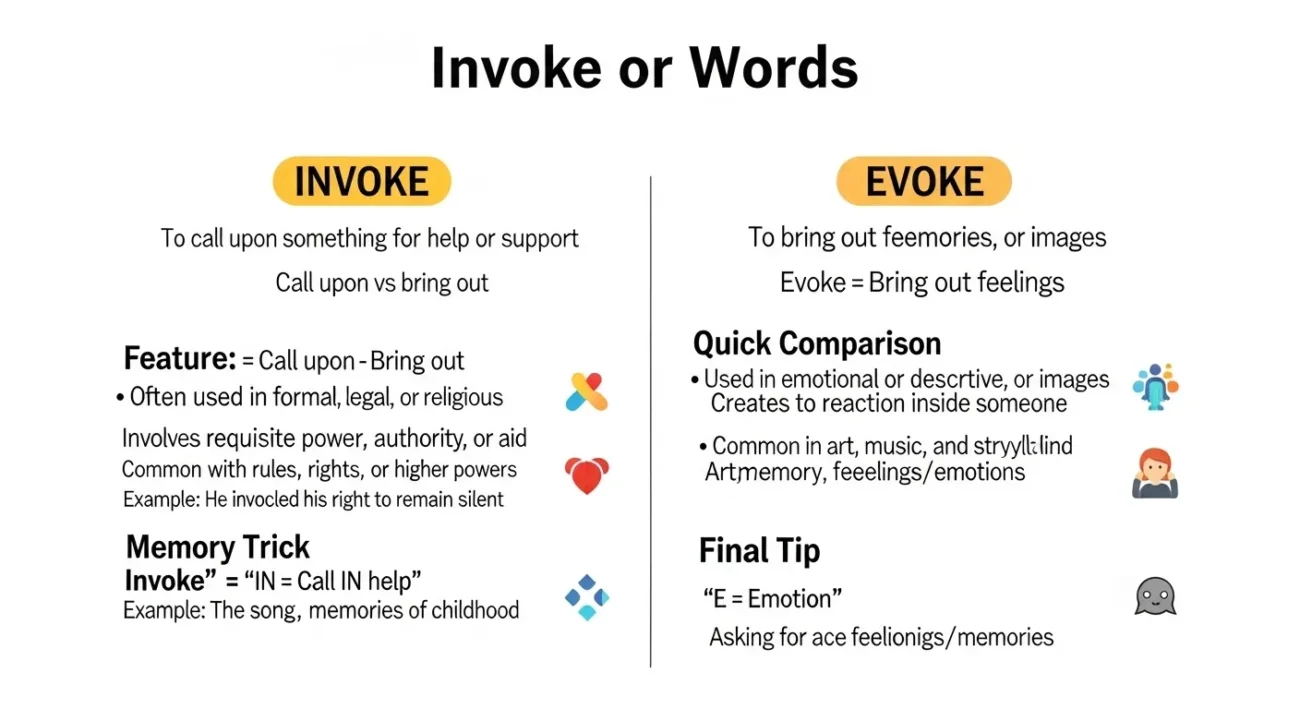
If you are confused between “invoke or evoke,” the simple answer is that invoke means to call upon something, while evoke means to bring out feelings or memories.
I often see people mix these words because they sound similar and are both used in slightly formal situations. When I first started using them, I also made mistakes, especially in essays and formal writing.
The confusion usually happens when we don’t focus on whether we are asking for help or creating an emotional response.
In this article, I will explain meanings, origins, usage, mistakes, and examples in a simple way so you can confidently use invoke or evoke in daily communication.
Invoke or Evoke : Quick Answer
The difference between invoke and evoke is based on purpose and context.
- Invoke: to call upon something (help, authority, power)
- Evoke: to bring out feelings, memories, or images
Examples
- He invoked his right to remain silent
- The smell evoked memories of childhood
Simple idea
- Invoke = Call for help 📢
- Evoke = Feel something 🎭
The Origin of Invoke or Evoke
Invoke
The word invoke comes from Latin invocare, meaning “to call upon.” In earlier times, it was mainly used in religious settings where people called upon gods or higher powers for guidance or help.
Later, the word became common in legal language, where it is used to refer to calling upon laws, rights, or authority. Today, it is widely used in formal communication.
Evoke
The word evoke comes from Latin evocare, meaning “to call out.” Over time, its meaning changed and became more emotional.
Today, evoke is used when something brings out feelings, memories, or mental images. It is commonly used in storytelling, poetry, and descriptive writing.
British English vs American English Spelling
There is no difference between British and American English spelling for these words.
| Word | American English | British English | Meaning |
| Invoke | Invoke | Invoke | Call upon |
| Evoke | Evoke | Evoke | Bring out |
👉 Examples:
- He invoked the law during the case
- The movie evoked strong emotions
Which One Should You Use?
Use Invoke if:
- You are asking for help, authority, or support
- You are referring to laws, rights, or rules
- The context is formal, legal, or religious
- You want to show an external action
Use Evoke if:
- You want to create feelings or emotions
- You are describing memories or imagination
- You are writing about art, music, or stories
- You want to show an internal reaction
Common Mistakes with Invoke or Evoke
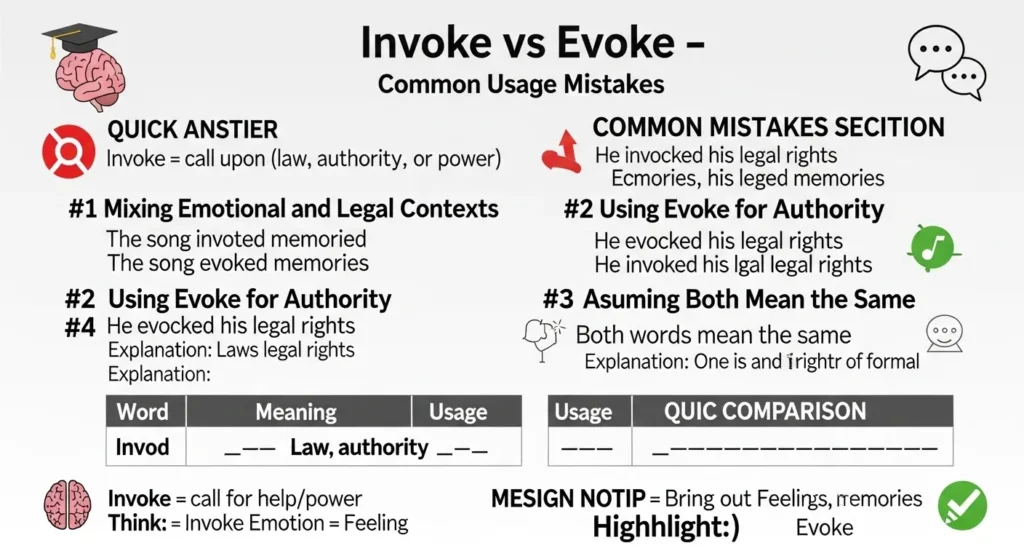
Mistake 1: Using invoke for emotions
❌ The film invoked sadness
✅ The film evoked sadness
Mistake 2: Using evoke for authority
❌ He evoked his legal rights
✅ He invoked his legal rights
3) Mistake: Thinking both words mean same
❌ Invoke and evoke are interchangeable
✅ They have different meanings
Mistake 4: Ignoring context
❌ Wrong word in sentence
✅ Always check purpose
Invoke and Evoke in Everyday Examples
Daily Conversation
- She invoked tradition during the ceremony
- That smell evoked childhood memories
Writing
- The lawyer invoked the constitution
- The story evoked deep emotions
Social Media
- This image evokes peace
- He invoked his authority
Formal Use
- The judge invoked the law
- The speech evoked strong feelings
Evoke or Invoke : Google Trends & Usage Data
Both words used worldwide, but their usage depends on context.
Invoke
- Common in legal and formal writing
- Used in speeches, debates, and law
- Moderate popularity
Evoke
- Common in creative writing and media
- Used in storytelling, films, and art
- Higher everyday usage
Popularity Summary
- Invoke → Formal & specific use
- Evoke → Emotional & common use
Comparison Table Invoke vs Evoke
| Feature | Invoke | Evoke |
| Meaning | Call upon | Bring out |
| Purpose | Ask for help/authority | Create feelings |
| Context | Legal/formal | Emotional/creative |
| Usage | Rights, laws, power | Memories, emotions |
| Frequency | Moderate | High |
FAQs
1. What is the main difference between invoke and evoke?
Invoke means to call upon something, while evoke means to bring out feelings or memories.
2. Are invoke and evoke interchangeable?
No, they have different meanings and cannot be used in place of each other.
3. Which word is more common?
Evoke is more common in everyday communication.
4. Is invoke used in legal context?
Yes, it widely used in legal and formal situations.
5. Evoke can be used for authority?
No, evoke used for emotions, not authority.
6. How can I remember the difference?
Invoke = IN help, Evoke = Emotion.
7. Which word should I use in essays?
Use evoke for descriptive writing and invoke for formal arguments.
Conclusion
When I compare invoke or evoke, I clearly understand that the confusion comes from their similar pronunciation, but their meanings are completely different. Invoke is used when we call upon something external, such as authority, power, or help.
It mostly used in formal, legal, or serious contexts where someone is requesting support or applying rules.On the other hand, evoke is used when something creates an internal reaction.
It brings out emotions, memories, or mental images, making it very useful in storytelling, creative writing, and everyday communication. This is why evoke is more common in daily language.
From my experience, the easiest way to avoid confusion is to focus on intention. If your sentence is about asking for help or authority, use invoke. If your sentence is about creating a feeling or memory, use evoke. This simple rule can solve most mistakes.
In short, invoke is about calling outward, while evoke is about bringing something inward. Once you understand this difference, you will be able to use both words correctly and confidently.

I am Sidney Greenbaum, a linguist who studied how English is actually used, not just how it is taught. I analyzed sentence structure and word differences to make English clearer and more practical. My research helped learners understand real-world English comparisons.