

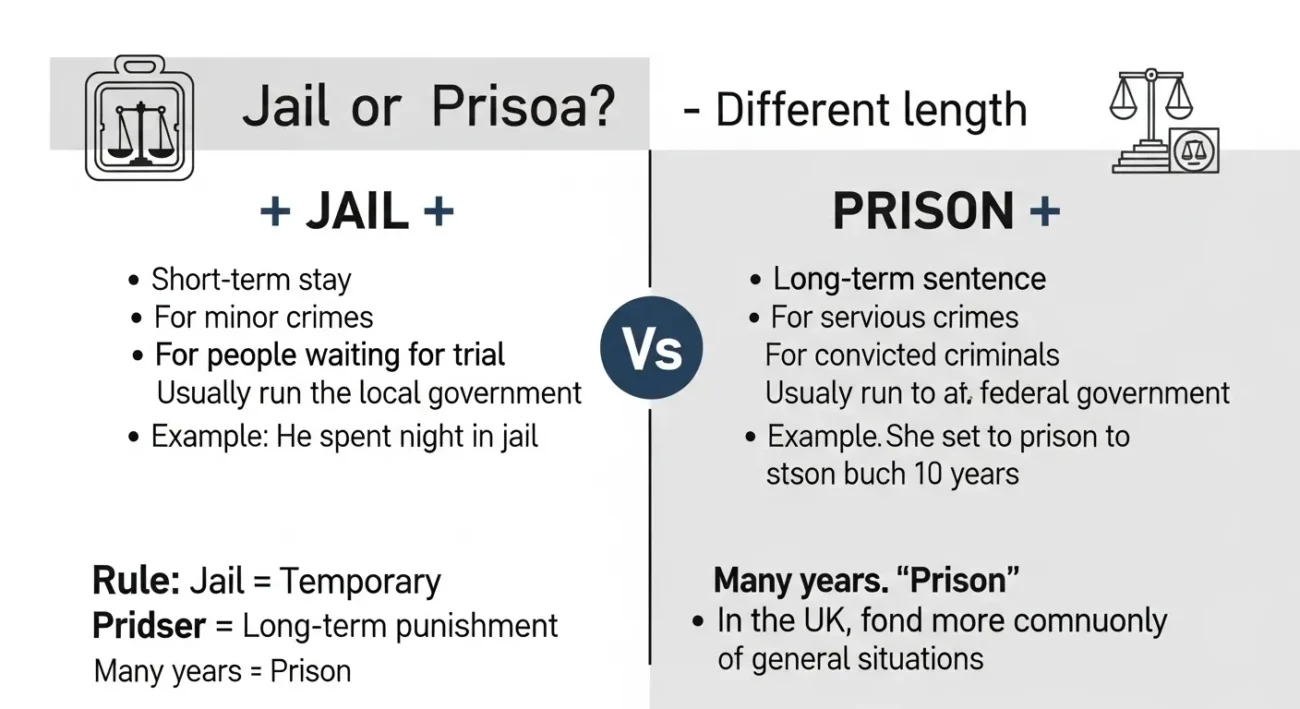
Jail or prison? The quick answer is simple: jail is short-term, prison is long-term.
I used to think both words meant the same place. Many people do. We hear them in movies, news, and daily talk. So we mix them up. But the meaning is not the same.
The length of stay, the type of crime, and who runs the facility are different. That is why people search “jail or prison.” They want to know which word is correct.
In this guide, I will explain the difference in a simple way. You will learn the meaning, history, usage rules, common mistakes, and when to use each word correctly.
Jail or Prison : Quick Answer
Jail is for short-term stays. Prison is for long-term sentences.
Jail is used for:
- People waiting for trial
- Minor crimes
- Short sentences (usually less than one year)
Prison is used for:
- Serious crimes
- Long sentences (more than one year)
- Convicted criminals
Example:
- ✅ He spent two nights in jail after the arrest.
- ✅ She was sent to prison for 10 years.
Simple rule:
- Jail = temporary
- Prison = long-term punishment
The Origin of Jail and Prison
The word jail comes from Old French gaiole. It entered English in the Middle Ages. In British English, it is often spelled gaol (older form).
The word prison comes from the Latin prehensio, meaning “to seize.”
In the United States, jails are usually run by local governments like counties. Prisons are run by state or federal authorities.
In the United Kingdom, the word “prison” is more common in official use, even for shorter stays.
History shaped how we use the words today.
British English vs American English Spelling
In American English:
- Jail = short-term facility
- Prison = long-term facility
In British English:
- Prison is used more widely
- The old spelling gaol may appear in historical texts
Comparison Table
| Word | US Meaning | UK Meaning | Length of Stay |
| Jail | Local facility | Rarely used officially | Short-term |
| Prison | State/federal facility | Main term used | Long-term |
In modern writing, jail is standard spelling worldwide. “Gaol” is mostly historical.
Which Spelling Should You Use?
Use jail when:
- Talking about short detention
- Referring to arrest holding
- Writing about local facilities
Use prison when:
- Talking about serious crimes
- Referring to long sentences
- Writing formal or international content
If your audience is American, the jail vs prison difference is important.
If your audience is British, “prison” often works in most contexts.
Choose based on sentence length and legal context.
Common Mistakes with Jail or Prison
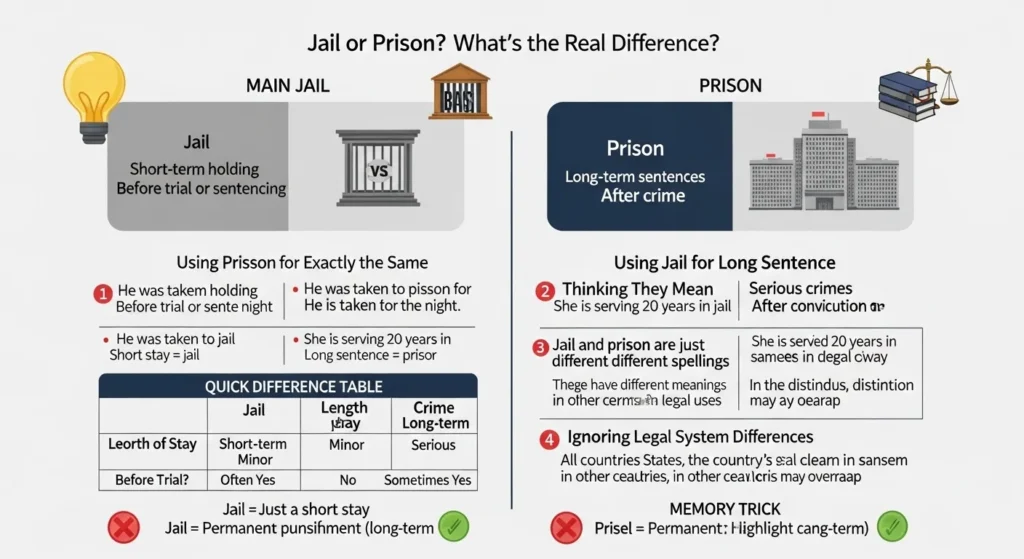
Mistake 1: Using prison for short arrest
❌ He was taken to prison for the night.
✅ He was taken to jail for the night.
Mistake 2: Using jail for long sentence
❌ She is serving 20 years in jail.
✅ She is serving 20 years in prison.
Mistake 3: Thinking they mean exactly the same
❌ Jail and prison are just different spellings.
✅ Jail and prison have different meanings.
Mistake 4: Ignoring legal system differences
❌ All countries use jail and prison the same way.
✅ Usage depends on the country’s legal system.
Prison or Jail in Everyday Examples
News:
“The suspect remains in jail awaiting trial.”
Court Report:
“The judge sentenced him to five years in prison.”
Movie Dialogue:
“If you lie, you’re going to jail.”
Formal Writing:
“The inmate was transferred from jail to a state prison.”
Context helps you choose the correct word.
Jail or Prison : Google Trends & Usage Data
Search data shows that in the United States, people search “jail vs prison” frequently. The difference matters in American law.
In the Canada and Australia, both terms appear, but prison is often more formal.
In the United Kingdom, “prison” is searched more than “jail.”
Legal blogs and news sites often explain this difference because many readers are confused.
Detailed Comparison Table Jail vs Prison
| Feature | Jail | Prison |
| Type of Stay | Short-term | Long-term |
| Crimes | Minor | Serious |
| Run By | Local government | State or federal government |
| Purpose | Holding before trial | Serving sentence |
| Security Level | Lower | Higher |
| Example Sentence | He stayed in jail overnight. | He is in prison for robbery. |
FAQs
1. Is jail the same as prison?
No. Jail is short-term. Prison is long-term.
2. How long do people stay in jail?
Usually less than one year.
3. Who runs a prison?
State or federal government.
4. Can someone go from jail to prison?
Yes. After conviction, they may transfer.
5. Is “gaol” still used?
It is old British spelling. Rare today.
6. Which word is more formal?
Prison sounds more formal.
7. Do all countries use the same system?
No. Legal systems differ.
Conclusion
Jail or prison is not just a small word choice. It shows the length and seriousness of a crime. I once thought both words were equal. But now I know the simple rule: jail is temporary, prison is long-term. Jail holds people before trial or for minor offenses.
Prison is for convicted criminals serving longer sentences. The difference matters most in American English. In British English, prison is more common in general use.
When writing or speaking, think about time, crime level, and legal system. Choose the word that matches the situation. Once you understand this rule, you will use jail and prison correctly every time.
Discover More Articles:

I am Mark Twain, a writer who loved the English language for its humor, irony, and everyday comparisons. I used simple words to show deep differences between truth and lies, wisdom and foolishness. My writing proves that clear English is always more powerful than complicated English.