

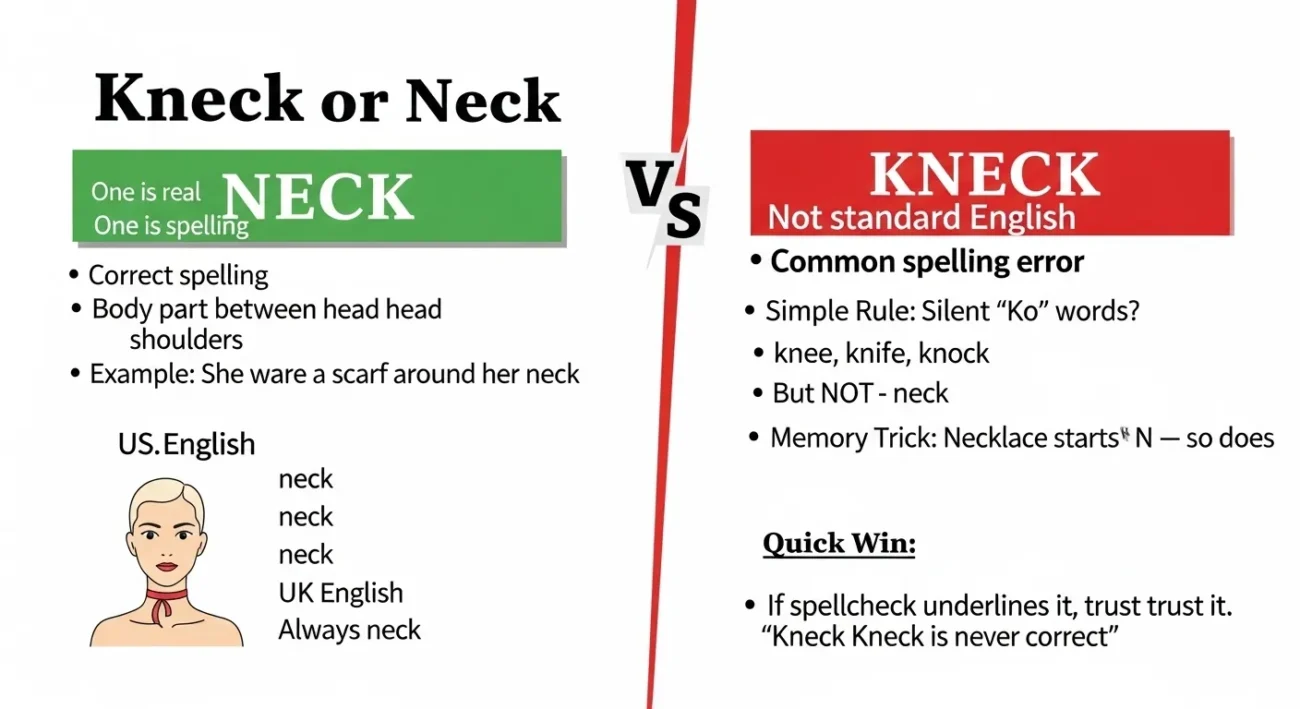
The Short answer is: The correct spelling is “neck,” not “kneck.”
I still remember the first time I typed “kneck” in a hurry. It looked strange, but I almost ignored it. Many people search for “kneck or neck” because English spelling can be tricky.
We see silent letters in words like knee and knife, so we start to doubt simple words too. Is there a silent “k” in neck? Is “kneck” used in British English? This article clears that confusion.
I will explain the correct spelling, the word’s origin, common mistakes, and when to use it. By the end, you’ll never hesitate again.
Kneck or Neck: Quick Answer
The correct spelling is neck.
“Kneck” is incorrect in standard English. It is a spelling mistake.
Correct Example:
- She wore a scarf around her neck.
- He felt pain in his neck.
Incorrect Example:
- She wore a scarf around her kneck. ❌
There is no silent “k” in the word neck. The word always starts with N.
The Origin of Kneck and Neck
The word neck comes from Old English “hnecca.” Over time, the spelling changed. The “h” sound disappeared, and the word became shorter and simpler.
English once had many silent letters. Words like:
- knee
- knife
- knock
These words kept the silent “k.”
But neck never had a “k” at the start in modern spelling. That is why “kneck” never became correct.
Language changes over time. Some silent letters stay. Others disappear. In this case, English kept it simple: just neck.
British English vs American English Spelling
Good news: both British and American English use “neck.”
There is no difference in spelling between the US and the UK for this word.
Here’s a comparison table of Neck vs Kneck:
| Version | Correct Spelling | Example Sentence |
| American English | neck | He injured his neck playing football. |
| British English | neck | She wore pearls around her neck. |
| Incorrect Form | kneck | ❌ Not used in any standard English |
Unlike words such as color/colour or center/centre, neck stays the same worldwide.
Which Spelling Should You Use?
You should always use neck, no matter your audience.
- 🇺🇸 If you write for the United States → use neck
- 🇬🇧 If you write for the UK → use neck
- 🌍 If you write for a global audience → use neck
There is no situation where “kneck” is correct in professional, academic, or casual writing.
If you are writing blog posts, SEO articles, emails, or business content, always choose neck.
Common Mistakes with Kneck or Neck
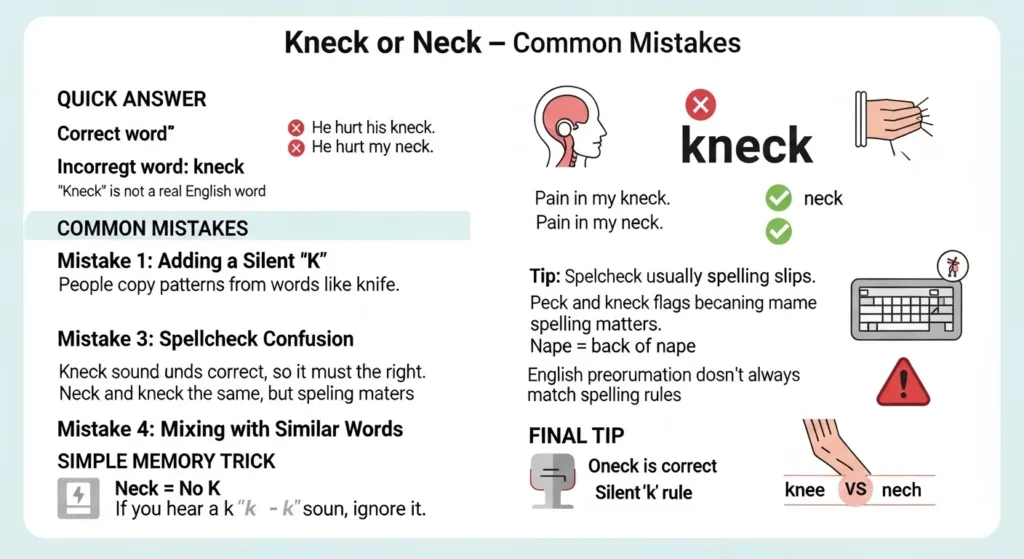
Here are common errors I often see:
1. Adding a Silent “K”
People copy patterns from words like knee and write kneck.
✔ Correct: neck
❌ Wrong: kneck
2. Spellcheck Confusion
Sometimes typing fast causes errors. Spellcheck usually marks “kneck” as wrong.
3. Pronunciation Confusion
Both neck and kneck would sound the same if spoken. But spelling matters in writing.
4. Mixing with Similar Words
Some confuse neck with nape (back of the neck). These words are different.
Kneck or Neck in Everyday Examples
Let me show you how “neck” appears in daily life.
In Emails
- I have a stiff neck today.
- Please adjust the shirt size around the neck area.
In News Writing
- The athlete suffered a minor neck injury.
- Doctors examined his neck after the accident.
On Social Media
- My neck hurts after working all day.
- This dress has a high neck design.
In Formal Writing
- The patient reported pain in the cervical neck region.
- The necklace rested gently on her neck.
Notice: “kneck” is never used in professional writing.
Neck or Kneck: Google Trends & Usage Data
Search data shows that “neck” is widely used worldwide.
People search “kneck or neck” mostly because:
- They are unsure about silent letters.
- They want to check spelling before publishing.
- They are students learning English.
Countries where spelling questions are common:
- United States
- United Kingdom
- India
- Pakistan
The term “kneck” appears mostly in spelling-error searches, not in real usage.
In books, newspapers, and academic articles, only neck appears as the correct form.
Comparison Table: Kneck vs Neck
| Word | Is It Correct? | Used in US? | Used in UK? | Professional Writing? |
| neck | ✅ Yes | Yes | Yes | Yes |
| kneck | ❌ No | No | No | No |
The answer is simple: neck wins every time.
FAQs About Kneck or Neck
1. Is “kneck” ever correct?
No. “Kneck” is always a spelling mistake.
2. Why do people write “kneck”?
Because English has silent “k” words like knee and knife.
3. Do Americans spell it differently?
No. Americans and British both use neck.
4. Is there a silent letter in neck?
No. All letters in “neck” are pronounced.
5. How do I remember the correct spelling?
Think: Necklace starts with N, not K.
6. Is neck a noun or verb?
Mostly a noun (body part). It can also be a verb in informal use (to kiss closely).
7. What is the plural of neck?
The plural is necks.
Conclusion
When it comes to “kneck or neck,” the rule is simple: always use “neck.” I used to hesitate because English has tricky silent letters. Words like knee made me doubt myself. But after checking history and usage, I learned that “kneck” has never been standard English. Both American and British English use the same spelling. That makes it easy.
If you are writing for school, business, blogging, or social media, choose neck every time. Spelling mistakes can reduce trust and hurt SEO performance. A small error like “kneck” can make your content look unprofessional. Now that you know the rule, you can write with confidence. Keep it simple. Keep it correct. Use neck.
Discover More Articles:

I am Sidney Greenbaum, a linguist who studied how English is actually used, not just how it is taught. I analyzed sentence structure and word differences to make English clearer and more practical. My research helped learners understand real-world English comparisons.