

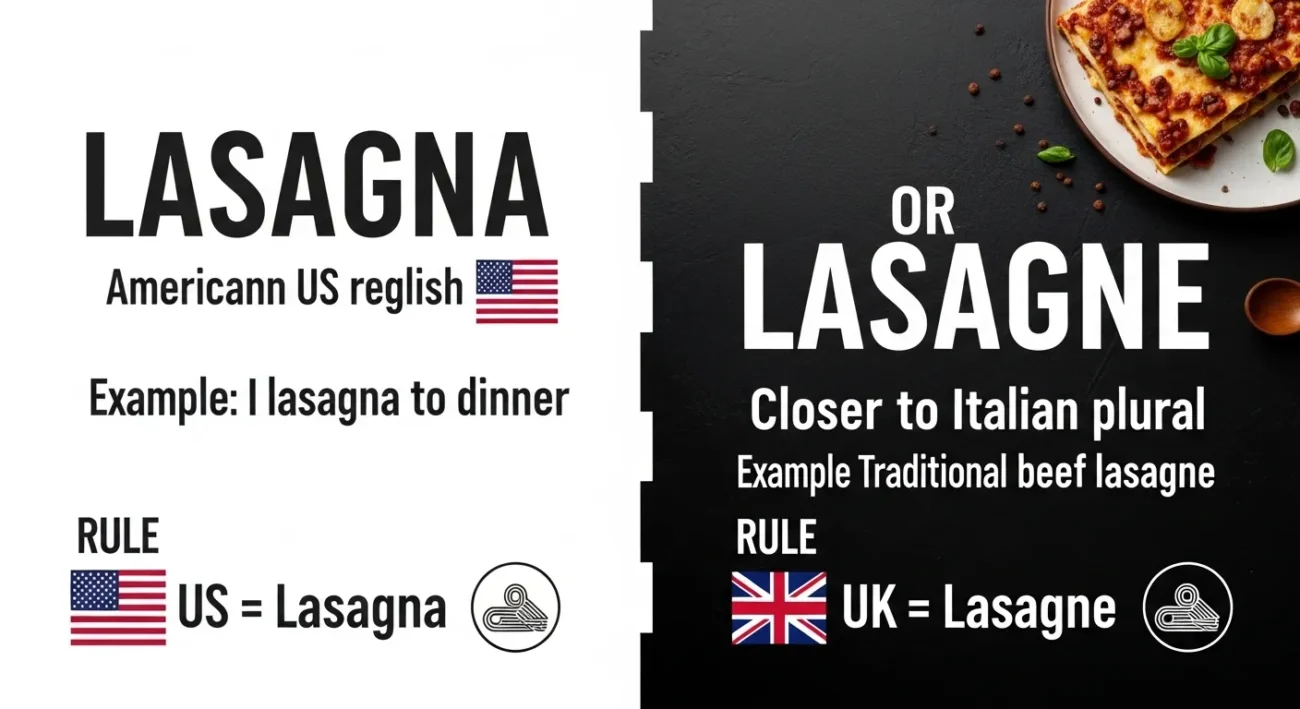
Lasagna or lasagne? The quick answer: both are correct.
The spelling depends on the type of English you use. I remember writing a recipe blog and stopping in the middle because I did not know which version looked right. I searched it, just like many people do. That is why this question is so common. Restaurants, cookbooks, menus, and social media posts use both spellings. It can feel confusing.
In this guide, I will clearly explain the difference, the origin, spelling rules, common mistakes, real-life examples, and which spelling you should choose.
Lasagna or Lasagne: Quick Answer
Both words refer to the same Italian dish made with layers of pasta, meat or vegetables, sauce, and cheese.
- Lasagna → American English spelling
- Lasagne → British English spelling
In Italian grammar:
- Lasagna = one sheet of pasta
- Lasagne = multiple sheets
Example:
- I cooked lasagna for dinner. (US style)
- I cooked lasagne for dinner. (UK style)
The meaning does not change. Only the spelling changes.
The Origin of Lasagna and Lasagne
The word comes from Italy. The dish is traditional in the region of Emilia-Romagna.
In Italian:
- “Lasagna” is singular.
- “Lasagne” is plural.
Since the dish uses many pasta sheets, “lasagne” is technically the plural form.
When the recipe became popular in the United States, the spelling changed slightly. American English often simplifies foreign words. British English usually keeps spellings closer to the original form.
That is why today we see both spellings in books and online.
British English vs American English Spelling
English spelling often changes between the US and the UK.
Here are common examples:
| American English | British English |
| Color | Colour |
| Flavor | Flavour |
| Theater | Theatre |
| Lasagna | Lasagne |
American English prefers shorter endings. British English keeps traditional forms.
So the difference between lasagna and lasagne follows this same pattern.
Which Spelling Should You Use?
The best choice depends on your audience.
Writing for the United States
Use lasagna. It is the standard American spelling.
Writing for the UK, Australia, or New Zealand
Use lasagne. These countries follow British spelling rules.
Writing for an International Audience
Choose one spelling and use it consistently. Consistency looks professional.
When I write, I first think about where my readers live. That makes the decision simple.
Common Mistakes with Lasagna or Lasagne
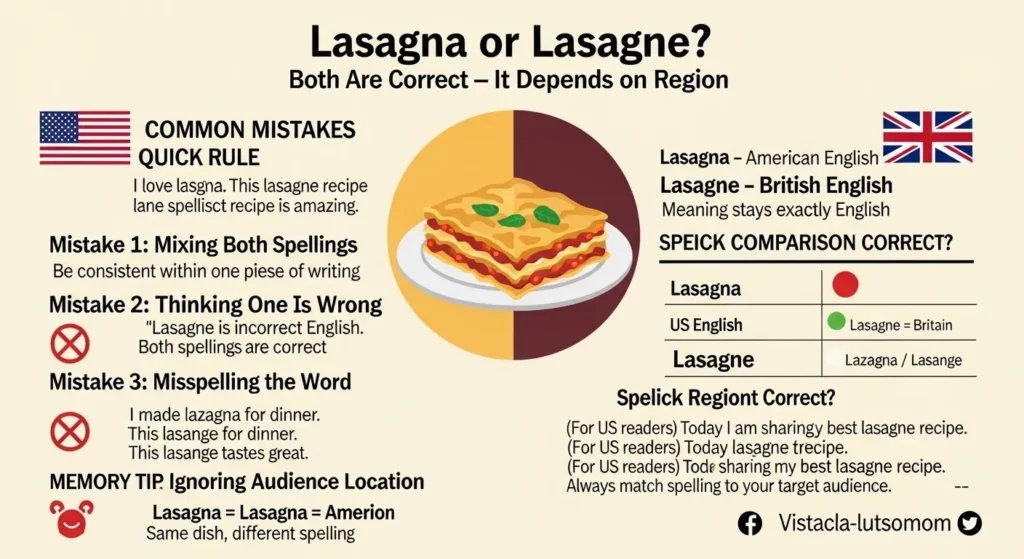
Mistake 1: Mixing Both Spellings in One Piece
❌ I love lasagna. This lasagne recipe is amazing.
✅ I love lasagna. This lasagna recipe is amazing.
(Or use “lasagne” consistently in UK writing.)
Mistake 2: Thinking One Spelling Is Wrong
❌ “Lasagne” is incorrect English.
✅ Both “lasagna” and “lasagne” are correct. The choice depends on region.
Mistake 3: Misspelling the Word
❌ I made lazagna for dinner.
✅ I made lasagna for dinner.
❌ This lasange tastes great.
✅ This lasagne tastes great.
Mistake 4: Ignoring Audience Location
❌ (For US readers) Today I am sharing my best lasagne recipe.
✅ (For US readers) Today I am sharing my best lasagna recipe.
Always match spelling with your target country.
Lasagna or Lasagne in Everyday Examples
You can see both spellings in daily use.
In Emails
“Please bring lasagna to the family dinner.”
On Social Media
“Homemade lasagne tonight! So cheesy and warm!”
In News Headlines
“Local chef wins award for best lasagna.”
In Formal Writing
“The restaurant specializes in traditional beef lasagne.”
The dish stays the same. Only the spelling changes.
Lasagne or Lasagna: Google Trends & Usage Data
Search patterns show clear regional differences.
- In the United States, lasagna is searched more often.
- In the United Kingdom, lasagne is more common.
- In Canada and Australia, both are used, but “lasagne” appears slightly more.
Because the US population is large, “lasagna” has slightly higher global search numbers.
Food blogs in America prefer “lasagna.” British cooking sites prefer “lasagne.”
Usage depends mainly on geography.
Comparison Table: Lasagna vs Lasagne
| Feature | Lasagna | Lasagne |
| English Style | American | British |
| Italian Form | Singular | Plural |
| Meaning | Same dish | Same dish |
| Correct Usage | Yes | Yes |
| Common in US | Very common | Rare |
| Common in UK | Less common | Very common |
Frequently Asked Questions
1. Is lasagna or lasagne correct?
Both are correct. It depends on American or British spelling.
2. What is the original Italian spelling?
In Italian, “lasagna” is singular and “lasagne” is plural.
3. Do they mean different dishes?
No. They describe the same layered pasta dish.
4. Why do Americans use lasagna?
American English simplified the spelling over time.
5. Which spelling is older?
“Lasagne” is closer to the original Italian plural form.
6. Can I use both in one article?
It is better to choose one spelling and stay consistent.
7. Which spelling is more common worldwide?
“Lasagna” has slightly more global searches because of US usage.
Conclusion
Lasagna or lasagne may look different, but they describe the same delicious Italian dish. The difference comes from Italian grammar and regional English spelling traditions. American English uses “lasagna.” British English uses “lasagne.” Both are correct.
When I first faced this spelling question, I felt confused. Now I simply check my audience. If I am writing for American readers, I choose “lasagna.” If my audience is in the UK or other Commonwealth countries, I use “lasagne.” The most important rule is consistency.
Language changes across countries. That is normal and natural. What matters most is clarity. Now you can confidently use the correct spelling based on your audience and context.
Discover More Articles:

I am Michael Swan, an English grammarian known for explaining confusing grammar and word comparisons in a clear way. I focused on real usage, not just rules, helping learners understand why English works the way it does. My work simplifies complex language problems for everyday users.