
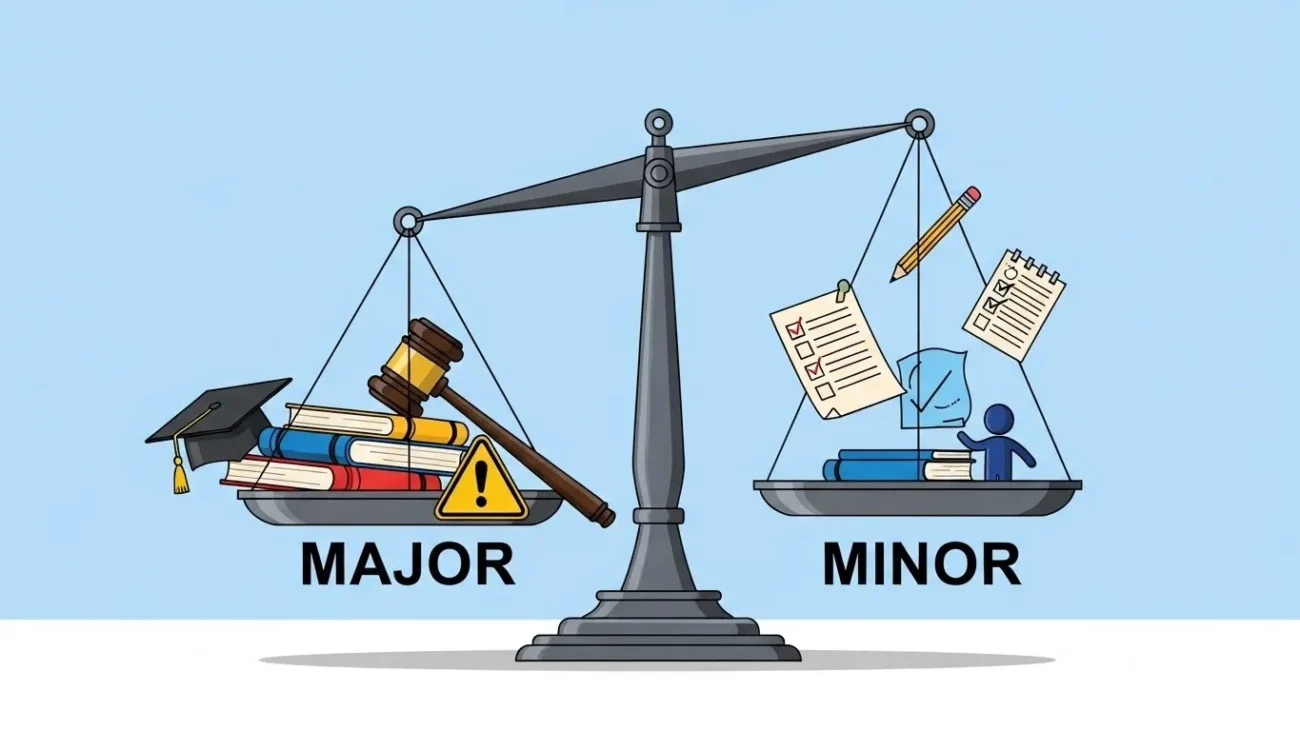
People often search for major or minor because these two small words create big confusion.
I see it happen in schools, offices, legal papers, news headlines, and even daily conversations. Are we talking about age, importance, music, law, or mistakes?
Many writers mix them up or use one when the other fits better. This keyword solves one clear problem: how to choose the right word in the right situation.
In this guide, I break it down simply. I explain meanings, origins, real life usage, and common errors, so you can decide fast and write with confidence every time.
Major or Minor: Quick Answer
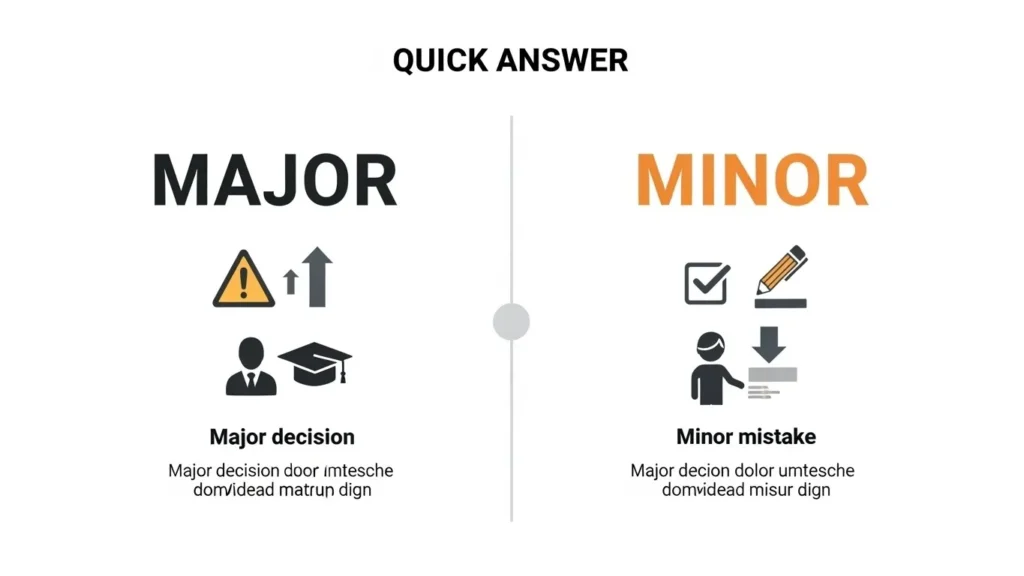
Major means big, important, serious, or adult.
Minor means small, less important, slight, or underage.
Examples:
- A major decision can change your life.
- A minor mistake is easy to fix.
- A person over 18 is a major (adult).
- A person under 18 is a minor (child).
If it feels big, serious, or full-level → major.
If it feels small, light, or limited → minor.
The Origin of Major or Minor
Both words come from Latin.
- Major comes from maior, meaning “greater” or “larger.”
- Minor comes from minor, meaning “smaller” or “less.”
Over time, English kept both words but expanded their use. That’s why today we see them in:
- Education (major subject, minor subject)
- Law (legal major, legal minor)
- Music (major scale, minor scale)
- Everyday speech (major issue, minor problem)
There are no spelling differences here only meaning differences. The confusion exists because the words are opposites but used across many fields.
British English vs American English Spelling
Here’s the good news: there is no spelling difference between British and American English.
| Aspect | British English | American English |
| Spelling | major / minor | major / minor |
| Meaning | Same | Same |
| Usage | Same contexts | Same contexts |
Unlike words like colour/color or centre/center, major and minor stay the same everywhere. The challenge is meaning, not spelling.
Which Spelling Should You Use?
You don’t need to choose a spelling you need to choose the right meaning.
- US audience: Use major for serious or adult, minor for small or underage.
- UK & Commonwealth: Same rule applies.
- Global audience: These words are widely understood worldwide.
My advice:
👉 Focus on context, not region.
👉 Ask yourself: Is this big or small? Adult or underage? Core or optional?
Common Mistakes with Major or Minor
I often see these errors:
- ❌ This is a minor issue (when it’s serious)
✅ This is a major issue - ❌ He made a major typo (when it’s small)
✅ He made a minor typo - ❌ She is a major (age 16)
✅ She is a minor - ❌ Minor changes to the law (when changes are huge)
✅ Major changes to the law - ❌ Mixing education meaning with importance
- Major subject ≠ important subject (it means main field of study)
Learn More : Careing vs Caring Explained: Correct Spelling and Usage
Major or Minor in Everyday Examples
Emails
- “There is a minor delay in delivery.”
- “This is a major concern for our team.”
News
- “The city faced a major power outage.”
- “Only minor injuries were reported.”
Social Media
- “Just a minor setback, we move on.”
- “This update is a major win!”
Formal Writing
- “The contract breach was considered major.”
- “The error was minor and did not affect results.”
Major or Minor: Google Trends & Usage Data
Globally, major is searched more often because it appears in:
- News headlines
- Business reports
- Academic writing
Minor spikes in searches around:
- Legal topics (age laws)
- Education (degree programs)
- Medical terms (minor injury, minor surgery)
By region:
- US & UK: High usage for both, especially in education.
- India & Pakistan: Heavy use in exams, law, and news.
- Global English: Both words are core vocabulary.
Comparison Table: Major vs Minor
| Feature | Major | Minor |
| Meaning | Big, important, serious | Small, less important |
| Age | Adult (18+) | Under 18 |
| Education | Main subject | Secondary subject |
| Problems | Serious issue | Small issue |
| Music | Bright, strong tone | Sad, soft tone |
| Risk | High impact | Low impact |
FAQs: Major or Minor
1. What does major mean in simple words?
Major means something big, important, or serious.
2. What does minor mean?
Minor means small, less important, or underage.
3. Is a minor problem bad?
No. A minor problem is usually easy to fix.
4. Can a person be called a major?
Yes. In law, a major means an adult.
5. What is a major subject?
It is your main field of study in college.
6. Are major and minor opposites?
Yes. They are direct opposites in most contexts.
7. Is there any spelling difference between countries?
No. The spelling is the same worldwide.
Conclusion
Understanding major or minor is all about context. I’ve learned that most confusion happens when people focus on the word instead of the situation.
Major signals importance, seriousness, or adulthood. Minor signals small size, low impact, or being underage.
There is no spelling issue, no regional rule, and no grammar trick here just meaning. Whether you’re writing an email, a news article, a legal note, or a social post, choosing the right word builds clarity and trust.
If the issue feels big, lasting, or core, go with major. If it feels light, temporary, or secondary, minor is your word. Keep this simple rule in mind, and you’ll never hesitate again.

I am Michael Swan, an English grammarian known for explaining confusing grammar and word comparisons in a clear way. I focused on real usage, not just rules, helping learners understand why English works the way it does. My work simplifies complex language problems for everyday users.