I’ve personally wondered about “mamma or mama” because both spellings look right and sound the same.
I noticed mamma in old books and baby talk, while mama appeared everywhere social media, daily conversations, modern writing.
That contrast confused me, especially when trying to use the right word for the right audience.
When I looked deeper, I realized culture, language history, and geography all play a role. Words for “mother” evolve emotionally and linguistically, which is why both forms exist.
In this article, I clearly explain the difference, their history, British vs American usage, and exactly when mamma fits and when mama is the better choice.
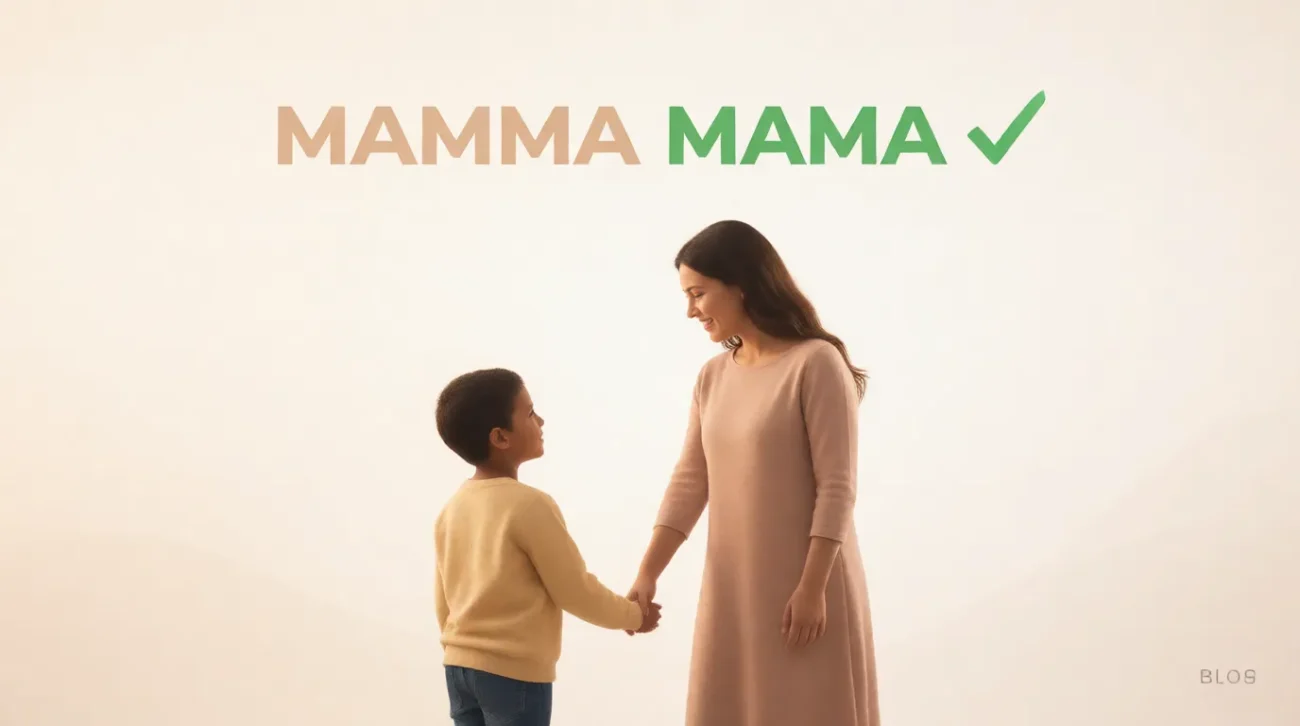
Mamma or Mama : Quick Answer
Both “mamma” and “mama” are correct, but they are used differently.
- Mama is the modern, global English spelling and the most commonly used.
- Mamma is an older or regional spelling, often linked to European languages or affectionate speech.
Examples:
- My mama is coming home today. ✅
- The baby cried for his mamma. ✅ (less common in modern English)
Quick rule:
👉 Use mama in most writing.
👉 Use mamma only for style, tradition, or regional context.
The Origin of Mamma or Mama
Both words come from very early human speech. Sounds like ma, mam, and amma are among the first sounds babies can make. Because of this, many languages developed similar words for “mother.”
- Mamma comes from Latin and spread into Italian, French, German, and other European languages.
- Mama evolved as a simplified form and became dominant in modern English.
Over time, English favored shorter, simpler spellings. That’s why mama replaced mamma in everyday use, especially in American English. Still, mamma survived in literature, music, and cultural expressions.
British English vs American English Spelling
Both British and American English recognize mamma and mama, but usage differs.
Key Differences
| Feature | British English | American English |
| Most common form | Mama | Mama |
| Use of “mamma” | Rare, literary | Very rare |
| Formal writing | Mama | Mama |
| Baby talk / affection | Mama | Mama |
Important note:
Even in British English, mama is now more common than mamma.
Which Spelling Should You Use?
Your audience decides the best choice.
Use Mama if:
- You write for a global audience
- You use American or modern British English
- You write blogs, emails, books, or social media
- You want clarity and simplicity
Use Mamma if:
- You refer to European languages or culture
- You quote old literature, songs, or poems
- You aim for a traditional or emotional tone
Professional advice:
👉 When in doubt, choose mama.
Common Mistakes with Mamma or Mama
Here are frequent errors people make:
- Thinking one is wrong
❌ “Mamma is incorrect.”
✅ Both are correct, but context matters. - Using mamma in formal writing unintentionally
❌ The mamma of the child arrived.
✅ The mama of the child arrived. - Mixing spellings in the same text
❌ Mama loves her mamma.
✅ Stick to one spelling. - Assuming spelling changes meaning
❌ Believing mamma means something different
✅ Meaning is the same; usage differs.
Read More: Interment or Internment: What’s the Real Difference?
Mamma or Mama in Everyday Examples
Emails
- Please ask your mama to call me. ✅
News
- The actress thanked her mama during the award speech. ✅
Social Media
- Best mama in the world ❤️ ✅
Formal Writing
- The child addressed his mother as mama. ✅
Literary or Cultural Use
- Mamma Mia! ✅ (fixed cultural phrase)
Mamma or Mama : Google Trends & Usage Data
Search data shows that “mama” is far more popular worldwide.
Popularity by Region
- United States: Mama dominates
- UK & Commonwealth: Mama preferred
- Europe: Mamma appears more often
- Global searches: Mama leads by a large margin
Context of Use
- Parenting blogs → Mama
- Baby products → Mama
- Music titles → Mamma (style choice)
- Daily conversation → Mama
Conclusion from trends:
👉 Mama is the safer and more searchable option.
Comparison Table: Mamma vs Mama
| Feature | Mamma | Mama |
| Correct spelling | Yes | Yes |
| Modern English | Less common | Most common |
| Formal writing | Rare | Preferred |
| Global usage | Limited | Widespread |
| SEO-friendly | Low | High |
Frequently Asked Questions (FAQs)
1. Is mamma or mama correct in English?
Both are correct, but mama is more common.
2. Which spelling should I use in writing?
Use mama unless style requires otherwise.
3. Is mamma British English?
It exists, but mama is more common even in British English.
4. Why do people still use mamma?
Because of tradition, culture, or emotional tone.
5. Is mamma outdated?
Not outdated, but less used today.
6. Does mamma mean something different?
No. Both mean “mother.”
7. Which spelling is better for SEO?
Mama performs better in search results.
Conclusion
The confusion between mamma or mama comes from history, culture, and language evolution not from correctness. Both spellings are valid, but they serve different purposes in modern English. Mama has become the standard choice worldwide, especially in American English, digital content, and professional writing. It is simple, familiar, and widely understood.
Mamma, on the other hand, carries a traditional and emotional tone. It appears in older texts, European languages, and artistic expressions. While it is not wrong, it is less common and may feel outdated in everyday English communication.
If your goal is clarity, correctness, and global understanding, choose mama. If your goal is style, nostalgia, or cultural reference, mamma can still work beautifully. Knowing the difference allows you to write with confidence and intention without second guessing your spelling.

I am Sidney Greenbaum, a linguist who studied how English is actually used, not just how it is taught. I analyzed sentence structure and word differences to make English clearer and more practical. My research helped learners understand real-world English comparisons.