Many people search for mean or meant because these two words look and sound closely related, yet they serve very different purposes in English.
You may have seen sentences like “I didn’t mean’t to say that” or “This is what I mean’t” and wondered which form is correct. This confusion appears frequently in emails, school writing, social media posts, and even professional communication.
The main reason for the confusion is pronunciation. In spoken English, mean and meant can sound similar, especially in fast speech.
Another reason is tense confusion: one word is present tense, while the other is past tense. A small spelling mistake can make your writing look careless or unclear.
This article solves that confusion step by step. You’ll get a quick answer, learn the origin of both words, understand British vs American usage, avoid common mistakes, see real-life examples, explore usage trends, and read FAQs.
By the end, you’ll confidently know when to use mean and when meant is the correct choice.
Mean or Meant: Quick Answer
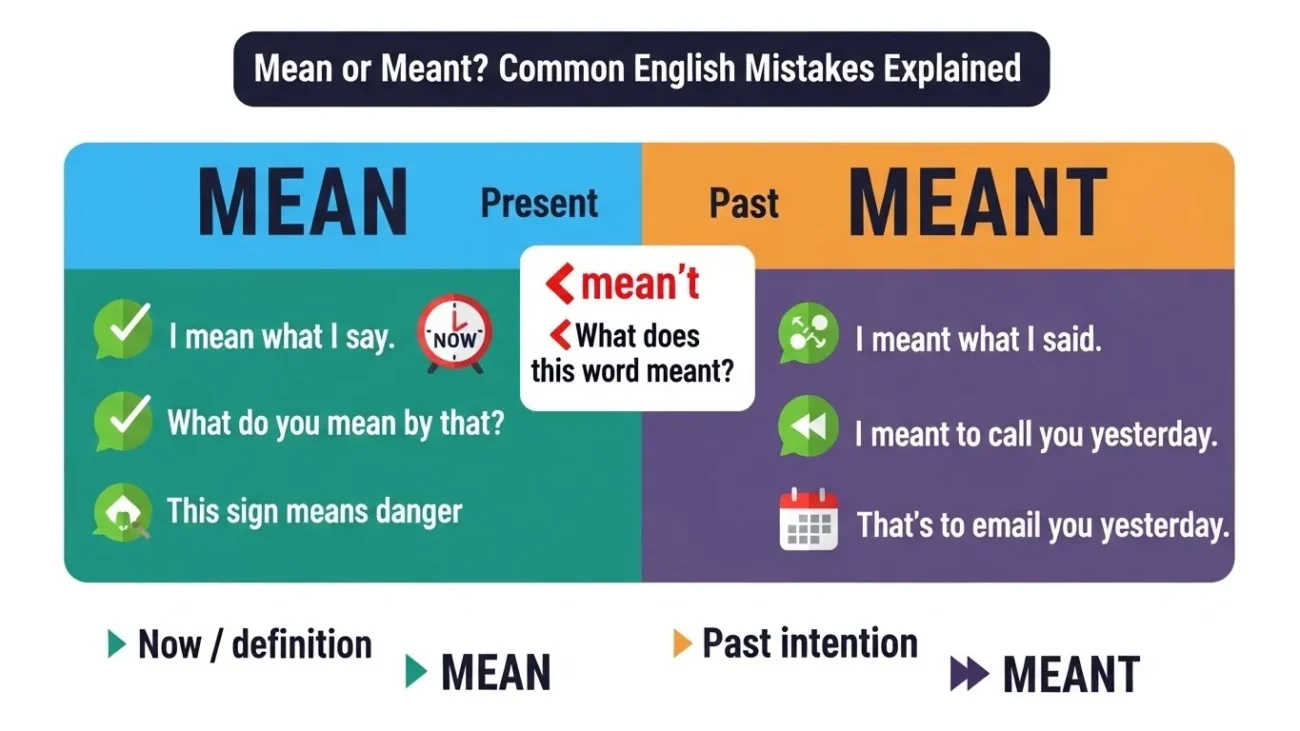
- Mean → Present tense (now, usually, generally)
- Meant → Past tense of mean (already happened)
Examples:
- I mean what I say. ✅
- I meant what I said. ✅
Simple rule:
👉 Now or always → mean
👉 Past or already happened → meant
Read More : Saphire vs Sapphire Explained: Correct Spelling and Meaning
The Origin of Mean and Meant
Origin of Mean
The word mean comes from Old English mænan, meaning to intend, signify, or have in mind. Over time, it kept its meaning of intention or definition.
Origin of Meant
Meant developed as the past tense and past participle of mean. English often changes verbs to show time, and mean → meant follows this pattern.
Why confusion exists:
- Similar pronunciation
- Same base word
- Confusion between present and past tense
British English vs American English Usage
There is no spelling or meaning difference between British and American English for mean or meant.
| Aspect | Mean | Meant |
| Tense | Present | Past |
| UK usage | Same as US | Same as US |
| US usage | Same as UK | Same as UK |
| Formal writing | Very common | Very common |
Key point:
This is a grammar difference, not a regional one.
Which One Should You Use?
Use Mean when:
- Talking about current intentions
- Explaining definitions
- Describing general truths
Examples:
- What do you mean by that?
- I mean no harm.
- This word means happiness.
Use Meant when:
- Referring to past intentions
- Explaining what someone wanted earlier
- Correcting past misunderstandings
Examples:
- I meant to call you yesterday.
- She meant well.
- That’s not what I meant.
Professional tip:
👉 If you can add “yesterday” or “earlier”, use meant.
Common Mistakes with Mean or Meant
1. Using “mean’t” (incorrect spelling)
❌ I didn’t mean’t to say that.
✅ I didn’t mean to say that.
2. Using mean for past actions
❌ I mean to email you yesterday.
✅ I meant to email you yesterday.
3. Using meant for present meaning
❌ What does this word meant?
✅ What does this word mean?
4. Confusing intention with definition
❌ This sign meant danger.
✅ This sign means danger.
Mean or Meant in Everyday Examples
Emails
- “I mean no offense.”
- “Sorry, I meant to reply earlier.”
School
- “What does this sentence mean?”
- “The teacher meant the test as practice.”
Social Media
- “I mean this seriously.”
- “That’s not what I meant!”
News
- “The policy means higher taxes.”
- “The law was meant to protect workers.”
Workplace
- “I mean we should try again.”
- “I meant to attach the file.”
Mean or Meant: Google Trends & Usage Data
Search data shows that mean is searched more for definitions, while meant is searched more for grammar clarification.
| Term | Popularity | Common Context |
| Mean | Very High | Definitions, explanations |
| Meant | High | Grammar, past tense |
| Mean vs meant | Rising | ESL learners |
| Mean’t | Common error | Spelling confusion |
Insight:
Most users want a quick grammar fix for writing accuracy.
Comparison Table: Mean vs Meant
| Feature | Mean | Meant |
| Tense | Present | Past |
| Function | Intend or define | Intended earlier |
| Verb form | Base / present | Past / past participle |
| Common error | Confused with meant | Used instead of mean |
| Interchangeable | ❌ No | ❌ No |
FAQs: Mean or Meant
1. Which is correct: mean or mean’t?
Mean is correct. Mean’t is incorrect.
2. Is “meant” always past tense?
Yes, meant refers to the past.
3. Can “mean” be a noun?
Yes. What’s the mean of these numbers?
4. Is there a UK vs US difference?
No difference at all.
5. Can “meant” describe purpose?
Yes. This gift was meant for you.
6. Why do people confuse mean and meant?
Because they sound similar in speech.
7. Which is more formal?
Both are equally formal when used correctly.
Conclusion
The difference between mean or meant is simple but important. Mean is used for present intentions and definitions, while meant refers to past intentions or explanations. Although they come from the same root word, they are not interchangeable.
To remember:
- 🕒 Now or general truth → mean
- ⏪ Past intention → meant
Using the correct word improves clarity, professionalism, and confidence in your writing. Once you master this difference, your emails, essays, and everyday English will sound natural and accurate.

I am Sidney Greenbaum, a linguist who studied how English is actually used, not just how it is taught. I analyzed sentence structure and word differences to make English clearer and more practical. My research helped learners understand real-world English comparisons.