

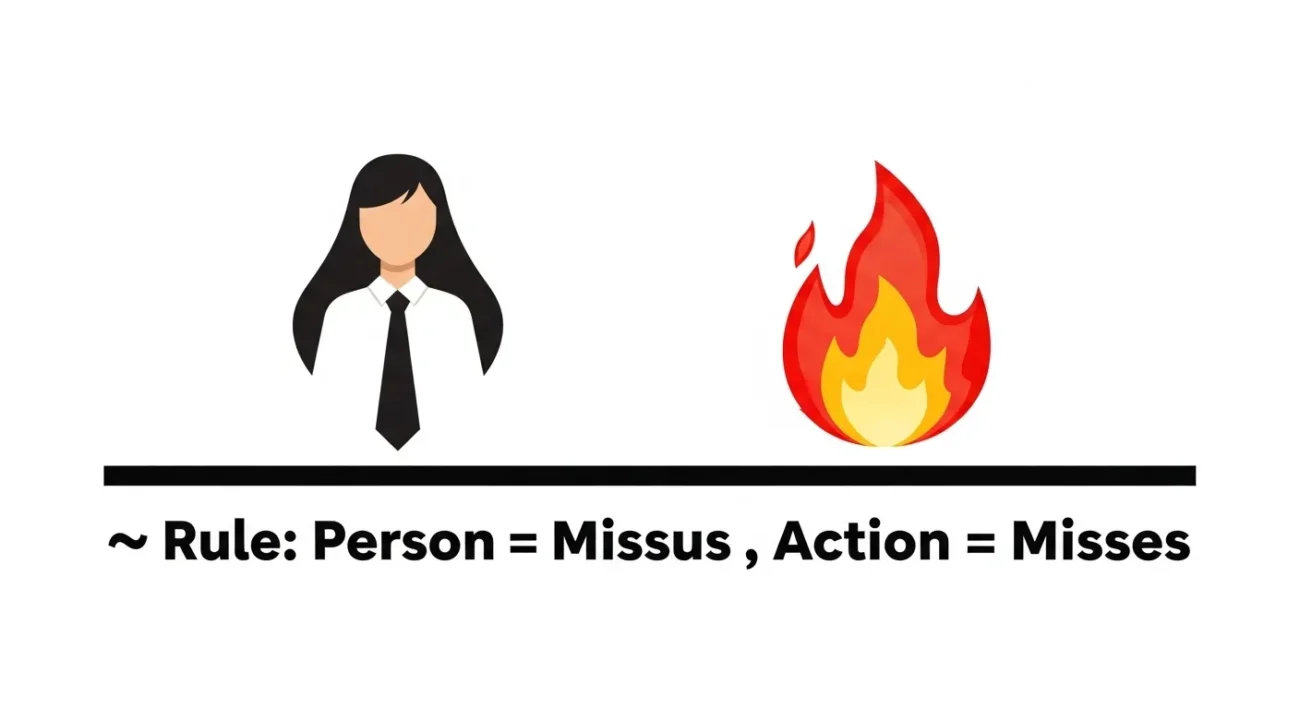
Missus or misses? Here’s the clear answer right at the start: missus is an informal noun meaning a wife, while misses is a verb form meaning fails to hit, catch, or attend something.
I still remember hearing someone say, “My misses is calling me,” and I paused. It sounded familiar, casual even common but something felt off. That moment of hesitation is exactly why people search missus or misses. These words sound similar, often appear in spoken English, and get mixed up easily in writing.
This article clears that confusion fully. I’ll explain meanings, origins, usage, common mistakes, examples, and practical advice so you never mix them up again.
Missus or Misses: Quick Answer
Missus = an informal noun meaning wife.
Misses = the third-person singular form of the verb miss.
Correct examples:
- My missus is waiting for me.
- He misses the bus every morning.
Wrong example:
- ❌ My misses is angry.
If you’re talking about a person (your wife), use missus.
If you’re talking about failing to do something, use misses.
The Origin of Missus and Misses
I find word origins helpful because they explain why confusion exists.
Missus
- Comes from mistress, an old English title for a married woman.
- Over time, it shortened in speech to missus.
- It is informal and mostly used in spoken English.
Example:
- I need to ask the missus first.
Misses
- Comes from the verb miss, meaning to fail to hit, reach, or attend.
- Misses is simply the present tense form used with he, she, or it.
Example:
- She misses her family.
The confusion happens because missus sounds like misses when spoken quickly.
British English vs American English Spelling
This is where usage becomes interesting.
British English
- Missus is very common in casual speech.
- Often used humorously or affectionately.
Example:
- The missus won’t be happy about this.
American English
- Missus exists but is less common.
- People often say my wife instead.
Comparison Table Misses vs Missus
| Aspect | British English | American English |
| Use of “missus” | Very common | Less common |
| Formal acceptance | Informal only | Informal only |
| Meaning | Wife | Wife |
| Use of “misses” | Verb | Verb |
Misses works the same way in both varieties of English.
Which Spelling Should You Use?
I always choose based on context and formality.
- Casual speech or dialogue → missus
- Formal writing → avoid missus, use wife
- Any writing involving actions or absence → misses
Audience-based guidance
- UK/Commonwealth readers: missus feels natural in informal tone.
- US readers: missus may sound slangy or unfamiliar.
- Professional writing: Use wife instead of missus.
Knowing your audience saves confusion.
Common Mistakes with Missus or Misses
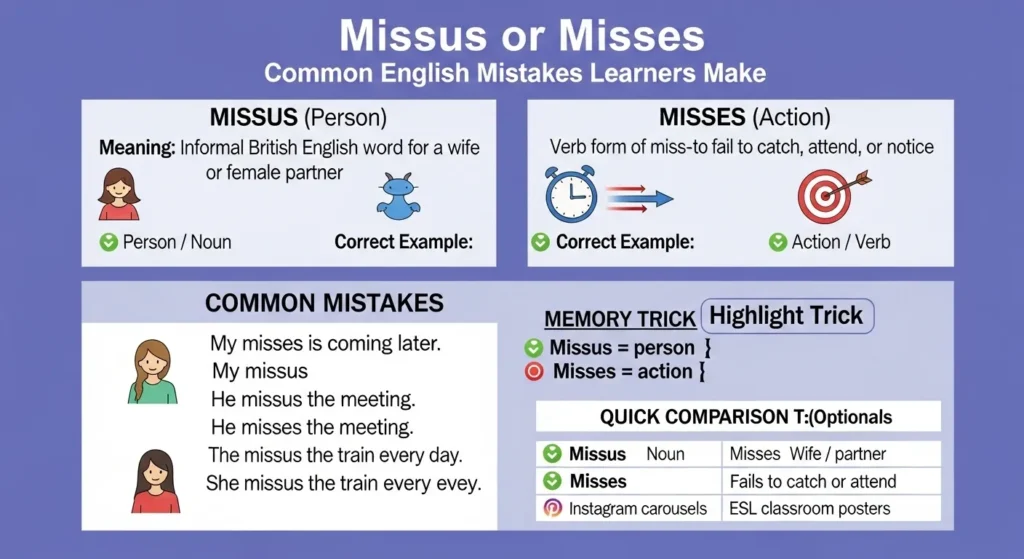
I see these errors often, especially from learners.
Mistake 1
❌ My misses is coming later.
✅ My missus is coming later.
Mistake 2
❌ He missus the meeting.
✅ He misses the meeting.
Mistake 3
❌ The missus the train every day.
✅ She misses the train every day.
Memory trick I use:
- Missus = person
- Misses = action
Missus or Misses in Everyday Examples
Emails
- I’ll check with my missus and confirm.
- He misses important details in emails.
News
- The suspect misses court appearance.
- He spoke fondly of the missus.
Social Media
- Date night with the missus.
- She misses old memories.
Formal Writing
- He frequently misses deadlines.
- (Avoid using missus in formal writing)
Misses or Missus: Google Trends & Usage Data
From general usage patterns:
- Misses appears far more often because it’s a verb.
- Missus is searched mostly by learners confused by spoken English.
- Searches spike when people hear the word and try to spell it.
The intent behind these searches is usually spelling clarity not meaning confusion.
Missus vs Misses: Side-by-Side Comparison
| Feature | Missus | Misses |
| Part of speech | Noun | Verb |
| Meaning | Wife | Fails to do something |
| Formal use | No | Yes |
| Common error | Spelled as “misses” | Used for a person |
| Spoken usage | Common | Common |
FAQs: Missus or Misses
1. Is “missus” a real word?
Yes. It’s informal but correct.
2. Can I use missus in writing?
Only in casual or conversational writing.
3. Is “misses” ever used for a wife?
No. That’s always incorrect.
4. Why do they sound the same?
Because missus comes from spoken English.
5. Is missus rude?
No, but it can sound too casual in formal settings.
6. Do Americans use missus?
Less often than British speakers.
7. What’s safer in professional writing?
Use wife instead of missus.
Conclusion
I’ve learned that missus or misses isn’t a spelling issue it’s a role issue. One names a person, the other describes an action. Missus belongs to casual conversation and refers to a wife. Misses belongs to grammar rules and shows that someone failed to do something. Mixing them up doesn’t just look wrong it changes the meaning completely.
Once I started asking myself, “Is this a person or an action?” the confusion disappeared. If you remember that simple distinction, you’ll never hesitate with this pair again and your writing will instantly feel clearer and more confident.

I am Mark Twain, a writer who loved the English language for its humor, irony, and everyday comparisons. I used simple words to show deep differences between truth and lies, wisdom and foolishness. My writing proves that clear English is always more powerful than complicated English.