

Many people search for need or needs because they are unsure which form to use in a sentence. This confusion is very common for English learners and even native speakers.
Both words come from the same verb, but a small change can make a sentence grammatically wrong.
I’ve seen sentences like “She need help” or “They needs support”, which sound incorrect but happen often in daily writing.
The reason is simple: subject verb agreement. English verbs change form depending on who or what is doing the action.
This article solves that confusion clearly and quickly. You’ll get a direct answer first, then learn the rule behind it, British vs American usage, common mistakes, everyday examples, and practical advice.
By the end, you’ll confidently know when to use need and when needs is required.
Need or Needs : Quick Answer
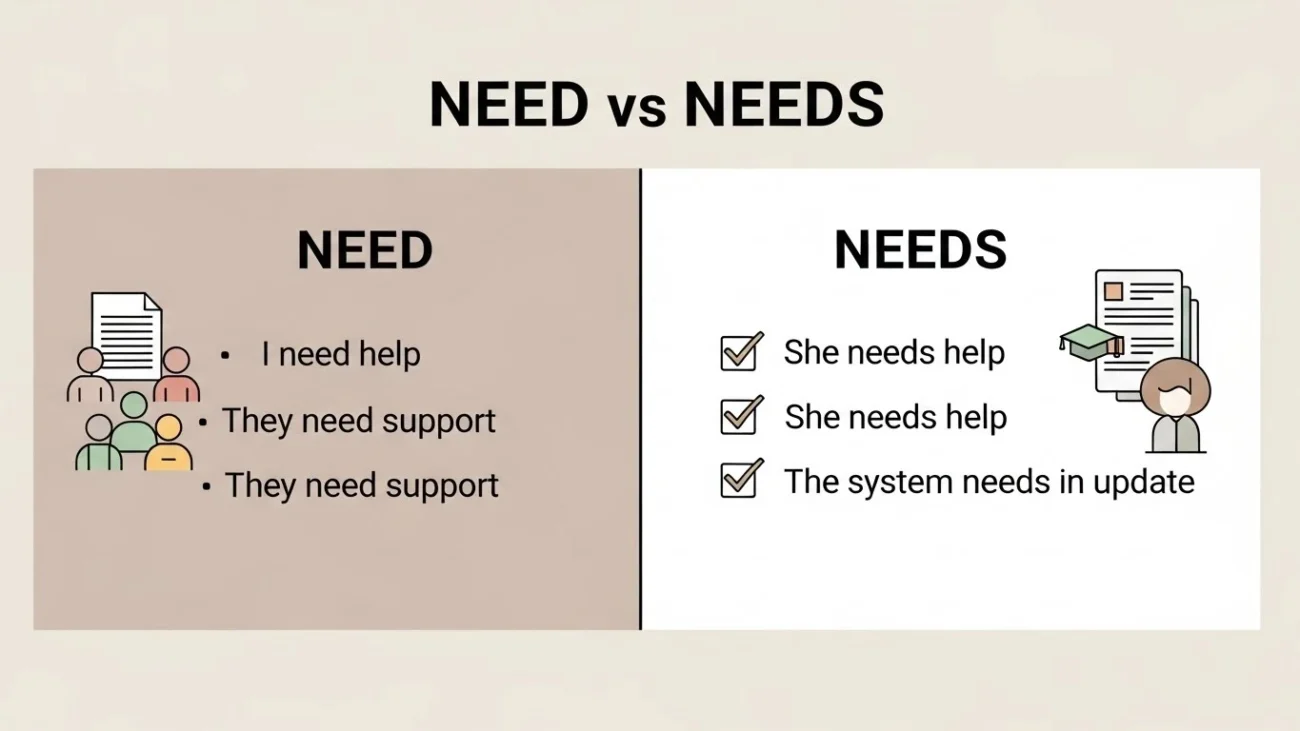
Use need with I, you, we, they, and plural nouns.
Use needs with he, she, it, and singular nouns.
Examples:
- I need help.
- She needs help.
- They need support.
- The machine needs repair.
👉 Singular third person → needs
👉 All others → need
Read More :Invoice or Bill : Meaning,Difference and Which One correct?
The Origin of Need or Needs
The verb need comes from Old English nēodian, meaning to require. English verbs developed endings like -s to show agreement with singular subjects.
Over time, modern English simplified verb forms, but the s ending remained for third-person singular in the present tense. That’s why we say:
- He runs
- She wants
- It needs
The confusion exists because most verbs don’t change much, but this small -s matters.
British English vs American English Spelling
There is no spelling difference between British and American English for need or needs.
| Aspect | British English | American English |
| Need | Need | Need |
| Needs | Needs | Needs |
| Grammar rule | Same | Same |
👉 Grammar rules are identical worldwide.
Which Spelling Should You Use?
Choose based on the subject of the sentence.
- He / She / It → needs
- I / You / We / They → need
- Singular noun → needs
- Plural noun → need
Professional tip:
If you can replace the subject with he/she/it, use needs.
Common Mistakes with Need or Needs
❌ She need more time.
✅ She needs more time.
❌ They needs help.
✅ They need help.
❌ The children needs care.
✅ The children need care.
Memory trick:
- One person → needs
- Many or I/you → need
Understanding the difference between need and needs is especially important in formal writing, exams, and professional communication. Even a small subject verb agreement error can make sentences sound unnatural or careless.
In emails, reports, and applications, mistakes like “She need assistance” can reduce clarity and credibility. Many ESL learners struggle because English verbs change very little, making the s ending easy to overlook.
IF this small letter plays a big role in grammatical accuracy. A helpful habit is to pause and identify the subject before choosing the verb form. If the subject refers to one person or thing, needs is required. If it refers to more than one or includes I or you, need is correct. Mastering this rule improves sentence flow, accuracy, and confidence in everyday English writing.
Need or Needs in Everyday Examples
Emails
- Please let us know if you need assistance.
Office
- The system needs an update.
Education
- Students need guidance.
Home
- The baby needs attention.
Need or Needs : Google Trends & Usage Data
Search trends show:
- High confusion among ESL learners
- Frequent queries in grammar related searches
- Consistent global usage without regional variation
Top regions searching this:
- India
- Pakistan
- United States
- United Kingdom
👉 Most users want to fix basic grammar accuracy.
Comparison Table: Need vs Needs
| Feature | Need | Needs |
| Used with | I, you, we, they | He, she, it |
| Noun number | Plural | Singular |
| Verb tense | Present | Present |
| Grammar role | Base form | Third-person singular |
| Interchangeable | No | No |
FAQs: Need or Needs
1. Is “she need” ever correct?
No, it should be she needs.
2. Can “need” be a noun?
Yes, but this article focuses on verb use.
3. Do British and American English differ here?
No, rules are the same.
4. Is “needs” always singular?
Yes, for third-person singular subjects.
5. What about questions?
Use need: Does she need help?
6. Is “need to” followed by a verb?
Yes: need to study.
7. Which mistake is most common?
Using need instead of needs.
Conclusion
The difference between need or needs is a basic but important grammar rule. Need is used with most subjects, while needs is only used with third-person singular subjects like he, she, it, or a single noun.
There is no spelling difference between British and American English only correct subject verb agreement.
Once you focus on the subject of your sentence, choosing the right form becomes easy. Mastering this small rule can greatly improve your English clarity and confidence.

I am Mark Twain, a writer who loved the English language for its humor, irony, and everyday comparisons. I used simple words to show deep differences between truth and lies, wisdom and foolishness. My writing proves that clear English is always more powerful than complicated English.