

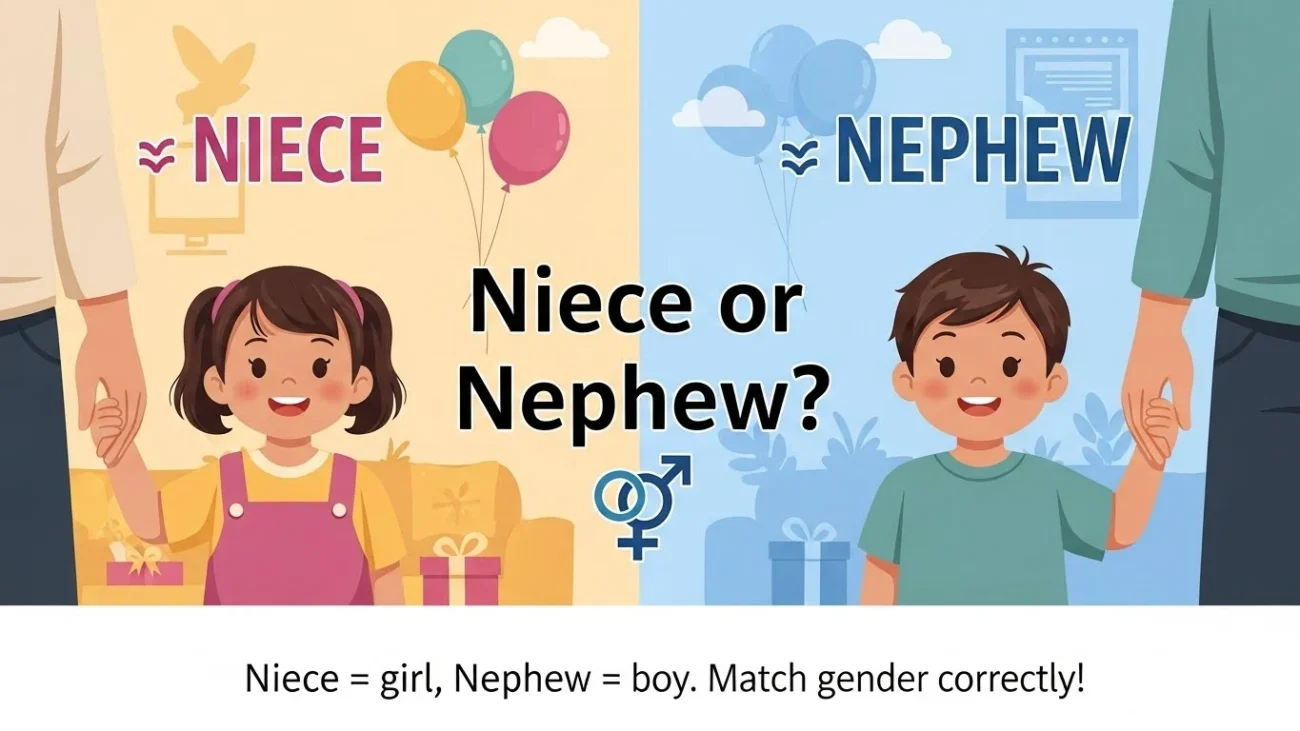
Niece or Nephew? → The short answer is: a niece is a female child of your sibling, and a nephew is a male child of your sibling.
Many people search for niece or nephew because these family terms are sometimes confusing for English learners.
You might wonder: “Is my sibling’s child a niece or a nephew?” Using the wrong term can lead to awkward situations in conversations, invitations, or even official documents.
These words are gender-specific and refer to a particular family relationship. Understanding the difference is simple, but many still make mistakes, especially when talking about extended family.
This article clears the confusion clearly and quickly. You’ll get a quick answer, then learn origins, usage tips, common mistakes, real-life examples, and professional advice.
Niece or Nephew : Quick Answer
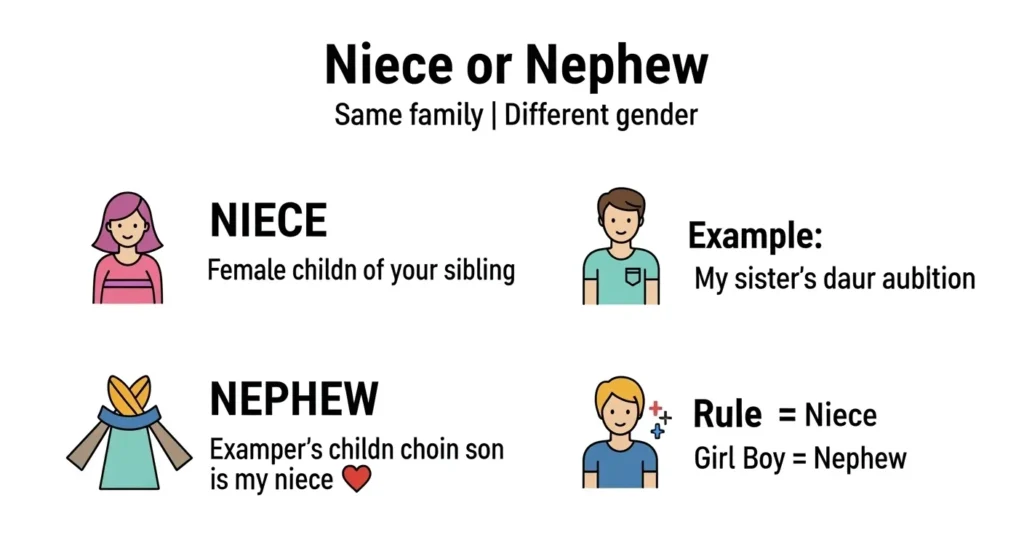
- 👧 Niece → a female child of your sibling
- 👦 Nephew → a male child of your sibling
Examples:
- My sister has a daughter; she is my niece.
- My brother has a son; he is my nephew.
👉 Gender-specific terms: girl = niece, boy = nephew
Read More : Dye vs Die Explained: Meaning, Examples, and Common Mistakes
Niece vs Nephew : Meaning & Difference Explained
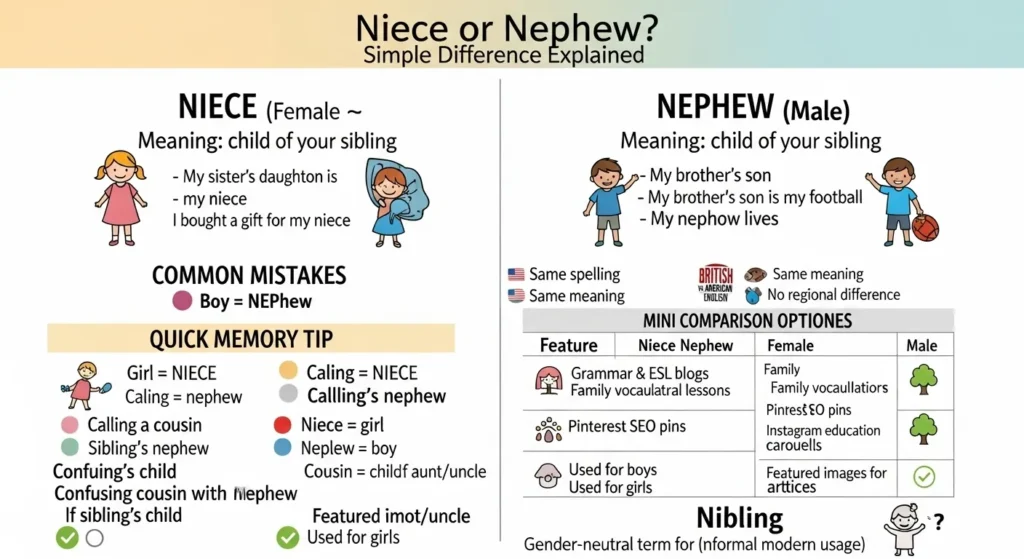
Many learners search niece vs nephew, niece and nephew difference, and difference between niece and nephew to understand family terms clearly.
The difference between nephew and niece is based only on gender.
People also search what is the difference between niece and nephew because these words look similar but mean different things.
- niece meaning → female child of your sibling
- nephew meaning → male child of your sibling
- nephew and niece meaning depends on gender only
This clears confusion like nephew boy or girl, is nephew a boy or girl, and is niece a boy or girl.
The Origin of Niece or Nephew
- Niece comes from Old French niece, meaning granddaughter or female relative.
- Nephew comes from Old French neveu, meaning grandson or male relative.
Both words entered English in the Middle Ages and have kept their gender distinction ever since.
British English vs American English Spelling
There is no spelling difference between British and American English.
| Word | British English | American English |
| Niece | Same | Same |
| Nephew | Same | Same |
👉 Only usage in context matters, not region.
Which Word Should You Use?
- Use niece for a female child of your brother or sister.
- Use nephew for a male child of your brother or sister.
Tip: If you’re unsure of gender, you can say “my sibling’s child” until confirmed.
Common Mistakes with Niece or Nephew

Many learners and even native speakers often confuse niece and nephew, especially when referring to extended family or writing quickly.
These mistakes can lead to awkward sentences or misunderstandings. Here are the most common errors and how to avoid them:
- Using niece for a male child
❌ “My niece has a son.”
✅ “My nephew has a son.”
Tip: Always check the gender: niece = girl, nephew = boy. - Using nephew for a female child
❌ “I bought a gift for my nephew (female child).”
✅ “I bought a gift for my niece.”
Tip: Remember, nephew only refers to boys. - Confusing niece/nephew with cousin
❌ “My nephew is coming to the family reunion (but he is actually a cousin).”
✅ “My cousin is coming to the family reunion.”
Tip: Niece/nephew = child of your sibling; cousin = child of your aunt or uncle. - Mixing terms in social media or cards
❌ “Happy birthday to my nephew (to a niece).”
✅ “Happy birthday to my niece!”
Tip: Always confirm the child’s gender before posting publicly. - Overgeneralizing
❌ Using niece or nephew when referring to all children of siblings.
✅ Specify niece or nephew individually for clarity.
Tip: If unsure of gender, use “my sibling’s child” until confirmed.
By avoiding these common mistakes, learners can write accurately, communicate clearly, and show respect for family relationships. Correct usage also helps in invitations, letters, emails, and everyday conversation.
Gender Confusion & Common Searches
“People often search variations like nephew and niece, nephew/niece, or simply nephew when unsure about gender.”
Others ask nephew is boy or girl, is nephew a boy or girl, or niece is girl or boy due to spoken English confusion.
Remember:
- niece is a girl
- nephew is a boy
- There is no male niece and no female nephew
🔹 Gender-Neutral Terms for Niece or Nephew
Many modern readers now search gender neutral term for niece or nephew because traditional family words are gender-specific.
So, is there a gender neutral term for niece or nephew?
Yes — the most commonly used informal term is nibling.
People also search:
- non binary niece or nephew
- gender neutral name for niece or nephew
- gender neutral for niece or nephew
✅ What does “nibling” mean?
A nibling is a gender-neutral word used to refer to a niece or nephew without specifying gender.
It is especially useful when talking about a non binary niece or nephew or when gender is unknown.
⚠️ Note:
“Nibling” is informal and not yet widely used in legal or official documents, but it is becoming popular in everyday English.
Niece or Nephew in Everyday Examples
Family Gatherings
- My niece is learning to play piano.
- My nephew loves football.
Invitations
- Inviting your niece and nephew to the party.
Social Media
- Proud uncle: “Happy birthday to my nephew!”
Education
- My niece graduated from school today.
Comparison Table: Niece vs Nephew
| Feature | Niece | Nephew |
| Gender | Female | Male |
| Relation | Child of sibling | Child of sibling |
| Common error | Using for male | Using for female |
| Usage context | Family | Family |
🔹 Comparison Column
| Query | Correct Answer |
| niece or nephew | Gender-based |
| nephew or niece | Depends on gender |
| nephew and niece | Sibling’s children |
| niece nephew | Family terms |
| niece/nephew | Gender-specific |
| nephew/niece | Same relation |
| nieces and nephews | Plural form |
| spell niece and nephew | Correct spelling |
| difference between nephew and cousin | Cousin ≠ sibling’s child |
| difference between nephew and niece | Gender only |
FAQs:
Niece or Nephew Basics
1. Can niece mean a boy?
No, niece always refers to a female.
2. Can nephew mean a girl?
No, nephew always refers to a male.
3. Are these words used worldwide?
Yes, common in English-speaking countries.
4. What is the opposite term for niece/nephew?
For the parent of a niece/nephew, you are the aunt or uncle.
5. Can I call a cousin a niece or nephew?
No, cousins are different.
6. Is the spelling different in UK and US English?
No, it’s the same.
Common Confusions & Usage
1. Niece and nephew meaning?
Niece and nephew meaning is simple: a niece is the female child of your sibling, and a nephew is the male child of your sibling.
2. Nephew and niece difference?
The nephew and niece difference is based on gender. Nephew refers to a boy, while niece refers to a girl.
3. Difference of nephew and niece?
The difference of nephew and niece lies in gender only: nephew = male child of your sibling, niece = female child of your sibling.
4. Different between nephew and niece
There is no difference in relationship, only gender. Nephew is a boy, and niece is a girl.
5. Nephew vs niece meaning
Nephew vs niece meaning depends on gender: nephew means a male sibling’s child, niece means a female sibling’s child.
6. Niece vs nephew meaning
Niece vs nephew meaning is gender-specific. Niece refers to a girl, while nephew refers to a boy.
7. Who is niece
A niece is the daughter of your brother or sister.
8. Nephew means
Nephew means the son of your brother or sister.
9. Nephew or niece meaning
Nephew or niece meaning depends on gender. Use nephew for a boy and niece for a girl.
10. What’s the difference between niece and nephew
The difference between niece and nephew is gender: niece is female, nephew is male.
🔹 Exercise Section: Niece & Nephew Practice
✅ True or False (10 queries)
- nephew is a boy or girl → Nephew is a boy ✅
- niece is a girl → True ✅
- nephew female is correct ❌
- is niece a girl → True ✅
- nephew girl is correct ❌
- niece is boy or girl → Girl ✅
- male niece is correct ❌
- nephew is boy or girl → Boy ✅
- female nephew is correct ❌
- is a niece a girl → True ✅
📝 MCQs (10 queries)
- nephew boy or girl
A) Girl
B) Boy ✅ - niece girl or boy
A) Boy
B) Girl ✅ - nephew for girl
A) Correct
B) Incorrect ✅ - niece for boy
A) Correct
B) Incorrect ✅ - nephew vs niece means
A) Same
B) Gender difference ✅ - nephew or niece depends on
A) Age
B) Gender ✅ - is niece boy or girl
A) Boy
B) Girl ✅ - nephew female
A) Correct
B) Incorrect ✅ - niece male
A) Correct
B) Incorrect ✅ - nephew girl or boy
A) Girl
B) Boy ✅
Conclusion
The difference between niece or nephew is simple: niece = female child of your sibling, nephew = male child of your sibling. Using the wrong term can cause confusion, but remembering the gender distinction will keep your family references accurate.
When talking about family, always match the term to the gender of the sibling’s child. If unsure, use “my sibling’s child” until confirmed . Mastering this small detail makes your English clear, polite, and professional.

I am Mark Twain, a writer who loved the English language for its humor, irony, and everyday comparisons. I used simple words to show deep differences between truth and lies, wisdom and foolishness. My writing proves that clear English is always more powerful than complicated English.