

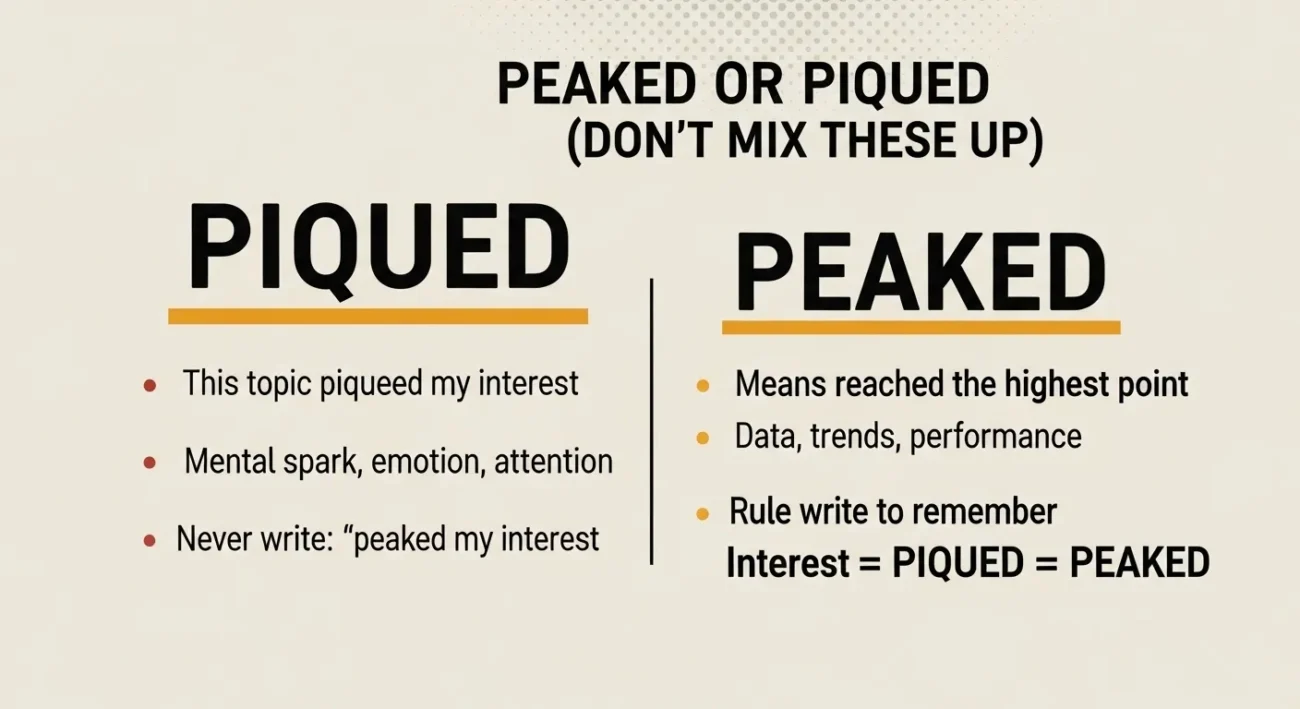
Peaked or piqued? I’ll answer it right away: “piqued” is correct when interest is raised, while “peaked” means something reached its highest point.
I still remember the first time I paused while writing “This topic peaked my interest.” It looked right. Spellcheck didn’t scream. But something felt off. That tiny doubt is exactly why people search peaked or piqued.
These two words sound similar, appear in the same sentence types, and often swap places by mistake. This article clears that confusion once and for all. I’ll explain the meaning, origin, regional usage, common mistakes, and real-life examples so next time, you’ll write with confidence, not hesitation.
Peaked or Piqued: Quick Answer
Piqued = interest, curiosity, or emotion is stimulated.
Peaked = something reached its highest level.
Correct examples:
- My curiosity was piqued by the headline.
- Sales peaked in December.
Wrong example:
- ❌ My interest was peaked.
If interest rises, it’s piqued. If something hits a maximum point, it peaked.
The Origin of Peaked and Piqued
I like understanding why words behave the way they do it makes them easier to remember.
Piqued
- Comes from the French word piquer, meaning to prick or sting.
- Over time, it came to mean to stimulate emotionally or mentally.
- That’s why we say “piqued my interest.”
Peaked
- Comes from peak, meaning the top or highest point.
- Used for mountains, performance, trends, health, or energy.
- Example: His career peaked early.
The confusion exists because both words are past tense, sound similar, and appear in abstract sentences.
British English vs American English Spelling
Here’s the good news: there is no spelling difference between British and American English for peaked or piqued.
Both regions:
- Use piqued for interest or curiosity
- Use peaked for maximum levels
Comparison Table
| Context | Correct Word | US English | UK English |
| Interest raised | Piqued | ✅ | ✅ |
| Reached maximum | Peaked | ✅ | ✅ |
| Curiosity | Piqued | ✅ | ✅ |
| Performance high point | Peaked | ✅ | ✅ |
So this isn’t a regional issue it’s a meaning issue.
Which Spelling Should You Use?
I always choose based on intent, not habit.
- US audience: Follow standard meaning (piqued = interest).
- UK/Commonwealth audience: Same rules apply.
- Global or writing: Always use piqued my interest.
If you write “peaked my interest” in professional content, it signals weak language control even if readers understand you.
Common Mistakes with Peaked or Piqued
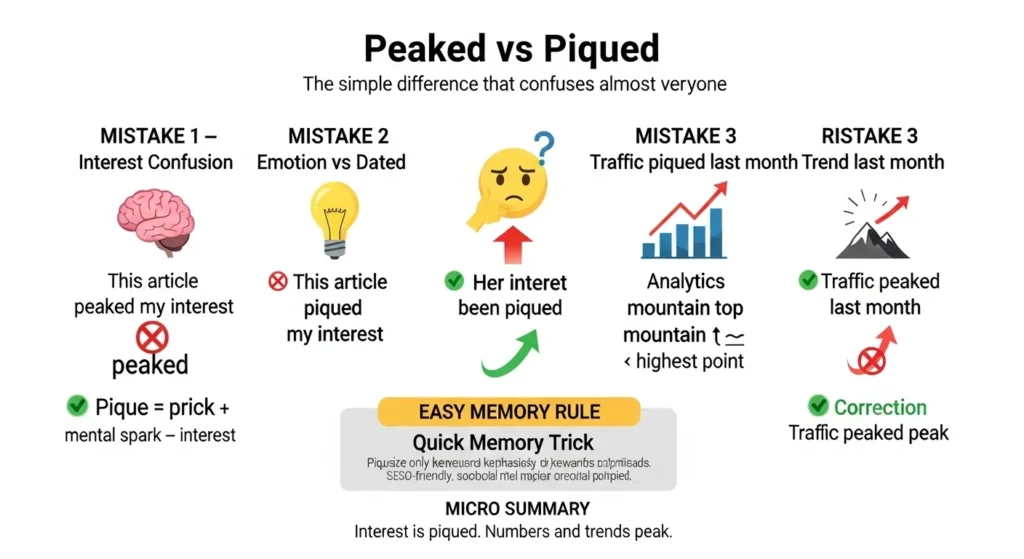
I see these mistakes everywhere even in news articles.
Mistake 1
❌ This article peaked my curiosity.
✅ This article piqued my curiosity.
Mistake 2
❌ Her interest has peaked recently.
✅ Her interest has been piqued recently.
Mistake 3
❌ Traffic piqued last month.
✅ Traffic peaked last month.
Quick memory trick I use:
- Pique = prick → mental spark
- Peak = top of a mountain
Piqued or Peaked in Everyday Examples
Emails
- Your proposal piqued my interest.
- Product demand peaked last quarter.
News
- Inflation peaked in early 2023.
- The scandal piqued public curiosity.
Social Media
- That reel really piqued my interest.
- Engagement peaked overnight.
Formal Writing
- The study piqued academic interest.
- The trend peaked before declining.
Piqued vs Peaked: Google Trends & Usage Data
From what I’ve seen in usage data and trends:
- “Peaked my interest” is searched often but mainly due to confusion.
- “Piqued my interest” dominates in edited content, books, and news.
- Native English regions (US, UK, Canada, Australia) strongly prefer piqued.
In professional writing, piqued signals authority and language accuracy, while peaked my interest is flagged as an error.
Peaked vs Piqued: Side-by-Side Comparison
| Feature | Peaked | Piqued |
| Meaning | Reached highest point | Stimulated interest |
| Used for | Trends, levels, performance | Curiosity, interest |
| Common error | Used for interest | Rarely misused |
| Professional usage | Correct in data context | Correct in emotional context |
FAQs: Peaked or Piqued
1. Is “peaked my interest” ever correct?
No. It’s always “piqued my interest.”
2. Why do so many people use “peaked my interest”?
It sounds logical and people widely repeat it , but it’s still wrong.
3. Can interest peak?
Yes, but the sentence structure changes:
Interest peaked in 2024.
4. Is piqued a negative word?
No. It simply means stimulated or triggered.
5. Does British English allow peaked for interest?
No. British and American English follow the same rule.
6. How do I remember the difference quickly?
Pique = prick → mental spark
Peak = mountain top → highest point
7. Which one is better for content writing?
Always piqued my interest.
Conclusion
I’ve learned that peaked or piqued isn’t a spelling problem it’s a meaning problem. Once you connect pique with curiosity and peak with height, the confusion disappears. Piqued belongs to emotions, thoughts, and interest. Peaked belongs to data, performance, and levels.
In professional, academic, and writing, this distinction matters more than people realize. One wrong word can quietly signal inexperience. If you want clarity, credibility, and clean writing, choose based on intent not sound. I always pause, check the meaning, and write with confidence.

I am Michael Swan, an English grammarian known for explaining confusing grammar and word comparisons in a clear way. I focused on real usage, not just rules, helping learners understand why English works the way it does. My work simplifies complex language problems for everyday users.