

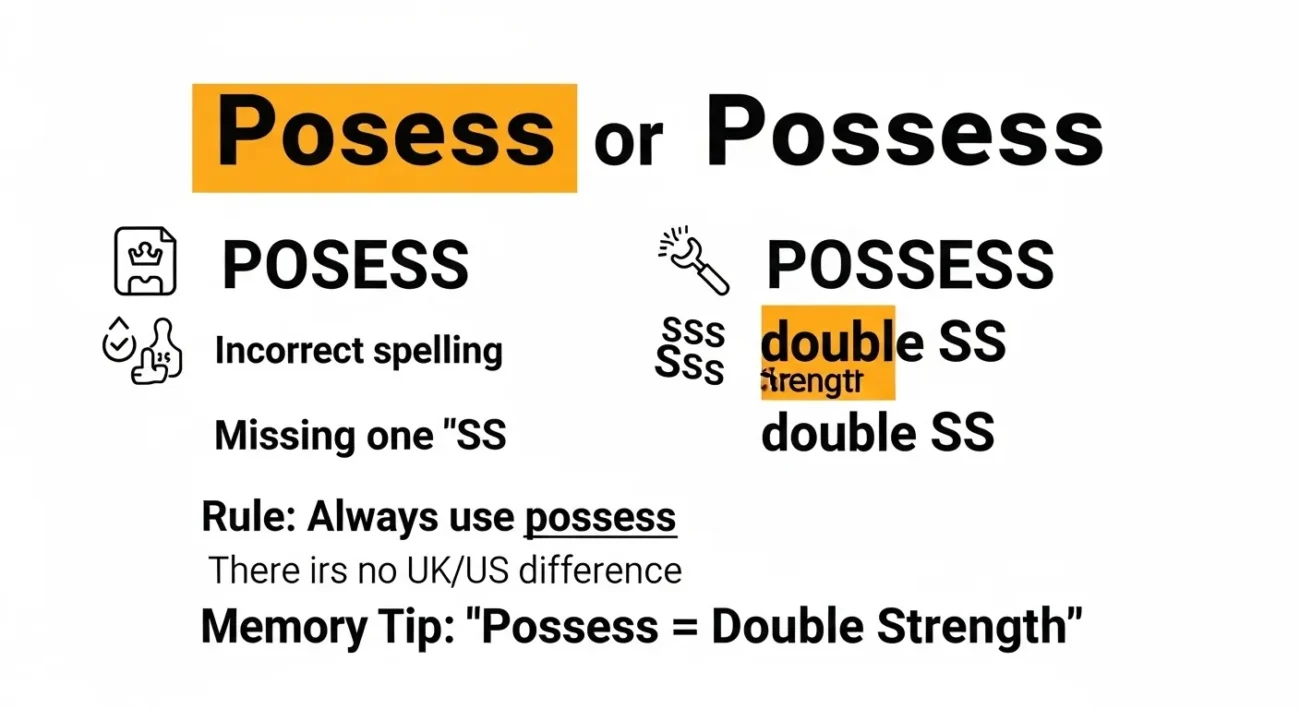
The correct spelling is “possess,” with double S in the middle and double S at the end.
I still remember the first time I typed posess in an email. It looked right to me. But my spell checker turned it red. That small mistake made me stop and think.
Is it posess or possess? Many people search for this keyword because the spelling feels tricky. The word sounds like it has one “s” in the middle. But in writing, it follows a different rule.
In this guide, I will clearly explain the difference, the origin, common mistakes, and which spelling you should use.
Posess or Possess: Quick Answer
The correct spelling is possess.
“Posess” is incorrect.
✅ Correct:
- I possess strong writing skills.
- She possesses great patience.
- They want to possess the land.
❌ Incorrect:
- I posess strong writing skills.
- She posesses great patience.
The word possess always has double S in the middle and double S at the end.
The Origin of Posess or Possess
The word possess comes from the Latin word possidere, which means “to have” or “to occupy.”
It entered English through Old French in the 14th century. Over time, the spelling became fixed as possess.
Many spelling mistakes happen because English keeps Latin roots. The double “ss” comes from its original form. That is why removing one “s” (posess) makes it wrong.
English spelling often keeps historical patterns. Even if pronunciation changes, spelling may stay the same.
British English vs American English Spelling
Unlike words such as:
- Colour vs Color
- Organise vs Organize
The word possess is spelled the same in both British and American English.
There is no difference between UK and US spelling here.
Comparison Table
| Region | Correct Spelling | Incorrect Form |
| American English | possess | posess |
| British English | possess | posess |
| Australian English | possess | posess |
| Canadian English | possess | posess |
So no matter where you live, the spelling stays the same.
Which Spelling Should You Use?
You should always use possess.
There is no audience difference. Whether you write for:
- US readers
- UK readers
- Commonwealth countries
- Global audience
The correct spelling remains possess.
If you are writing professionally, using posess may harm your credibility. In formal writing, even one spelling error can reduce trust.
I always double-check this word now, especially in client emails and blog posts.
Common Mistakes with Posess or Possess
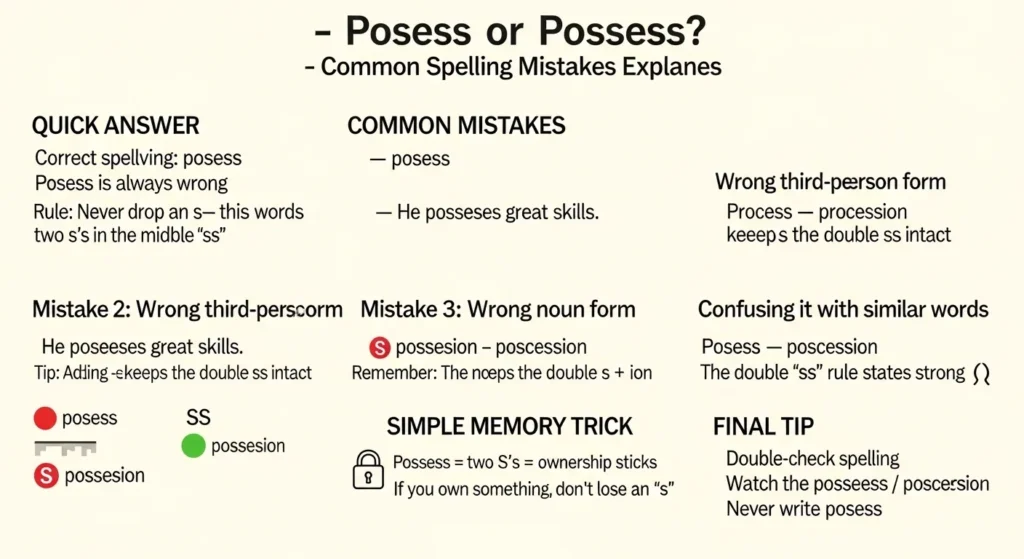
Here are the most common mistakes I see:
1. Removing one “S”
❌ posess
✅ possess
2. Wrong third-person form
❌ posesses
✅ possesses
3. Wrong noun form
❌ posession
✅ possession
4. Confusing with “process”
Some people mix up spelling because both words look similar.
Correct pattern:
- process → processing
- possess → possession
The double “ss” rule stays strong.
Posess or Possess in Everyday Examples
Let me show how possess appears in real life.
In Emails:
- “I possess five years of experience in marketing.”
- “Our company possesses advanced tools.”
In News Writing:
- “The country possesses large oil reserves.”
On Social Media:
- “You possess the power to change your life.”
In Formal Writing:
- “Citizens possess equal rights under the law.”
Using the correct spelling makes your writing look clean and professional.
Posess or Possess: Google Trends & Usage Data
Search data shows that many users type “posess” by mistake.
Countries with high search volume for this confusion often include:
- United States
- United Kingdom
- India
- Pakistan
Most searches happen from students, job seekers, and content writers.
The correct form possess dominates published books, academic papers, and official websites. The incorrect form appears mostly in search queries and typos.
This shows clear intent:
People search “posess or possess” to confirm the correct spelling quickly.
Comparison Table: Keyword Variations
| Variation | Correct or Incorrect | Meaning |
| possess | ✅ Correct | To have or own something |
| posess | ❌ Incorrect | Misspelling |
| possesses | ✅ Correct | Third-person singular |
| posesses | ❌ Incorrect | Misspelling |
| possession | ✅ Correct | Noun form |
| posession | ❌ Incorrect | Misspelling |
FAQs About Posess or Possess
1. Is posess ever correct?
No. Posess is always incorrect.
2. Why do people spell possess wrong?
Because pronunciation sounds like one “s” in the middle.
3. How many S letters are in possess?
Four total S letters — two in the middle and two at the end.
4. Is possess spelled differently in British English?
No. It is the same in British and American English.
5. What is the noun form of possess?
The noun form is possession.
6. What is the adjective form?
The adjective is possessive.
7. How can I remember the correct spelling?
Think: “You must possess double strength.” Double S reminds you.
Conclusion
The confusion between posess or possess is common, but the answer is simple. The correct spelling is always possess. It has double “s” in the middle and double “s” at the end. The mistake happens because English keeps old Latin spelling rules. Many people trust pronunciation, but English spelling does not always follow sound.
There is no difference between British and American English for this word. The spelling stays the same worldwide. If you write emails, blog posts, academic papers, or social media content, always use possess. Even a small spelling mistake can reduce your professional image.
I used to pause every time I typed this word. Now I remember the double “ss” rule, and I never get confused again. Keep this rule in mind, and your writing will always look correct and confident.
Discover More Articles:

I am Mark Twain, a writer who loved the English language for its humor, irony, and everyday comparisons. I used simple words to show deep differences between truth and lies, wisdom and foolishness. My writing proves that clear English is always more powerful than complicated English.